
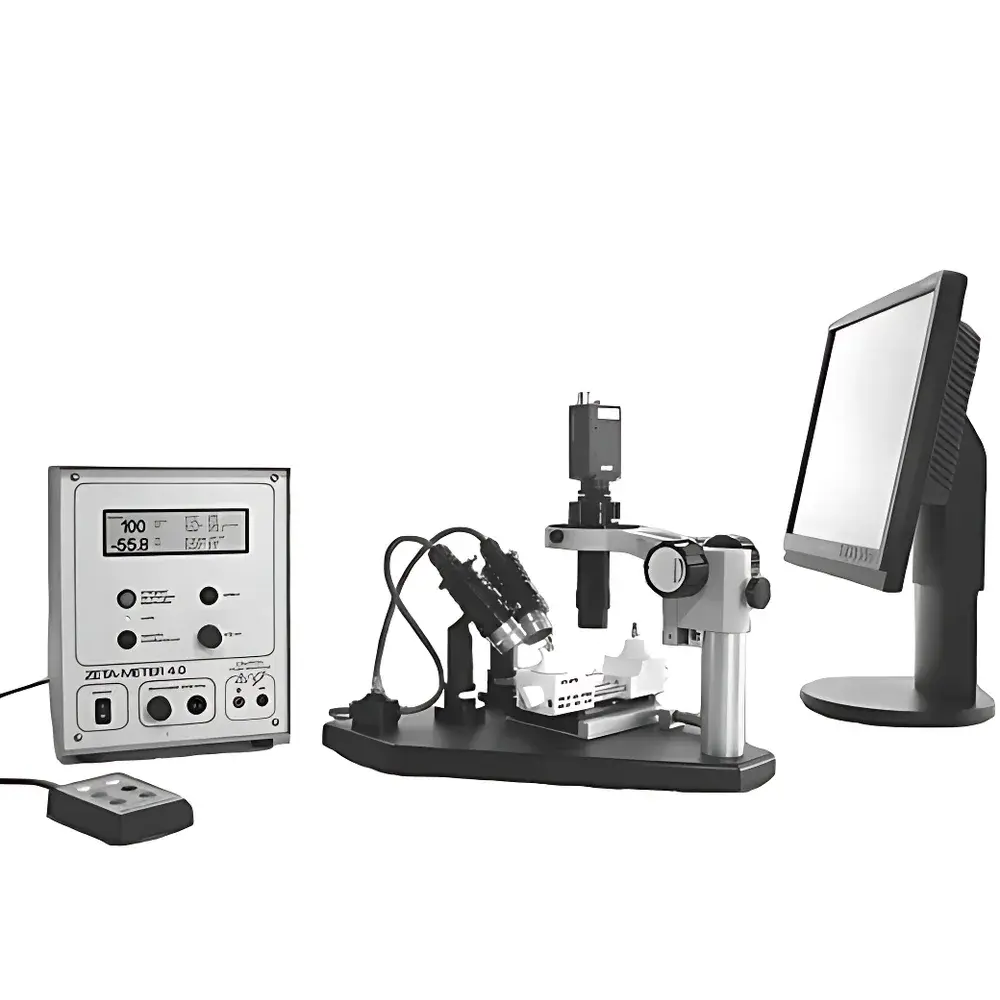
Zeta-Meter 4.0+ Zeta Potential Analyzer
| Origin | USA |
|---|---|
| Manufacturer Type | Authorized Distributor |
| Origin Category | Imported |
| Model | Zeta-Meter 4.0+ |
| Price Range | USD 1,400–7,000 (est.) |
| Zeta Potential Range | ±125 mV |
| pH Range | 0–12 |
| Operating Temperature Range | 5–75 °C |
| pH Resolution | 0.1 unit |
| Temperature Resolution | 0.1 °C |
| Accuracy | ±1% of reading |
| Repeatability | ±0.5% of reading |
| Electrophoretic Mobility Range | ±20 µm·s⁻¹·V⁻¹·cm |
| Conductivity Range | 0–60,000 µS/cm |
| Sample Volume | 5 mL or 20 mL |
| Particle Size Range | 0.5–100 µm |
| Compatible Dispersants | Aqueous and organic solvents |
| Solid Concentration Range | 0.001–80 wt% |
Overview
The Zeta-Meter 4.0+ Zeta Potential Analyzer is a microprocessor-controlled electrophoretic mobility and zeta potential measurement system engineered for precision, reproducibility, and operational simplicity in quality control, formulation development, and colloidal stability research. It operates on the principle of microelectrophoresis—applying a known electric field across a capillary cell containing a dispersed sample and measuring particle velocity via optical detection (typically using laser-based Doppler or video-tracking methods). From measured electrophoretic mobility (µm·s⁻¹·V⁻¹·cm), the instrument calculates zeta potential (mV) using the Henry equation with Smoluchowski or Hückel approximations, selectable based on medium conductivity and particle size. Designed for routine use in pharmaceutical, cosmetic, ceramic, ink, and nanomaterial laboratories, the system delivers rapid, operator-independent results without requiring advanced rheological or optical expertise.
Key Features
- Microprocessor-based architecture with embedded calibration routines and real-time signal processing for stable baseline acquisition.
- Dual-mode sample handling: supports both 5 mL and 20 mL disposable or reusable cells—optimized for low-volume R&D screening and high-throughput QC workflows.
- Wide dynamic range: measures zeta potential from –125 mV to +125 mV with ±1% accuracy and ±0.5% repeatability under controlled temperature and pH conditions.
- Broad dispersion compatibility: validated for aqueous systems (including high-salt buffers) and common organic solvents (e.g., ethanol, isopropanol, acetone), enabling characterization of non-aqueous nanoparticle dispersions.
- Integrated environmental monitoring: built-in high-resolution pH (0.1 unit) and temperature (0.1 °C) sensors ensure traceable, condition-stamped measurements compliant with GLP documentation requirements.
- Conductivity measurement (0–60,000 µS/cm) enables automatic selection of appropriate electrokinetic model and identification of double-layer compression effects in high-ionic-strength media.
Sample Compatibility & Compliance
The Zeta-Meter 4.0+ accommodates colloidal suspensions with particle diameters ranging from 0.5 µm to 100 µm and solid concentrations spanning three orders of magnitude—from dilute dispersions (10 mg/L) to highly loaded pastes (up to 80 wt%). Its electrode design and cell geometry minimize polarization artifacts and Joule heating during prolonged runs. The instrument meets essential metrological requirements outlined in ISO 13099-1:2012 (Colloidal systems — Methods for determining zeta-potential — Part 1: Electrophoretic light scattering and microelectrophoresis) and supports data integrity practices aligned with FDA 21 CFR Part 11 when used with validated electronic records procedures. While not certified as GMP-compliant hardware, its audit-trail-capable firmware and user-accessible calibration logs facilitate regulatory inspections in pharmaceutical development environments.
Software & Data Management
Controlled via intuitive front-panel interface or optional PC software (Windows-compatible), the Zeta-Meter 4.0+ stores up to 100 measurement sessions internally, each tagged with timestamp, operator ID, pH, temperature, conductivity, and raw mobility traces. Export formats include CSV and PDF reports with embedded metadata—structured for seamless import into LIMS or statistical analysis platforms (e.g., JMP, Minitab). All calibration events, parameter changes, and measurement sequences are logged with date/time stamps, satisfying basic ALCOA+ (Attributable, Legible, Contemporaneous, Original, Accurate) principles for regulated labs. No cloud connectivity or remote access functionality is included—ensuring full data sovereignty and network isolation where required.
Applications
- Stability assessment of drug nanosuspensions and lipid nanoparticles during accelerated storage studies.
- Optimization of surfactant selection and dosage in pigment dispersion formulations for coatings and inks.
- Monitoring surface charge reversal during pH titration of metal oxide nanoparticles (e.g., TiO₂, SiO₂, Fe₃O₄).
- Quality release testing of colloidal silica and polymer latex standards per ASTM D4187–19 (Standard Test Method for Zeta Potential of Colloidal Dispersions).
- Electrostatic stabilization evaluation of ceramic slurries prior to spray drying or slip casting.
- Batch-to-batch consistency verification in cosmetic emulsions and nanocapsule delivery systems.
FAQ
What electrophoretic mobility range does the Zeta-Meter 4.0+ support?
It measures electrophoretic mobility from –20 to +20 µm·s⁻¹·V⁻¹·cm, covering most industrially relevant colloids including proteins, polymers, and inorganic nanoparticles.
Can the instrument measure samples in non-aqueous media?
Yes—it is validated for use with common organic solvents such as ethanol, methanol, acetone, and ethyl acetate, provided conductivity remains within the 0–60,000 µS/cm operating window.
Is temperature control external or internal?
The unit includes an integrated Peltier-based temperature sensor with ±0.1 °C resolution; however, active temperature regulation requires an external circulating bath connected to the cell jacket port.
How is calibration performed?
Factory-calibrated mobility and zeta potential references are supplied; users perform daily verification using standard latex or silica suspensions traceable to NIST SRM 1980 or equivalent reference materials.
Does the system comply with FDA 21 CFR Part 11?
The instrument itself does not provide electronic signature or audit-trail encryption; however, its data export structure and logging capabilities support Part 11 compliance when deployed within a validated laboratory IT environment with appropriate procedural controls.



