
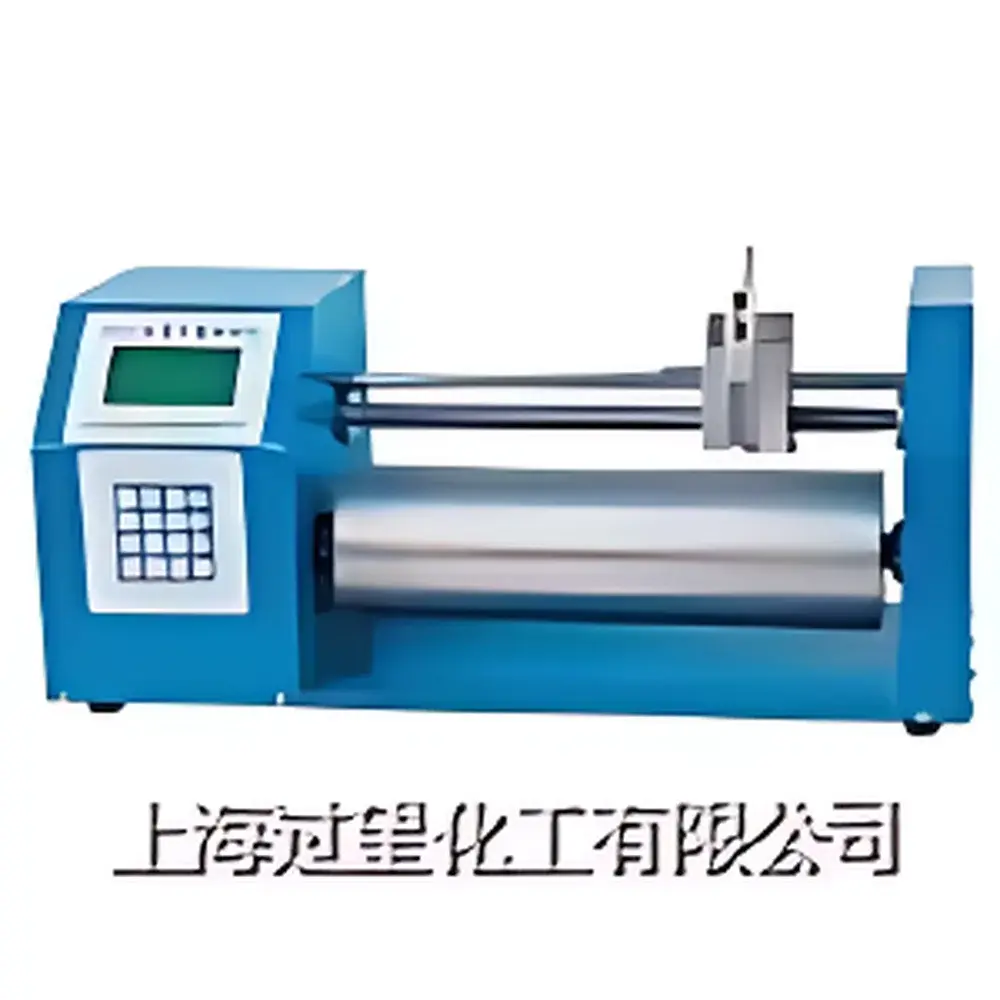
ZGY Automatic Ink Drying Tester
| Origin | Shanghai, China |
|---|---|
| Manufacturer Type | Authorized Distributor |
| Origin Category | Domestic (China) |
| Model | ZGY |
| Pricing | Available Upon Request |
| Power Supply | 220 V ± 22 V, 50 Hz |
| Pressure Roller Linear Speed | 2 mm/rev |
| Total Test Duration Range | 0.5–20 h |
| Time Accuracy | ±3 s over 20 h |
| Dimensions (L×W×H) | 500 × 200 × 220 mm |
| Pressure Roller Mass | 100 g |
| Net Weight | 17 kg |
Overview
The ZGY Automatic Ink Drying Tester is a dedicated mechanical testing instrument engineered for objective, time-resolved assessment of ink drying kinetics under controlled pressure and ambient conditions. It operates on the principle of progressive mechanical resistance measurement: a calibrated 100 g roller traverses the ink film at a constant linear speed of 2 mm per revolution, applying consistent surface pressure while the specimen remains stationary. As solvent evaporation and binder crosslinking progress, the increasing surface cohesion resists roller movement—eventually resulting in measurable adhesion or drag force onset. The system records elapsed time from application to defined endpoint criteria (e.g., visible tack cessation, roller slippage threshold, or operator-determined resistance plateau), enabling reproducible quantification of surface dry, rub resistance, and through-dry milestones. Designed specifically for gravure, flexographic, offset, and screen printing ink formulations, the ZGY supports standardized evaluation aligned with functional performance requirements in packaging, publishing, and industrial labeling applications.
Key Features
- Programmable test duration range from 0.5 to 20 hours, accommodating both rapid-drying UV-curable systems and slow-oxidizing alkyd-based inks.
- High-stability electromechanical drive ensures precise roller displacement at 2 mm per motor revolution—eliminating belt slip or gear backlash that could compromise timing fidelity.
- Integrated real-time clock with ±3-second accuracy over full 20-hour operation, meeting traceability requirements for QC documentation and internal method validation.
- Compact benchtop footprint (500 × 200 × 220 mm) optimized for integration into ink formulation labs, quality control environments, and R&D pilot lines without requiring climate-controlled enclosures.
- Modular roller assembly with interchangeable 100 g stainless-steel pressure wheels—designed for repeatable contact geometry and minimal thermal mass to avoid localized heating effects during extended tests.
- No consumables or calibration fluids required; verification performed via mechanical stopwatch comparison against system timer and physical ruler measurement of roller travel distance.
Sample Compatibility & Compliance
The ZGY accommodates standard ISO 2836-1 (Graphic technology — Printing inks — Test methods) substrate configurations, including coated and uncoated paper (80–300 g/m²), PET films (12–50 µm), and aluminum foil laminates. Ink films are applied manually using drawdown bars (e.g., 5 µm, 15 µm, or 25 µm gap) prior to placement in the tester—ensuring compatibility with existing lab workflows. While the instrument itself does not carry CE, UKCA, or FDA certification, its mechanical design conforms to IEC 61010-1 safety principles for laboratory electrical equipment. Data generated supports compliance with ISO 9001:2015 clause 8.5.1 (Control of production and service provision) and serves as objective evidence in GLP-aligned ink development reports. Time-stamped test logs may be archived manually to satisfy internal audit trails per ISO/IEC 17025:2017 clause 7.5.2 (Technical records).
Software & Data Management
The ZGY operates as a standalone electromechanical instrument with no embedded microprocessor or digital interface. All timing and positional data are recorded manually by the operator at predefined observation intervals (e.g., every 5 minutes during initial drying phase; hourly thereafter). This analog workflow intentionally avoids software validation complexities, making it suitable for laboratories operating under simplified quality systems or those maintaining legacy documentation protocols. Test records—including substrate type, ink batch ID, drawdown bar specification, ambient temperature/humidity (recorded separately), start time, and observed dry endpoints—are entered into paper-based logbooks or exported spreadsheets. For users requiring electronic data capture, third-party time-lapse imaging systems (e.g., USB microscope + frame-grabbing software) may be synchronized externally to document visual drying progression without modifying the core instrument architecture.
Applications
- Comparative evaluation of drying accelerators, photoinitiators, and reactive diluents in UV/EB-curable ink systems.
- Batch-to-batch consistency verification for OEM ink manufacturers supplying flexible packaging converters.
- Formulation screening during R&D of low-VOC water-based flexo inks where oxidative drying is minimized and film coalescence dominates.
- Validation of ink-substrate interaction parameters—particularly for metallized films and barrier-coated papers where surface energy mismatch delays drying onset.
- Supporting technical service responses to pressroom complaints related to set-off, blocking, or insufficient rub resistance in finished rolls.
FAQ
Does the ZGY comply with ASTM D5172 or ISO 2836-3?
No—the ZGY implements a proprietary mechanical endpoint detection method rather than the photometric or solvent-extraction approaches specified in those standards. It is intended for internal process control, not regulatory conformance testing.
Can the pressure roller speed be adjusted?
No—speed is fixed at 2 mm/rev to ensure inter-laboratory reproducibility. Variable-speed operation would invalidate comparative datasets across user sites.
Is temperature or humidity control integrated?
No. Ambient environmental parameters must be monitored externally using calibrated hygrometers and thermometers; recommended test conditions are 23 ± 2 °C and 50 ± 5 % RH per ISO 13468-1.
What maintenance is required?
Monthly inspection of roller axle lubrication, cleaning of guide rails with isopropyl alcohol, and verification of power supply voltage stability using a multimeter.
Can the ZGY be used for coating or adhesive drying assessment?
Yes—provided the material forms a continuous film on standard substrates and exhibits measurable surface tack transition; however, endpoint interpretation requires method adaptation and internal correlation studies.
Related Products



