
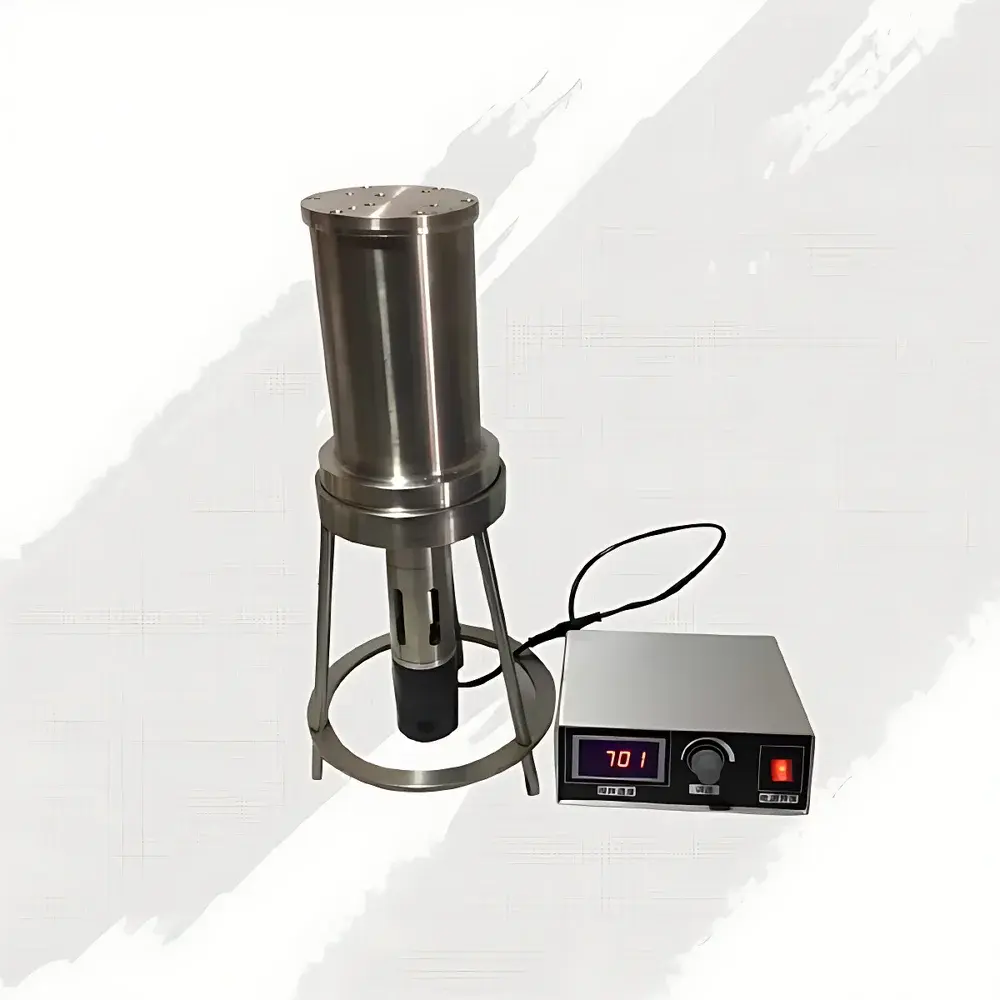
Zhengxin Instruments K-PA-1000ML Mechanical Stirred Laboratory Reactor
| Brand | Zhengxin Instruments |
|---|---|
| Origin | Jiangsu, China |
| Model | K-PA-1000ML |
| Working Volume | 1000 mL |
| Construction Material | 316L Stainless Steel |
| Operating Pressure | Low-pressure (up to 70 MPa optional per custom configuration) |
| Vacuum Capability | Up to –0.1 MPa |
| Heating Method | Integrated Modular Electric Heater |
| Temperature Range | 0–600 °C (configurable) |
| Stirring Speed | 0–1500 rpm |
| Control System | LCD-based PID Intelligent Temperature Controller with Auto-Tuning (AT) and Timer Function |
| Safety Features | Optional Pressure Relief Valve and Explosion-Proof Assembly |
| Compliance | Designed for GLP-compliant lab environments |
Overview
The Zhengxin Instruments K-PA-1000ML Mechanical Stirred Laboratory Reactor is an engineered platform for controlled chemical synthesis, catalytic testing, and kinetic studies under elevated temperature and pressure conditions. Built on a robust 316L stainless steel monocoque architecture, the reactor employs Couette-type mechanical stirring via magnetic coupling—ensuring hermetic seal integrity while delivering uniform shear distribution across heterogeneous or viscous reaction mixtures. Its modular design separates the heating jacket from the reactor vessel, enabling rapid disassembly, cleaning, and component replacement without compromising structural alignment or thermal calibration. The system supports both batch and semi-batch operation modes, with configurable inlet/outlet pathways for inert gas purging, vacuum degassing, reagent addition, and off-gas sampling—making it suitable for air-sensitive organometallic chemistry, hydrothermal synthesis, hydrogenation, and polymerization protocols.
Key Features
- 316L stainless steel pressure vessel with electropolished interior finish (Ra ≤ 0.4 µm) for enhanced corrosion resistance and reduced surface adsorption
- Modular fixed-position electric heating element integrated into the outer jacket; uniform thermal profile with ±1.5 °C spatial consistency at steady state
- Magnetic drive coupling system rated for continuous operation up to 1500 rpm, eliminating dynamic seal wear and minimizing maintenance intervals
- PID intelligent temperature controller with auto-tuning (AT), dual-mode timer (run-time and hold-time), and programmable ramp-soak profiles
- Interchangeable high-pressure needle valves (1/8″ and 1/4″ Swagelok-compatible ferrule fittings) for precise gas introduction, venting, and vacuum evacuation
- Optional K-type thermocouple probe with ±0.5 °C accuracy and 0.1 °C resolution, installed through a dedicated thermowell port
- Detachable reactor head assembly with standardized NPT and ISO-KF flange interfaces for integration with auxiliary modules (e.g., condensers, scrubbers, online IR cells)
Sample Compatibility & Compliance
The K-PA-1000ML accommodates a broad range of sample chemistries—including acidic, alkaline, halogenated, and reducing media—through material flexibility: standard 316L construction may be upgraded to Hastelloy C-276, titanium Grade 2, zirconium, or PTFE/PPL-lined variants upon request. All pressure-containing components conform to ASME BPVC Section VIII Division 1 design guidelines for laboratory-scale vessels. The system supports vacuum levels down to –0.1 MPa (absolute) and optional pressure ratings up to 70 MPa for specialized high-pressure applications. It is routinely deployed in laboratories adhering to Good Laboratory Practice (GLP) and ISO/IEC 17025 quality frameworks; full audit trails for temperature, pressure, and stirring parameters can be generated when paired with optional data logging software compliant with FDA 21 CFR Part 11 requirements.
Software & Data Management
While the base unit operates via standalone LCD interface, optional USB- or RS485-enabled data acquisition modules allow real-time streaming of temperature, pressure, and rotational speed to PC-based platforms. Compatible with third-party SCADA systems and LabVIEW drivers, the reactor supports CSV export of time-stamped parameter logs with millisecond-level timestamp resolution. Firmware updates are delivered via secure HTTPS endpoint, and all control algorithms—including PID tuning coefficients and timer logic—are stored in non-volatile memory with checksum validation to ensure traceability during regulatory audits.
Applications
- Catalytic hydrogenation and oxidation reactions under controlled H₂/O₂ atmospheres
- Hydrothermal synthesis of metal–organic frameworks (MOFs) and nanomaterials
- Acid-catalyzed esterification, transesterification, and Friedel–Crafts alkylation
- Thermal stability testing of battery electrolytes and energetic materials
- Batch-wise enzymatic biotransformations requiring precise pH and temperature coordination (when used with external pH module)
- Supercritical fluid processing using CO₂ or ethanol as solvents (with appropriate pressure-rated accessories)
FAQ
What is the maximum allowable working pressure for the standard K-PA-1000ML configuration?
The base model is rated for low-pressure service up to 1.6 MPa; higher pressure variants (up to 70 MPa) require custom engineering review and ASME U-stamp certification.
Can the reactor be configured for corrosive halogenated solvents such as chlorosulfonic acid?
Yes—selecting titanium Grade 2 or Hastelloy C-276 construction, along with PTFE-sealed valves and PPL internal lining, ensures compatibility with aggressive halogenated media.
Is the magnetic coupling system suitable for highly viscous polymerization mixtures?
The motor delivers peak torque ≥ 0.8 N·m at 300 rpm, supporting viscosities up to 50,000 mPa·s when equipped with anchor or helical ribbon impellers (available as optional accessories).
Does the system support automated gas dosing and mass flow control?
Yes—the standard 1/8″ and 1/4″ Swagelok ports accept MFC-integrated feed lines; integration with Brooks or Alicat mass flow controllers is verified and documented.
How is calibration traceability maintained for temperature and pressure sensors?
Each optional sensor ships with NIST-traceable calibration certificate; field recalibration procedures follow ASTM E74 and ISO 9001 Annex A.2 guidelines.



