
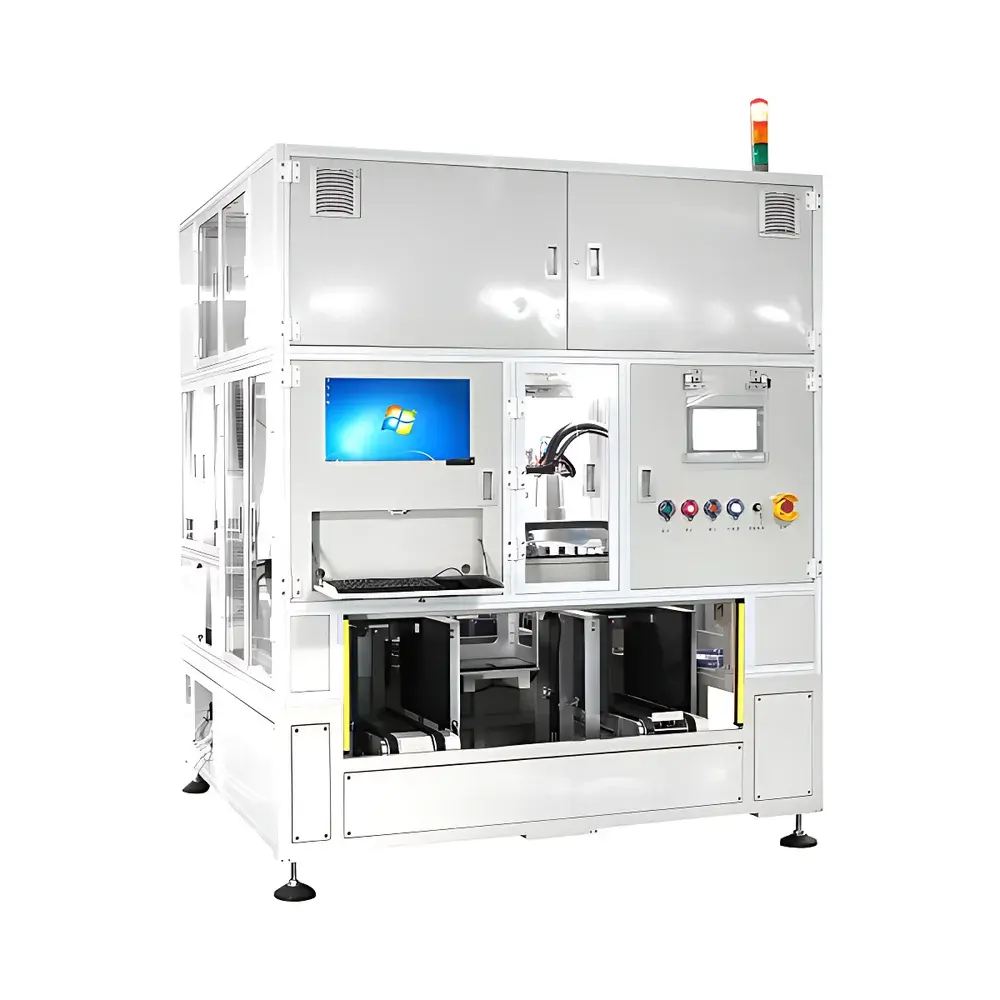
Zhengye DY5120 Fully Automated Battery Voltage and Internal Resistance Tester
| Brand | Zhengye |
|---|---|
| Origin | Guangdong, China |
| Manufacturer Type | OEM/ODM Manufacturer |
| Country of Origin | China |
| Model | DY5120 |
| Power Supply | AC 220 V / 50 Hz / 2.5 kW |
| Overall Dimensions (L×W×H) | 2600 × 1700 × 2000 mm |
| Test Throughput | ≥30 PPM |
| Voltage Measurement Accuracy | ±0.01% rdg + 3 digits |
| Internal Resistance Measurement Accuracy | ±0.5% rdg + 5 digits |
| Barcode Recognition Rate | ≥99.8% |
| Supported Barcode Types | 1D & 2D barcodes |
| Applicable Cell Dimensions (L×W×T) | 40–160 mm × 30–110 mm × 2–12 mm |
| Gage R&R (GRR) | ≤10% |
| False Rejection Rate | 0.0% |
| Repeatability & Reproducibility | GRR ≤10% |
| Control System | HMI-integrated PLC with servo-driven motion control |
| Vision System | CCD-based positioning and alignment |
| Automation Architecture | 4-axis robotic handling platform |
Overview
The Zhengye DY5120 Fully Automated Battery Voltage and Internal Resistance Tester is an integrated electrochemical quality assurance system engineered for high-throughput, non-destructive evaluation of lithium-ion and polymer battery cells in 3C electronics manufacturing environments. It operates on the principle of four-terminal (Kelvin) DC voltage and AC impedance measurement to simultaneously acquire open-circuit voltage (OCV), alternating-current internal resistance (AC-IR), and surface temperature—critical parameters correlated with cell state-of-charge (SOC), state-of-health (SOH), and interfacial integrity. Unlike manual or semi-automated testers, the DY5120 embeds metrological-grade instrumentation—including a calibrated Hioki BT3562 battery tester—within a synchronized mechatronic architecture comprising servo-controlled linear stages, a 4-axis SCARA robot, and real-time CCD vision guidance. This enables traceable, repeatable measurements under defined environmental conditions (e.g., ambient temperature stabilization), satisfying foundational requirements for process validation per ISO 9001 and IATF 16949 frameworks.
Key Features
- Four-terminal Kelvin sensing architecture ensures elimination of lead resistance errors during internal resistance measurement.
- CCD-based vision-guided robotic loading and alignment achieves sub-millimeter positional repeatability for consistent probe contact across variable cell geometries.
- Integrated thermal sensor array monitors cell surface temperature during testing, supporting correlation analysis between OCV drift and thermal transients.
- HMI-driven parameter configuration allows rapid setup of pass/fail thresholds for voltage, resistance, temperature, and barcode validation—all enforceable via programmable logic controller (PLC) logic.
- Automated sorting mechanism routes compliant and non-compliant units to designated output chutes, with digital logging of each decision event for audit trail generation.
- One-click model changeover functionality reconfigures end-effector tooling, probe spacing, vision ROI, and test sequence without mechanical recalibration—reducing changeover time to under 5 minutes.
Sample Compatibility & Compliance
The DY5120 accommodates prismatic, pouch, and cylindrical lithium-based cells within dimensional limits of 40–160 mm (length), 30–110 mm (width), and 2–12 mm (thickness). Its modular electrode interface supports both spring-loaded pogo-pin and vacuum-suction contact methods, minimizing mechanical stress on fragile electrode tabs. All electrical safety circuits comply with GB/T 16836-2018 (equivalent to IEC 61010-1) for laboratory and industrial equipment. Measurement uncertainty budgets are documented per ISO/IEC 17025 guidelines, and the system’s data integrity controls—including timestamped raw-value logging and immutable result archives—support alignment with FDA 21 CFR Part 11 electronic record requirements when deployed in regulated production settings.
Software & Data Management
The embedded HMI software provides real-time graphical monitoring of OCV, AC-IR, and temperature trends per cell, with configurable statistical process control (SPC) charts (X-bar/R, Cpk). Test logs are exported in CSV and SQLite formats, compatible with MES integration via OPC UA or Modbus TCP protocols. Audit trails record operator ID, timestamp, parameter revisions, and final disposition—retained for ≥18 months as standard. Optional cloud synchronization enables remote diagnostics and centralized fleet performance analytics across multiple production lines.
Applications
This instrument is deployed in incoming material inspection (IMI), in-process quality control (IPQC), and final functional testing (FFT) stages across lithium battery pack assembly lines. Typical use cases include: verification of cell matching prior to module stacking; detection of micro-short defects via abnormal IR deviation; qualification of thermal management interface integrity; and barcode-linked traceability for lot-level failure root cause analysis. It is widely adopted by Tier-1 suppliers serving smartphone, tablet, and wearable OEMs in China and Southeast Asia.
FAQ
Does the DY5120 support custom communication protocols for factory-wide MES integration?
Yes—it offers native Modbus TCP and optional OPC UA server modules for bidirectional data exchange with enterprise-level manufacturing execution systems.
Can the system be validated for GLP or GMP compliance?
While not pre-certified, its design includes features required for validation: electronic signatures, audit trails, calibration log retention, and configurable user access levels—enabling customers to execute IQ/OQ/PQ protocols per ASTM E2500.
What maintenance intervals are recommended for the robotic and vision subsystems?
Preventive maintenance is scheduled every 1,000 operating hours, including CCD lens cleaning, servo encoder calibration, and pneumatic circuit leak checks—documented in the included maintenance logbook.
Is temperature compensation applied during internal resistance measurement?
No automatic compensation is applied; however, ambient and cell surface temperatures are recorded synchronously with each measurement, allowing post-test correction using published TCR coefficients for specific cathode chemistries.
How is measurement traceability ensured across different DY5120 units in a multi-line facility?
All units ship with NIST-traceable calibration certificates for voltage and resistance channels, and firmware versioning ensures consistent algorithmic behavior across deployments.



