
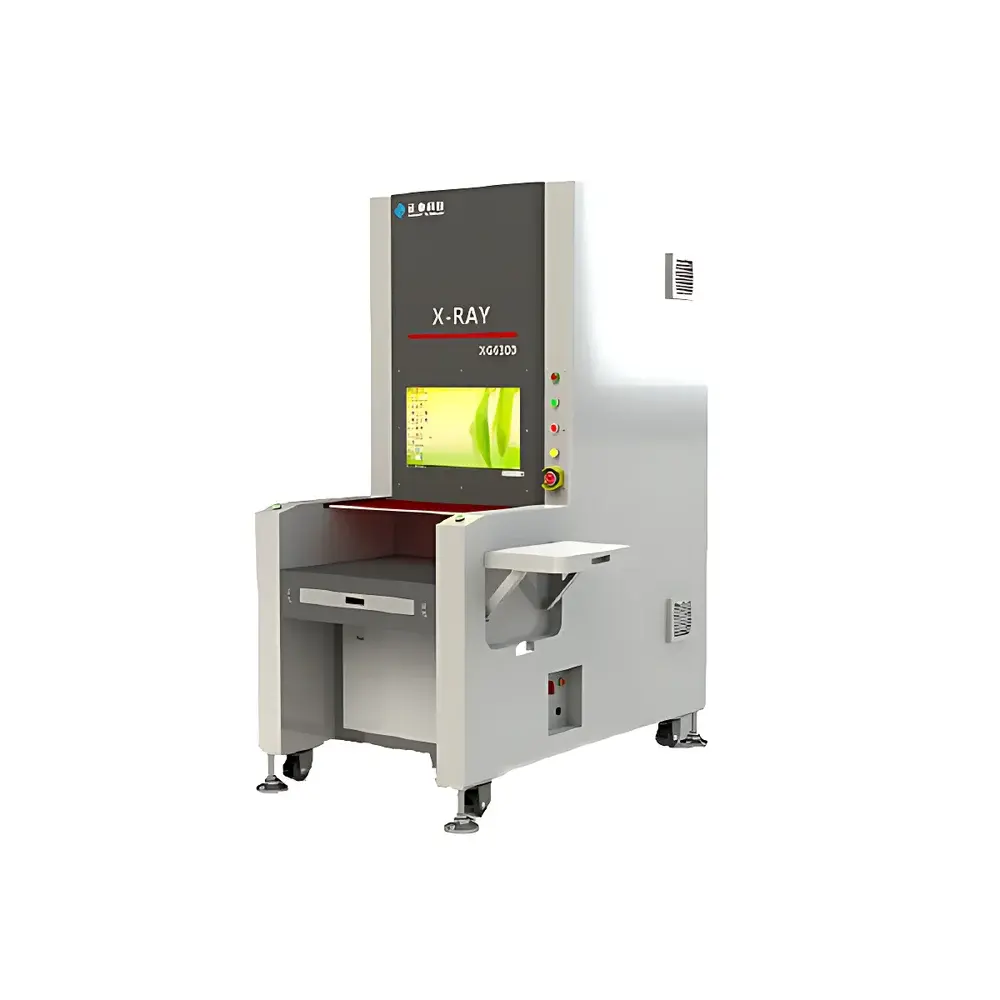
Zhengye X-Ray Automatic Component Counter – High-Speed 4-Tray-in-8-Second PCB Component Verification System
| Brand | Zhengye |
|---|---|
| Origin | Guangdong, China |
| Manufacturer Type | OEM/ODM Manufacturer |
| Country of Origin | China |
| Model | X-Ray Component Counter |
| Quotation | Available Upon Request |
| Dimensions (L×W×H) | 1430 × 848 × 1950 mm |
| Power Supply | 220 V, 10 A, 50–60 Hz |
| Control System | Industrial PC with Windows 10 64-bit OS |
| Compatible Tray Sizes | 7″–15″ (178–381 mm), Stack Height: 6–80 mm |
| X-ray Source | Low-energy side-window microfocus tube, 50 kV nominal voltage, 0–1000 µA adjustable current, max. 50 W output power |
| Detector | Flat-panel detector, FOV: 434 × 434 mm, Pixel Matrix: 3072 × 3072, Spatial Resolution: 3.6 lp/mm |
| Radiation Leakage | <1 µSv/hour at 5 cm from enclosure surface |
| Safety Interlock | Dual-interlocked safety door (X-ray emission disabled when open) |
Overview
The Zhengye X-Ray Automatic Component Counter is an industrial-grade non-destructive verification system engineered for high-throughput, high-accuracy counting of surface-mount technology (SMT) components on standard tape-and-reel carriers. Unlike optical or mechanical counters—which suffer from occlusion, reflectivity errors, or tray misalignment—the system employs dual-energy X-ray transmission imaging to penetrate packaging layers and resolve individual passive and active devices—including capacitors, resistors, diodes, transistors, and small-outline ICs—regardless of orientation, stacking density, or opaque carrier tape material. The core measurement principle relies on attenuation contrast differentiation between component bodies, lead frames, and carrier substrate, followed by sub-pixel centroid detection and morphology-based classification in real time. Designed specifically for electronics manufacturing environments, the system delivers verified counts within 8 seconds across four trays simultaneously—achieving throughput rates exceeding 1,800 trays per 8-hour shift—while maintaining traceability, audit readiness, and regulatory compliance.
Key Features
- Simultaneous 4-tray processing architecture with synchronized X-ray exposure and image acquisition
- Real-time auto-calibration of detector gain and X-ray source intensity to ensure long-term counting stability
- Integrated barcode scanner and Zebra thermal label printer for one-to-one binding of tray ID, count result, timestamp, and operator ID
- Dual-channel hardware interlock system: physical door switch + software handshake prevents X-ray activation unless all safety conditions are met
- Modular I/O interface supporting RS-232, Ethernet (TCP/IP), and OPC UA protocols for factory-level system integration
- Embedded radiation shielding compliant with IEC 61000-6-4 (EMC) and GBZ 126–2011 (Chinese radiation safety standards); leakage measured and certified <1 µSv/hour at 5 cm from any external surface
Sample Compatibility & Compliance
The system accommodates industry-standard plastic and embossed carrier tapes (7″–15″ reels; 6–80 mm stack height), including EIA-481-D-compliant formats. It reliably distinguishes components as small as 0402 (1.0 × 0.5 mm) passives and QFN packages down to 2 × 2 mm with exposed thermal pads. All operational parameters—including exposure time, kV/mA settings, and image thresholding—are configurable per component family to optimize signal-to-noise ratio without overexposure. The device meets ISO 9001:2015 manufacturing quality requirements and supports GLP/GMP-aligned workflows through mandatory electronic audit trails, user role-based access control, and tamper-evident data logging. Radiation safety documentation—including type examination reports and annual dose monitoring records—is provided for internal EHS audits and third-party certification.
Software & Data Management
The embedded Windows 10 64-bit industrial PC runs Zhengye’s proprietary CountVision™ software suite, featuring a validated GUI with password-protected configuration modes and FDA 21 CFR Part 11–compliant electronic signature capability. Raw X-ray images, processed binary masks, and count logs are stored in encrypted SQLite databases with automatic daily backup to network shares or NAS. The software exports structured CSV/Excel reports containing tray ID, component part number (parsed from barcode), gross count, net count, variance vs. expected quantity, and operator-assigned disposition codes (e.g., “Accept”, “Quarantine”, “Rework”). API endpoints support RESTful integration with MES (Siemens Opcenter, Camstar), ERP (SAP S/4HANA, Oracle EBS), and WMS platforms—enabling automated work order triggering, inventory reconciliation, and SPC charting via external analytics engines.
Applications
- Pre-staging verification prior to SMT line loading to prevent line stoppages caused by underfilled reels
- Receiving inspection of consigned materials from Tier-1 suppliers, satisfying AS9100 Rev D clause 8.4.2 requirements
- Internal warehouse cycle counting with full traceability back to purchase order and lot number
- Engineering change validation—e.g., confirming correct component substitution across multiple reel batches
- Supporting Industry 4.0 digital twin initiatives via real-time count data ingestion into plant-wide data lakes
FAQ
Does the system require annual radiation safety certification?
Yes—users must engage an accredited radiation protection service provider to perform annual leakage testing and dosimetry evaluation per local regulatory requirements (e.g., NRC 10 CFR 35 or CNSC REG-262). Zhengye provides test fixture documentation and calibration reference artifacts to streamline this process.
Can the system distinguish between identical-looking components with different polarity markings?
Yes—advanced edge-enhanced segmentation combined with directional gradient analysis enables detection of cathode bands, dot markings, and asymmetrical lead frame features, supporting polarity-aware counting for diodes and electrolytic capacitors.
Is offline operation supported without MES connectivity?
Yes—the system operates autonomously with local database storage, manual job creation, and USB export of reports. Network connectivity is required only for real-time ERP synchronization or remote diagnostics.
What maintenance intervals are recommended for the X-ray tube and detector?
The microfocus X-ray tube has a rated lifetime of ≥8,000 hours under typical duty cycles; preventive replacement is advised at 7,500 hours. The flat-panel detector requires biannual dark-current calibration and annual pixel defect mapping—both procedures are guided interactively within CountVision™.



