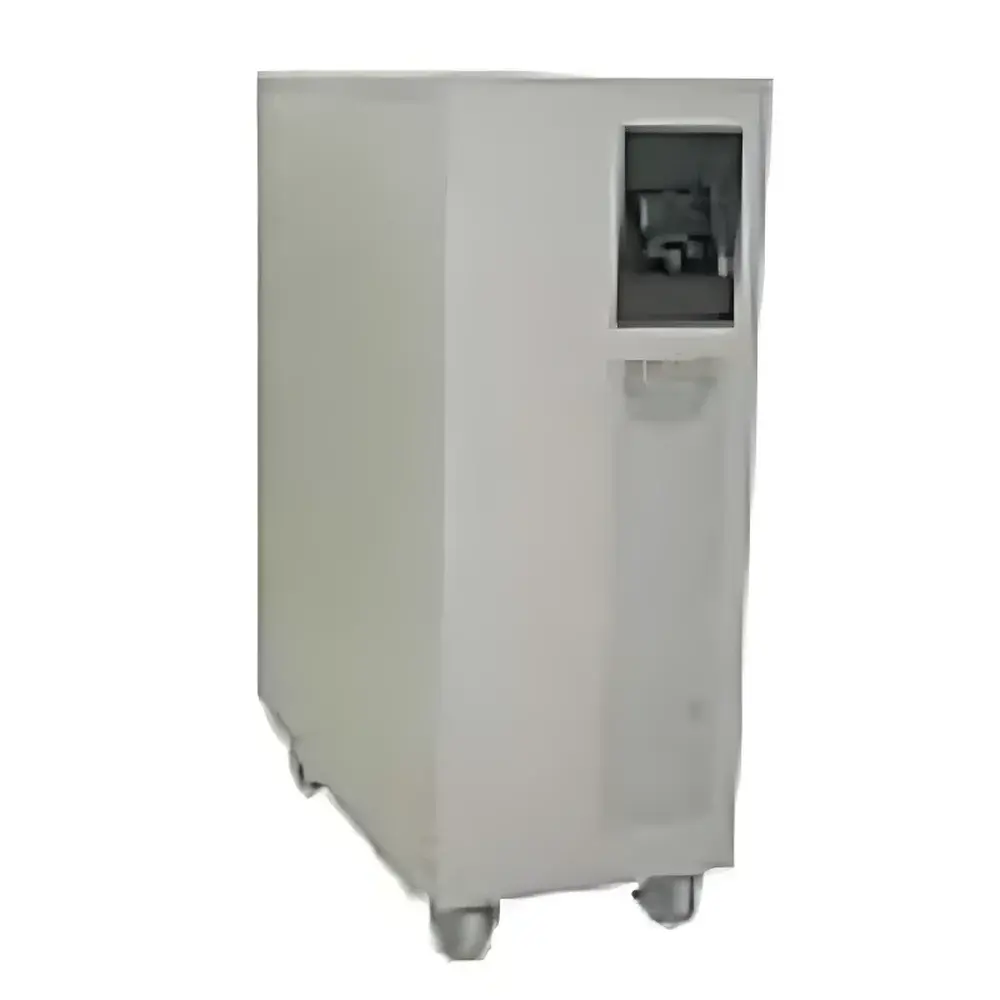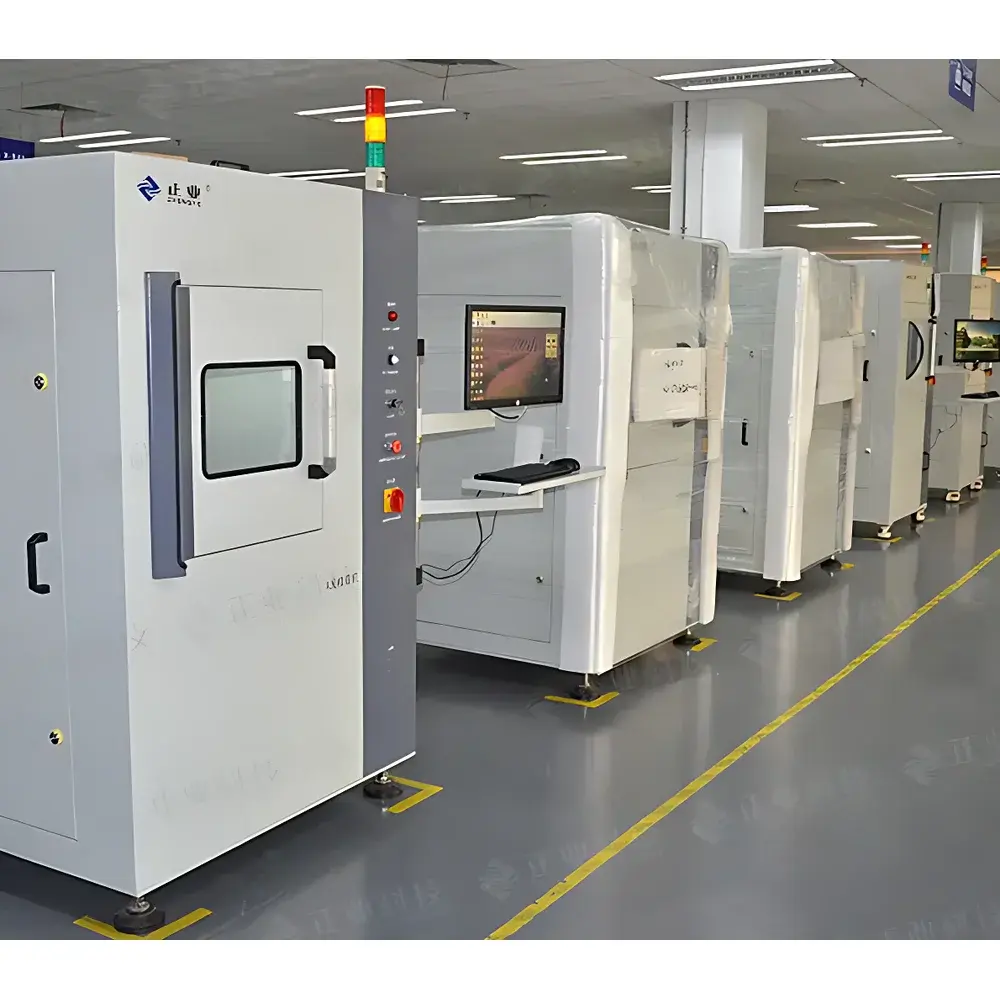
Zhengye XG5010 High-Magnification X-ray Non-Destructive Inspection System
| Brand | Zhengye |
|---|---|
| Origin | Guangdong, China |
| Manufacturer Type | OEM Manufacturer |
| Country of Origin | China |
| Model | XG5010 |
| X-ray Tube Voltage | 90–130 kV (configurable) |
| X-ray Tube Current | 89–455 µA (configurable) |
| Focal Spot Size | 5–15 µm |
| Cooling Method | Forced Air Cooling |
| Detector Type | Image Intensifier / Flat Panel Detector |
| Field of View | Φ100 mm / 114.9 mm × 64.6 mm (configurable) |
| Image Resolution | 1392 × 1040 / 1536 × 864 pixels (configurable) |
| Geometric Magnification | 12×–48× |
| Repeatability Accuracy | ±60 µm |
| Inspection Speed | ≥1.5 points/sec (excluding loading/unloading and stage motion) |
| Stage Dimensions | 515 mm × 460 mm |
| Effective Inspection Area | 450 mm × 410 mm |
| Max Load Capacity | ≤5 kg |
| Radiation Safety | ≤1 µSv/hr (compliant with IEC 61331-1 and IEC 62495) |
| Computer | 22" widescreen LCD/touch display, Intel Core i5, 4 GB RAM, 500 GB HDD |
| System Dimensions | 1136 mm × 1076 mm × 1730 mm |
| Weight | ~750 kg |
| Power Supply | AC 220 V, 10 A |
| Operating Environment | 25 °C ± 3 °C, RH 50% ± 10% |
Overview
The Zhengye XG5010 High-Magnification X-ray Non-Destructive Inspection System is an industrial-grade computed radiography platform engineered for high-precision internal structural analysis without sample destruction. It operates on the principle of differential X-ray attenuation—where variations in material density and thickness produce contrast in transmitted radiation—captured by a high-sensitivity digital detector. Designed specifically for quality assurance in high-value electrochemical manufacturing, the system delivers real-time, sub-100 µm spatial resolution imaging ideal for detecting voids, delaminations, electrode misalignments, solder joint defects, and foreign object debris (FOD) within lithium-ion battery cells, pouch modules, and cylindrical assemblies. Its geometric magnification range (12×–48×) enables both macro-level component verification and micro-scale feature interrogation—supporting failure analysis (FA), process validation, and incoming material inspection under controlled environmental conditions (25 °C ± 3 °C, 50% RH ± 10%). The system complies with international radiation safety standards (IEC 61331-1, IEC 62495), ensuring operator protection while maintaining regulatory traceability in ISO 9001 and IATF 16949 environments.
Key Features
- 2.5D metrology suite: Measures linear distances, circle diameters, concentricity, point-to-center offsets, and angular deviations directly on reconstructed radiographs—enabling quantitative dimensional verification per ISO 10360 and ASTM E2737.
- CNC path programming: Records and repeats complex multi-axis inspection trajectories with encoder-based positional repeatability of ±60 µm—optimized for low-volume, high-mix production batches.
- Intuitive navigation interface: Large-field-of-view preview window allows mouse-click targeting; motorized stage automatically repositions to selected coordinates with closed-loop feedback control.
- Real-time image processing engine: Supports DICOM, TIFF, BMP, and PNG formats; includes dynamic range compression, edge enhancement, noise suppression, and histogram equalization algorithms for improved defect conspicuity.
- Modular detector architecture: Configurable selection between image intensifier and flat-panel detectors—balancing cost, frame rate, and detective quantum efficiency (DQE) for application-specific throughput requirements.
Sample Compatibility & Compliance
The XG5010 accommodates samples up to 450 mm × 410 mm in planar footprint and 5 kg in mass, with vertical clearance optimized for stacked battery modules and assembled electronics subassemblies. Its radiation shielding enclosure meets IEC 61331-1 Type B classification, limiting ambient dose rate to ≤1 µSv/hr at 5 cm from any surface—validated via third-party dosimetry certification. All operational parameters—including tube voltage, current, exposure time, and detector gain—are logged with timestamped metadata to support GLP/GMP audit trails. Software-generated reports include full measurement traceability, operator ID, calibration status, and pass/fail decision logic—aligned with FDA 21 CFR Part 11 electronic record requirements when configured with user authentication and audit logging.
Software & Data Management
The proprietary Zhengye VisionInsight™ software provides a unified interface for acquisition, measurement, reporting, and data archival. It supports automated pass/fail classification using configurable threshold rules applied to geometric features or grayscale intensity profiles. Measurement data exports to CSV, Excel, or XML formats; images are stored with embedded EXIF metadata (kV, µA, magnification, detector model). Version-controlled firmware updates ensure long-term compatibility with evolving industry standards. Optional integration with MES/SCADA systems is available via OPC UA or RESTful API—enabling direct linkage to SPC dashboards and statistical process control workflows.
Applications
- Lithium-ion battery manufacturing: Anode/cathode coating uniformity assessment, separator integrity verification, tab weld porosity detection, and cell stack alignment validation.
- Power electronics: Inspection of IGBT module solder joints, heat sink bond integrity, and capacitor winding consistency.
- Aerospace components: Detection of casting porosity in turbine blades, brazing defects in heat exchangers, and fastener seating verification.
- Medical device assembly: Verification of hermetic seal integrity in implantable battery housings and lead wire routing accuracy.
- Automotive EV subsystems: In-line inspection of busbar welds, connector crimp quality, and thermal interface material distribution.
FAQ
What X-ray tube configurations are supported?
The XG5010 accepts standard microfocus X-ray tubes rated for 90–130 kV and 89–455 µA, with focal spot sizes ranging from 5 µm to 15 µm—selected based on required resolution versus penetration depth trade-offs.
Is the system compliant with FDA or EU MDR requirements for medical device inspection?
While the hardware meets IEC 62495 for radiation safety, regulatory compliance for medical device use requires site-specific validation—including IQ/OQ/PQ protocols, calibration against NIST-traceable standards, and documented risk analysis per ISO 14971.
Can the system perform automated defect classification without manual threshold tuning?
Yes—VisionInsight™ supports supervised machine learning models trained on annotated defect libraries; however, initial model development requires representative sample sets and engineering validation prior to deployment in production.
What maintenance intervals are recommended for the X-ray source and detector?
X-ray tube life expectancy exceeds 5,000 operating hours under nominal conditions; annual preventive maintenance includes collimator alignment verification, detector dark current calibration, and cooling system filter replacement.
Does the system support remote diagnostics and software updates?
Yes—secure TLS-encrypted remote access is enabled via optional VPN configuration; firmware and software patches are distributed through Zhengye’s authenticated update portal with version rollback capability.