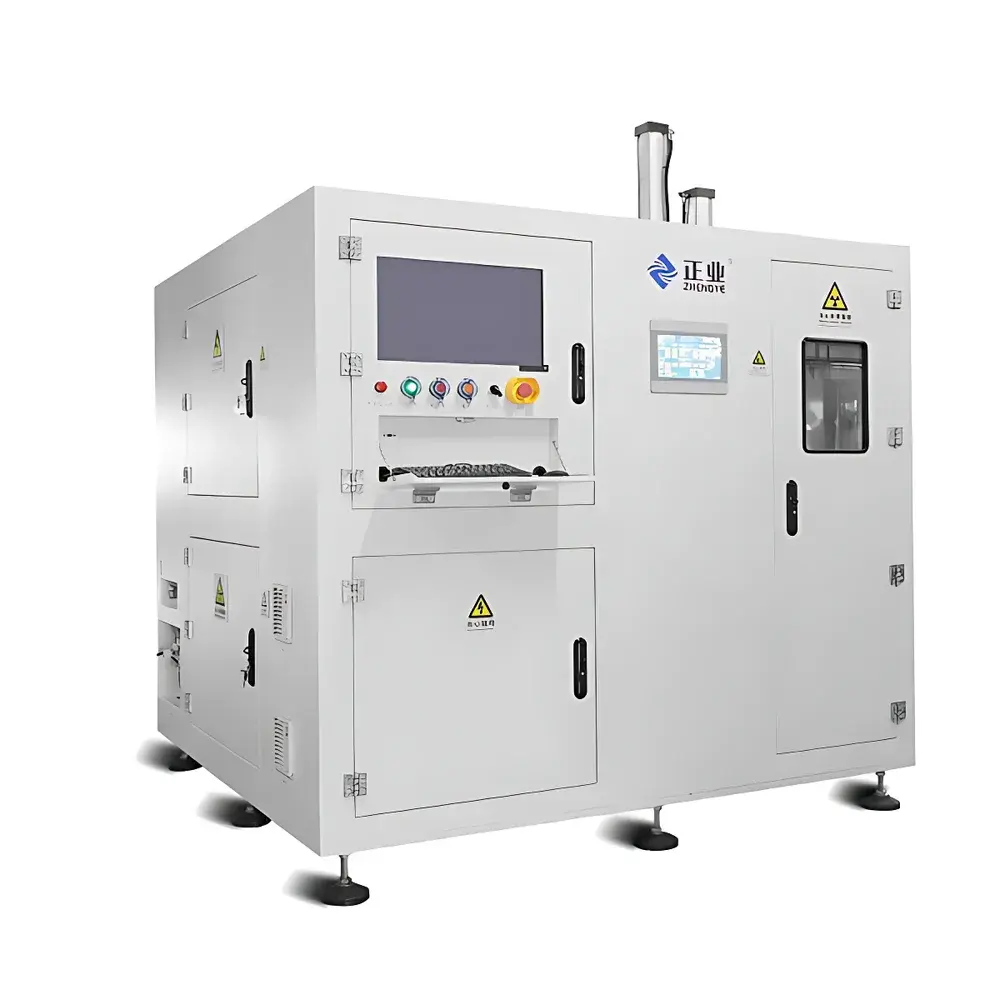
Zhengye XG6000 Automated X-ray Inspection System for IC Solder Joint Integrity
| Brand | Zhengye |
|---|---|
| Origin | Guangdong, China |
| Manufacturer Type | OEM/ODM Manufacturer |
| Country of Origin | China |
| Model | XG6000 |
| Pricing | Upon Request |
Overview
The Zhengye XG6000 is an industrial-grade, fully automated X-ray inspection system engineered for non-destructive evaluation of solder joint integrity in integrated circuit (IC) packages and discrete semiconductor components. It operates on the principle of transmission X-ray imaging—utilizing a sealed microfocus X-ray source to generate penetrating radiation, which passes through the device-under-test and is captured by a high-resolution flat-panel detector (FPD). The resulting grayscale projection images are processed in real time using physics-informed image reconstruction and defect-specific segmentation algorithms. Unlike optical or acoustic methods, this approach enables volumetric assessment of internal interconnects—including voids, cracks, bridging, insufficient solder, lift-off, and wire bond misalignment—without physical contact or sample preparation. Designed for 24/7 operation in Class 10K cleanroom-adjacent environments, the XG6000 supports inline integration into semiconductor final test and assembly lines, delivering metrology-grade repeatability under ISO/IEC 17025-aligned operational protocols.
Key Features
- Fully automated four-axis robotic handling system with precision pick-and-place capability for standard JEDEC trays (7″, 11″, and 13″ formats), eliminating manual intervention and reducing operator-induced variability.
- Real-time traceable retrace algorithm: Simultaneously acquires and reconstructs tray-level positional metadata during imaging—enabling deterministic mapping of each component’s physical location (row/column/index) within the carrier, critical for downstream auto-sorting and failure root-cause analysis.
- Proprietary defect classification engine trained on >50,000 labeled solder joint anomalies; supports detection of wire sweep, die tilt, solder voiding (>5% area threshold), intermetallic compound (IMC) thickness estimation (qualitative), and foreign material presence.
- Integrated CCD-based vision alignment subsystem ensures sub-50 µm placement accuracy prior to X-ray exposure—minimizing motion blur and geometric distortion across multi-die packages.
- Triple-layer radiation safety architecture: Interlocked shielding enclosure, real-time dose monitoring sensor array, and fail-safe beam shutter control—all compliant with IEC 61000-6-4 (EMC) and GBZ 117–2020 (Chinese national radiation safety standard).
Sample Compatibility & Compliance
The XG6000 accommodates surface-mount devices (SMDs) from 0201 to QFN-64, SOIC, SOP, TSSOP, DFN, and leaded and leadless QFP packages. Tray compatibility includes standard JEDEC MO-118, MO-137, and EIAJ ED-7320 formats. All hardware and software modules conform to ISO 9001:2015 manufacturing controls and support GLP/GMP audit readiness via optional 21 CFR Part 11-compliant electronic signature and audit trail logging. Radiation emissions meet both IEC 62495 (industrial X-ray equipment safety) and GB 18871–2002 (basic safety standards for ionizing radiation protection).
Software & Data Management
The embedded inspection software (v4.2+) provides a unified interface for acquisition, analysis, reporting, and data exchange. Core capabilities include drag-zoom-pan navigation of full-resolution radiographs, dual-pane NG review (original image + annotated defect overlay), barcode scanning (1D/2D), and native OPC UA and SECS/GEM protocol support for factory-wide MES integration. All inspection logs—including image thumbnails, confidence scores, defect coordinates, tray map metadata, and operator ID—are stored in SQLite3 databases with configurable retention policies. Optional cloud synchronization enables remote diagnostics and centralized fleet performance analytics across multiple production sites.
Applications
- In-line post-reflow solder joint verification for automotive-grade MCUs and power modules (AEC-Q100 qualified processes).
- Final QA screening of wafer-level chip-scale packages (WLCSP) and fan-out wafer-level packages (FOWLP) prior to singulation.
- Failure analysis correlation: Cross-referencing X-ray findings with subsequent cross-section SEM or acoustic microscopy results.
- Process capability studies (Cp/Cpk) for solder paste volume control and reflow profile optimization.
- Supplier qualification audits requiring objective, repeatable evidence of interconnect reliability.
FAQ
Does the XG6000 support custom defect rule sets for proprietary package architectures?
Yes—via the Rule Builder module, users can define geometry-based, intensity-thresholded, and pattern-matching criteria without coding; validated rules export as XML for version-controlled deployment.
Is offline training of new defect models possible?
Yes—customers may upload anonymized radiograph datasets to Zhengye’s secure AI training portal; model updates are delivered as signed firmware patches compliant with IEC 62304 Class B software lifecycle requirements.
What is the maximum throughput for 13-inch trays containing QFN-48 devices?
At nominal configuration (120 kV, 0.8 mA, 2×2 binning), average cycle time is ≤4.2 minutes per tray (≈4,200 units), including robotic loading, alignment, 16-field tiled imaging, and full-tray defect aggregation.
Can the system interface with third-party AOI or ICT platforms?
Yes—through standardized RESTful APIs and configurable CSV/JSON data exports, enabling bidirectional pass/fail handshaking and shared defect taxonomy alignment.
Is radiation shielding certification documentation available for international facility commissioning?
Yes—full Type Test Reports (TTRs) per IEC 61331-1 and local regulatory equivalents (e.g., FDA 21 CFR 1020.40, Health Canada SOR/2014-269) are provided with each shipment.