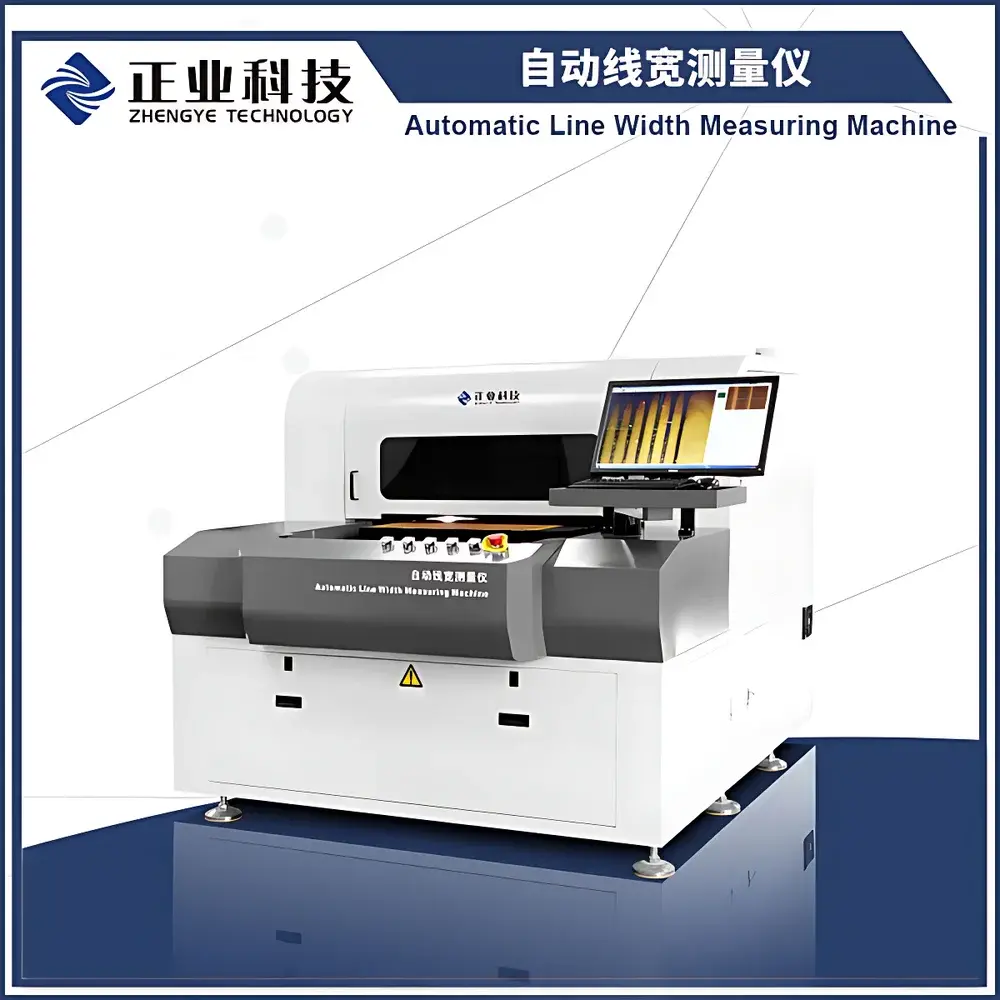
Zhengye XK32 Automated Online Line Width Measurement System
| Brand | Zhengye |
|---|---|
| Origin | Guangdong, China |
| Manufacturer Type | Original Equipment Manufacturer (OEM) |
| Regional Classification | Domestic (PRC) |
| Model | XK32 |
| Pricing | Available upon Request |
Overview
The Zhengye XK32 Automated Online Line Width Measurement System is a high-precision optical metrology platform engineered for real-time, non-contact dimensional inspection of micro-patterned features in semiconductor and advanced PCB manufacturing. Built on a robust machine vision architecture, the system employs high-resolution telecentric imaging combined with sub-pixel edge detection algorithms to quantify critical geometric parameters—including line width (upper and lower profile), line-to-line spacing, pad-to-edge distance, via diameter (through-hole, blind via), and trace pitch—on etched copper layers prior to solder mask application. Its measurement principle relies on calibrated pixel-to-micron mapping under stabilized illumination, with automated focus control ensuring consistent depth-of-field across varying substrate topographies. Designed for integration into inline or near-line production environments, the XK32 delivers traceable, repeatable measurements compliant with industry-standard process control requirements for fine-line PCBs (≤50 µm), IC substrates, and flat-panel display (FPD) photomasks.
Key Features
- Automated Programmed Measurement: Supports import of CAM data files in Gerber RS-274X format; enables graphical definition of measurement locations and automatic generation of executable inspection routines.
- Auto-Focus Imaging System: Integrated motorized Z-axis stage and contrast-based autofocus algorithm ensure optimal image sharpness at each measurement point—critical for maintaining measurement fidelity across warped or uneven substrates.
- Motorized Zoom Lens: Continuous optical zoom (e.g., 1×–5× magnification range) controlled entirely via software; eliminates manual lens swapping and enables dynamic resolution adjustment without interrupting workflow.
- Navigator-Based Positioning: High-resolution overview camera provides real-time mosaic navigation; operators or scripts can rapidly locate target features using coordinate referencing or pattern-matching search.
- Sub-Pixel Edge Detection: Proprietary edge-finding algorithm identifies conductor boundaries at <0.1 µm precision; simultaneously computes upper/lower line widths, centerline deviation, and sidewall angle proxies.
- Statistical Process Control (SPC) Engine: Real-time calculation of Cp/Cpk, X-bar & R charts, histogram distribution, and trend analysis per lot, panel, or feature group; configurable alarm thresholds and OCAP triggers.
- Database Integration Framework: Native support for SQL-based MES connectivity (e.g., ODBC/JDBC); bidirectional data exchange for recipe management, SPC results upload, and audit trail synchronization.
Sample Compatibility & Compliance
The XK32 accommodates rigid and flexible PCBs (up to 610 × 610 mm), IC substrates, glass panels (LCD/OLED), and ceramic carriers. It operates under cleanroom-compatible environmental conditions (Class 10K ambient, 20–25 °C, 40–60% RH). Measurement traceability aligns with ISO/IEC 17025 principles for calibration management. Software supports audit trail logging, user access control (role-based permissions), and electronic signature capability—facilitating alignment with FDA 21 CFR Part 11 and ICH-GCP/GLP documentation requirements where applicable. All measurement reports include timestamped metadata: operator ID, system calibration status, illumination intensity, focus Z-position, and image capture hash for forensic verification.
Software & Data Management
The Zhengye proprietary measurement suite runs on Windows 10 IoT Enterprise, featuring a modular GUI with dedicated modules for program editing, live acquisition, batch reporting, and SPC dashboarding. Raw images and coordinate data are stored in a local SQLite repository with optional replication to central SQL Server instances. Export formats include native .ZMW project files, CSV for statistical packages, and Excel (.xlsx) with embedded charts and summary statistics. Audit logs record all user actions—including parameter changes, report generation, and database sync events—with immutable timestamps. The software architecture supports TLS-encrypted API endpoints for MES integration, enabling automated job dispatch, result ingestion, and quality gate enforcement within Industry 4.0 workflows.
Applications
- Pre-solder mask inspection of inner/outer layer PCBs after etching—validating compliance with IPC-6012 Class 2/3 line width tolerances.
- In-process monitoring of fan-out wafer-level packaging (FOWLP) redistribution layers (RDL).
- Photomask qualification for TFT-LCD and AMOLED backplane patterning.
- Failure analysis correlation: overlaying measurement data with AOI defect coordinates for root cause investigation.
- Process capability studies during DOE (Design of Experiments) for etch chemistry optimization.
FAQ
Does the XK32 support multi-layer registration measurement?
Yes—the system allows fiducial-based alignment between layers using pre-defined registration marks; measurement coordinates are transformed into a unified datum frame for cross-layer dimensional comparison.
What is the minimum measurable line width and repeatability specification?
Based on optical resolution and edge detection algorithm performance, typical measurement uncertainty is ±0.5 µm at 95% confidence for features ≥3 µm wide; actual performance depends on surface reflectivity, edge contrast, and calibration standard traceability.
Can the system be integrated with existing factory automation protocols?
Yes—it supports SECS/GEM communication over TCP/IP and provides RESTful APIs for integration with CIM systems, allowing remote job triggering, status polling, and result retrieval.
Is remote diagnostics and software update capability available?
Yes—secure remote desktop access (with customer authorization) and over-the-air firmware/software updates are supported via encrypted HTTPS channels.
Does the software comply with data integrity requirements for regulated industries?
Yes—audit trail, electronic signatures, and change control mechanisms meet ALCOA+ principles and are validated per GAMP5 guidelines for use in GxP environments.