
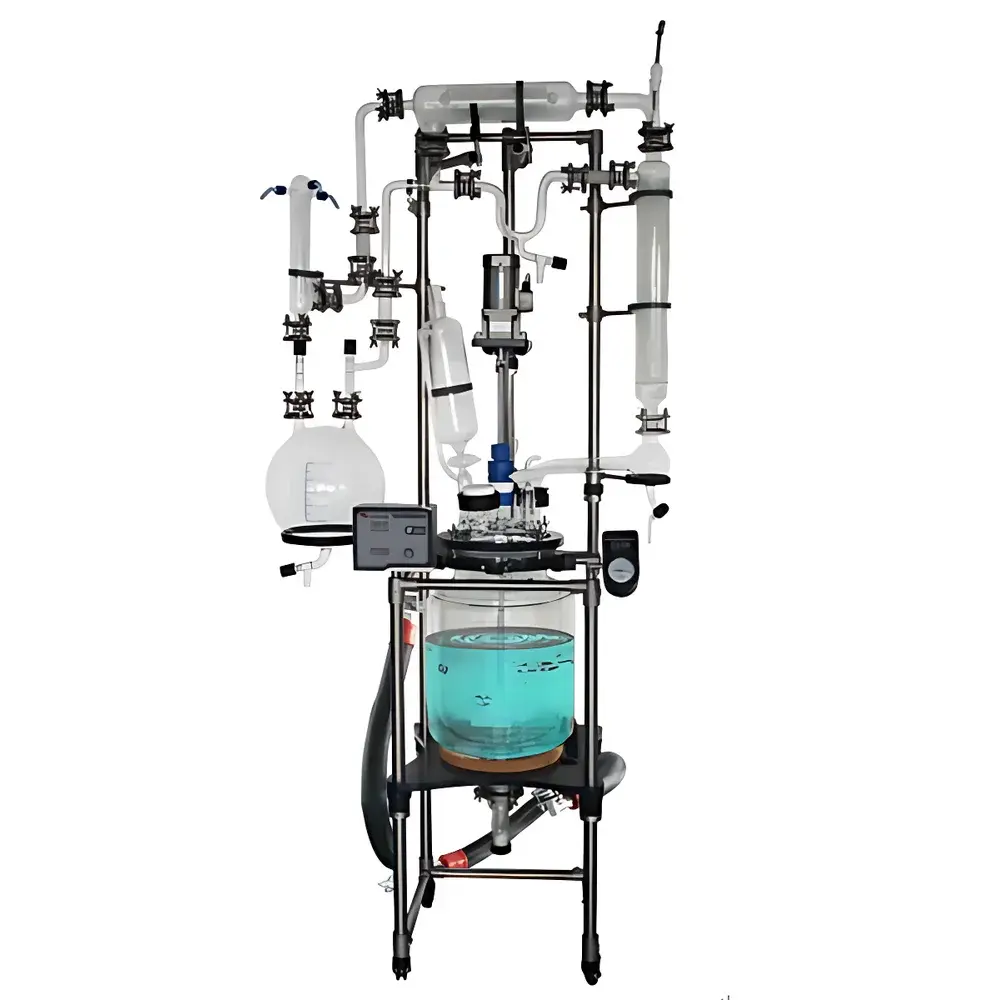
Zhengzhou Great Wall Customized Fractional Distillation Reactor GR-10T
| Brand | The Great Wall |
|---|---|
| Origin | Henan, China |
| Manufacturer Type | Direct Manufacturer |
| Origin Category | Domestic |
| Model | GR-10T |
| Price Range | USD 2,800–7,000 (FOB) |
| Usable Volume | 10 L |
| Vessel Material | Borosilicate Glass 3.3 |
| Operating Pressure Range | −0.1 to 0 MPa (gauge) |
| Vacuum Capability | ≤ −0.098 MPa (absolute) |
| Jacket Volume | ~3.0 L |
| Condenser Heat Transfer Area | 0.234 m² |
| Constant-Pressure Dropping Funnel Capacity | 1000 mL |
| Fractionation Column Dimensions | Φ85 × 715 mm |
| Packing | Glass Raschig Rings |
| Number of Ports on Reactor Head | 6 |
| Temperature Range | −80 °C to +200 °C |
| Max Allowable ΔT (Jacket–Vessel) | ≤80 °C |
| Jacket Pressure Rating | ≤ +0.03 MPa |
| Stirring Motor Power | 90 W |
| Speed Control | Frequency Inverter |
| Speed Range | 50–500 rpm |
| Temperature Sensor | Pt100 (SUS304 sheath + PTFE outer sleeve) |
| Temp. Display Accuracy | ±0.1 °C |
| Sealing Material | PTFE |
| Discharge Valve Height from Floor | 320 mm |
| Agitator Type | Anchor-type with PTFE blades |
| Shaft Material | SUS304 + PTFE cladding |
| Frame Material | SUS304 |
| Mobility | Lockable Casters |
| Power Supply | 220–240 V~, 50/60 Hz |
| Ambient Operating Temp. | 5–35 °C |
| Max. Relative Humidity | ≤70% RH |
| Overall Dimensions (W×D×H) | ~1080 × 650 × 2380 mm |
Overview
The Zhengzhou Great Wall Customized Fractional Distillation Reactor GR-10T is a bench-scale, jacketed glass reactor system engineered for precise temperature-controlled distillation, fractional separation, and multi-step synthesis under reduced pressure. Designed around the principles of vapor–liquid equilibrium (VLE) manipulation and controlled reflux dynamics, it integrates a high-efficiency horizontal condenser, calibrated fractionation column, and vacuum-compatible borosilicate glass 3.3 construction to support reproducible separation of thermally sensitive or low-boiling-point mixtures. Its operational envelope—spanning −80 °C to +200 °C with pressure control from −0.1 MPa to atmospheric—enables applications ranging from solvent recovery and essential oil isolation to pilot-scale purification of fine chemical intermediates. The system adheres to standard laboratory reactor design conventions per ISO 8573-1 (compressed air purity), ASTM E2654 (laboratory equipment qualification), and general GLP-compliant installation practices for non-automated analytical instrumentation.
Key Features
- Borosilicate glass 3.3 components (reactor body, condenser, column, funnels) certified to DIN ISO 3585 standards for thermal shock resistance (ΔT ≤ 80 °C), chemical inertness toward organic solvents and mild acids/bases, and optical clarity for real-time process observation.
- Horizontal condenser with 0.234 m² effective heat transfer area, optimized for high reflux ratios and minimal hold-up volume—critical for sharp boiling point separation in binary or ternary mixtures.
- Integrated Φ85 × 715 mm fractionation column packed with uniform glass Raschig rings (surface area ≈ 190 m²/m³), enabling theoretical plate counts up to 8–10 under optimal reflux conditions.
- SUS304 structural frame with lockable stainless steel casters; all load-bearing joints reinforced for static stability at full liquid load (10 L) and vacuum operation.
- PTFE-sealed, side-mounted discharge valve with zero dead-leg geometry and corrosion-resistant PTFE–SUS304 composite stem—designed to prevent residue accumulation and cross-contamination between batches.
- Frequency-inverter-driven 90 W three-phase agitator delivering 50–500 rpm continuous duty, coupled with dual-seal PTFE bearings to eliminate metal particulate generation and ensure long-term vacuum integrity.
- Pt100 temperature sensor (IEC 60751 Class B) housed in SUS304 sheath with external PTFE insulation, providing ±0.1 °C display resolution and traceable calibration capability.
Sample Compatibility & Compliance
The GR-10T accommodates a broad range of organic solvents (e.g., acetone, ethanol, THF, dichloromethane), aqueous solutions, and moderately aggressive reagents (e.g., dilute HCl, NaOH ≤1 M) without degradation of glass or sealing surfaces. It is not rated for hydrofluoric acid, molten alkali metals, or strong oxidizers (e.g., fuming nitric acid). All wetted parts comply with USP (elastomeric components) and EU Pharmacopoeia 2.6.23 (glass quality). The system meets CE machinery directive 2006/42/EC requirements when installed with appropriate local electrical grounding and vacuum pump interlocks. While not intrinsically safe, optional ATEX-compliant motor enclosures and explosion-proof vacuum controllers are available upon request for Class I, Division 2 environments.
Software & Data Management
The GR-10T operates as a manually supervised, analog-digital hybrid platform: temperature and agitation speed are monitored via front-panel digital displays, but no embedded data logging or PC interface is included in the base configuration. For regulated environments requiring audit trails, users may integrate third-party USB/RS485-enabled chart recorders or PLC-based SCADA systems compliant with FDA 21 CFR Part 11 (electronic records/signatures) via optional 4–20 mA output modules for temperature and speed signals. Calibration documentation—including as-received verification reports for Pt100 sensors and pressure transducers—is provided with each unit and conforms to ISO/IEC 17025 traceability frameworks through accredited metrology partners in China.
Applications
- Fractional distillation of multi-component solvent blends (e.g., ethyl acetate–ethanol–water) in QC laboratories verifying raw material purity per USP .
- Low-temperature vacuum distillation of heat-labile natural product extracts (e.g., terpenoids, alkaloid fractions) preserving stereochemical integrity.
- Reflux-coupled synthesis followed by in-situ solvent removal—such as esterification or amidation reactions where water azeotrope removal drives equilibrium.
- Method development for industrial-scale distillation columns, using GR-10T-derived HETP (height equivalent to a theoretical plate) and Murphree efficiency data.
- Educational demonstration of Raoult’s law deviations, azeotrope behavior, and minimum/reflux ratio determination in undergraduate chemical engineering curricula.
FAQ
What vacuum level can the GR-10T sustain during operation?
The system is validated for continuous operation at ≤ −0.098 MPa (absolute), corresponding to ~2 mbar residual pressure—sufficient for most low-boiling-point separations below 100 °C.
Is the glass column jacketed or air-cooled?
The fractionation column is unjacketed and relies on ambient convection and controlled reflux ratio for thermal management; optional circulating coolant jackets for column sections are available as custom add-ons.
Can the reactor be used for hydrogenation or other gas-introduction reactions?
Yes—two of the six standardized ports on the reactor head are configured for gas inlet/outlet with Swagelok SS-4 fittings; users must supply compatible pressure-rated gas manifolds and back-pressure regulators.
Does the system include a vacuum pump or chiller?
No—these are auxiliary components selected based on application-specific requirements (e.g., oil-free diaphragm pump for solvent compatibility; −20 °C recirculating chiller for condenser duty) and must be procured separately.
What maintenance intervals are recommended for the stirring seal and PTFE components?
Under normal use (≤4 hrs/day, non-abrasive media), inspect PTFE seals annually; replace agitator shaft bearings every 18–24 months or after 2,000 operating hours—whichever occurs first.



