
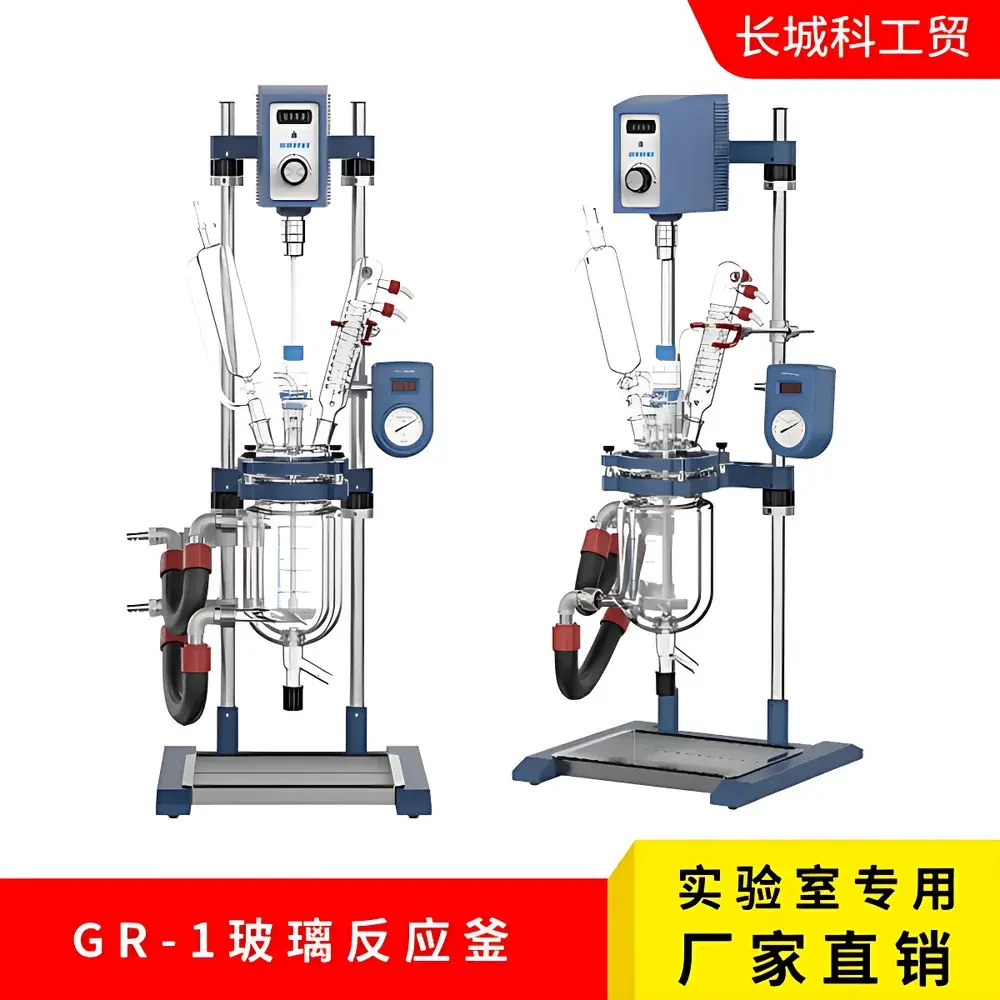
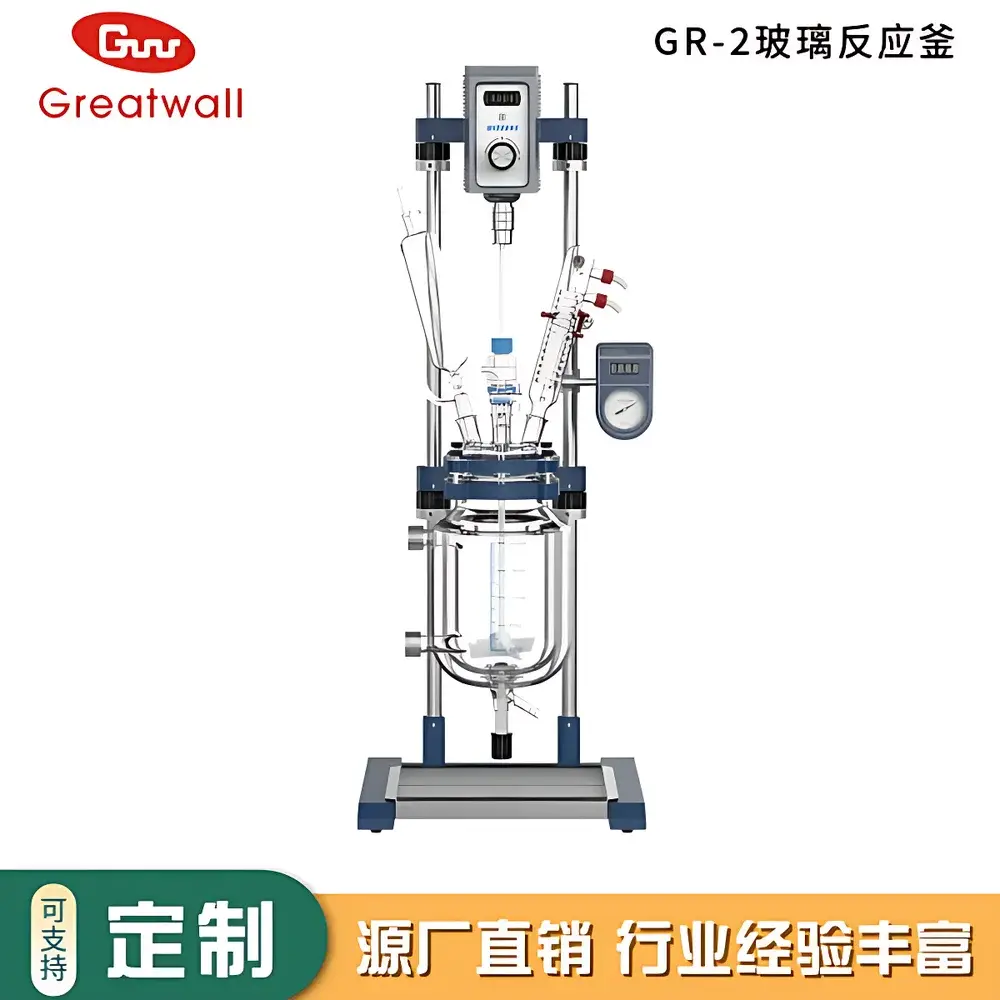
Zhengzhou Great Wall GR-2 Double-Jacketed Glass Reactor
| Brand | The Great Wall |
|---|---|
| Origin | Henan, China |
| Manufacturer Type | Direct Manufacturer |
| Country of Origin | China |
| Model | GR-2 |
| Reactor Type | Jacketed Glass Reactor |
| Working Volume | 2 L |
| Minimum Stirring Volume | ~0.2 L |
| Vessel Material | Borosilicate Glass 3.3 |
| Operating Pressure Range | –0.1 MPa to 0 MPa (vacuum to atmospheric) |
| Jacket Pressure Rating | ≤0.03 MPa |
| Temperature Range | –80 °C to +200 °C |
| Thermal Shock Resistance | 80 °C |
| Stirring Speed Range | 40–500 rpm |
| Speed Accuracy | ±1 rpm |
| Motor Type | Brushless DC |
| Motor Power | 50 W |
| Stirrer Shaft Material | 06Cr19Ni10 stainless steel with PTFE coating |
| Impeller Material | PTFE-coated 06Cr19Ni10 |
| Sealing System | Vacuum-rated mechanical seal with PTFE/PEEK/glass support components |
| Flange Diameter | 105 mm |
| Top Port Configuration | Five ports (one 24/40 central, three 24/40 side, one 19/26) |
| Bottom Valve Outlet | φ10 mm internal diameter, φ20 mm discharge port |
| Jacket Inlet/Outlet | Rc 3/4 and Rc 1/2 threaded connections |
| Condenser Length | 326 mm |
| Condenser Surface Area | 0.025 m² |
| Drip Funnel Capacity | 200 mL (24/29 joint) |
| Temperature Sensor | PT100, ±0.1 °C accuracy |
| Display | Digital LED for speed and temperature |
| Power Supply | Stirrer: 100–240 V~, 50/60 Hz |
| Control Box | 220–240 V~, 50/60 Hz |
| Dimensions (W×D×H) | ~480 × 420 × 1100 mm |
| Net Weight | ~20 kg |
Overview
The Zhengzhou Great Wall GR-2 Double-Jacketed Glass Reactor is an engineered laboratory-scale synthesis platform designed for controlled chemical reactions, solvent reflux, distillation, concentration, and vacuum-assisted processes under precisely regulated thermal and pressure conditions. Its core architecture employs a dual-wall borosilicate glass 3.3 vessel—internally resistant to thermal shock up to 80 °C and chemically inert across a broad pH range—enabling safe operation from –80 °C (with cryogenic coolant circulation) to +200 °C (under pressurized heating media). The reactor operates exclusively in the low-pressure regime (–0.1 MPa to ambient), making it suitable for applications requiring vacuum degassing, reduced-boiling-point distillation, or moisture-sensitive synthesis without high-pressure certification. All wetted surfaces—including the vessel body, lid, condenser, and collection components—are constructed from ASTM E438 Type I, Class A borosilicate glass 3.3, ensuring compliance with ISO 3585 and USP specifications for laboratory glassware performance and dimensional stability. The unit integrates a vacuum-mechanical stirring system with hermetic sealing, eliminating vapor leakage during prolonged reaction cycles and supporting GLP-compliant experimental documentation.
Key Features
- Double-jacketed borosilicate glass 3.3 vessel (2 L working volume) with 1.7 L jacket capacity for efficient thermal transfer via external circulator
- Vacuum-rated mechanical seal assembly using PTFE/PEEK composite bearings and glass-reinforced support elements for long-term leak-free operation at –0.1 MPa
- Brushless DC drive motor (50 W) delivering smooth, maintenance-free stirring from 40 to 500 rpm with ±1 rpm digital feedback and stepless speed control
- PTFE-coated 06Cr19Ni10 (AISI 304 equivalent) stirrer shaft and four-blade inclined turbine impeller optimized for homogeneous mixing of low- to medium-viscosity reaction mixtures
- Five standardized ground-glass ports (one 24/40 center, three 24/40 side, one 19/26) enabling simultaneous integration of thermometer, condenser, dropping funnel, nitrogen inlet, and vacuum line
- Stainless steel (06Cr19Ni10) structural frame with epoxy-painted carbon steel and anodized aluminum panels—corrosion-resistant, static-dissipative, and compatible with cleanroom-grade wiping protocols
- Rc 3/4 and Rc 1/2 jacket inlet/outlet fittings connected via flexible stainless steel-braided PTFE-lined hoses to eliminate thermal stress and vibration transmission
- Integrated digital control panel with independent LED displays for real-time monitoring of stir speed and PT100-sensed vessel temperature (±0.1 °C accuracy)
Sample Compatibility & Compliance
The GR-2 is validated for use with organic solvents (e.g., THF, toluene, DMF), aqueous electrolytes, mild acids and bases, and air/moisture-sensitive reagents when operated under inert gas blanket or vacuum. It is not intended for exothermic polymerization, hydrogenation under H₂ pressure >0.1 MPa, or highly abrasive slurries. All glass components conform to DIN ISO 3585 for hydrolytic resistance (Class HGB 1), and the mechanical seal meets ISO 21049 (API 682) Category 1 baseline requirements for low-energy, non-contacting operation. The system supports audit-ready workflows per FDA 21 CFR Part 11 when paired with external data logging software, and its temperature and speed control architecture satisfies the repeatability criteria outlined in ASTM E2877 for laboratory reactor calibration verification.
Software & Data Management
While the GR-2 operates as a standalone analog-digital hybrid instrument with front-panel controls, its temperature and rotational speed outputs are accessible via 0–10 V analog signals (optional interface module required) for integration into third-party SCADA or LIMS environments. The digital display retains last-set parameters after power cycling, and the PT100 sensor output is traceable to NIST-certified reference standards. For full electronic recordkeeping, users may connect external USB or RS-485 data loggers compliant with ISO/IEC 17025 metrological validation requirements. No proprietary firmware or cloud-based telemetry is embedded—ensuring full data sovereignty and compatibility with air-gapped laboratory networks.
Applications
- Small-scale batch synthesis of pharmaceutical intermediates under reflux or vacuum distillation
- Controlled crystallization studies with programmable cooling ramping via external chiller
- Grignard and organolithium reactions requiring strict exclusion of moisture and oxygen
- Essential oil extraction via steam distillation or solvent-assisted concentration
- Photocatalytic reaction screening with optional quartz viewport modification
- QC testing of polymer solution viscosity and thermal degradation onset under inert atmosphere
FAQ
What is the maximum allowable jacket pressure for the GR-2 reactor?
The double jacket is rated for continuous operation at ≤0.03 MPa (30 kPa gauge)—sufficient for standard heat transfer fluids but not for pressurized steam or high-temperature oil systems.
Can the GR-2 be used for hydrogenation reactions?
Only under atmospheric or vacuum conditions with external H₂ sparging; it is not rated for elevated H₂ partial pressures and lacks explosion-proof motor certification.
Is the PT100 temperature sensor calibrated and replaceable?
Yes—the sensor is factory-calibrated to ±0.1 °C at 0 °C and 100 °C; replacement probes with 2-meter lead and standard M12 connector are available as spare parts.
Does the mechanical seal require periodic lubrication or maintenance?
No—the seal uses dry-running PTFE/PEEK faces and is designed for >5,000 hours of continuous operation without servicing under recommended load and temperature profiles.
What safety certifications does the GR-2 hold?
It complies with CE marking requirements under the EU Machinery Directive 2006/42/EC and Low Voltage Directive 2014/35/EU; full test reports are available upon request for institutional procurement review.



