
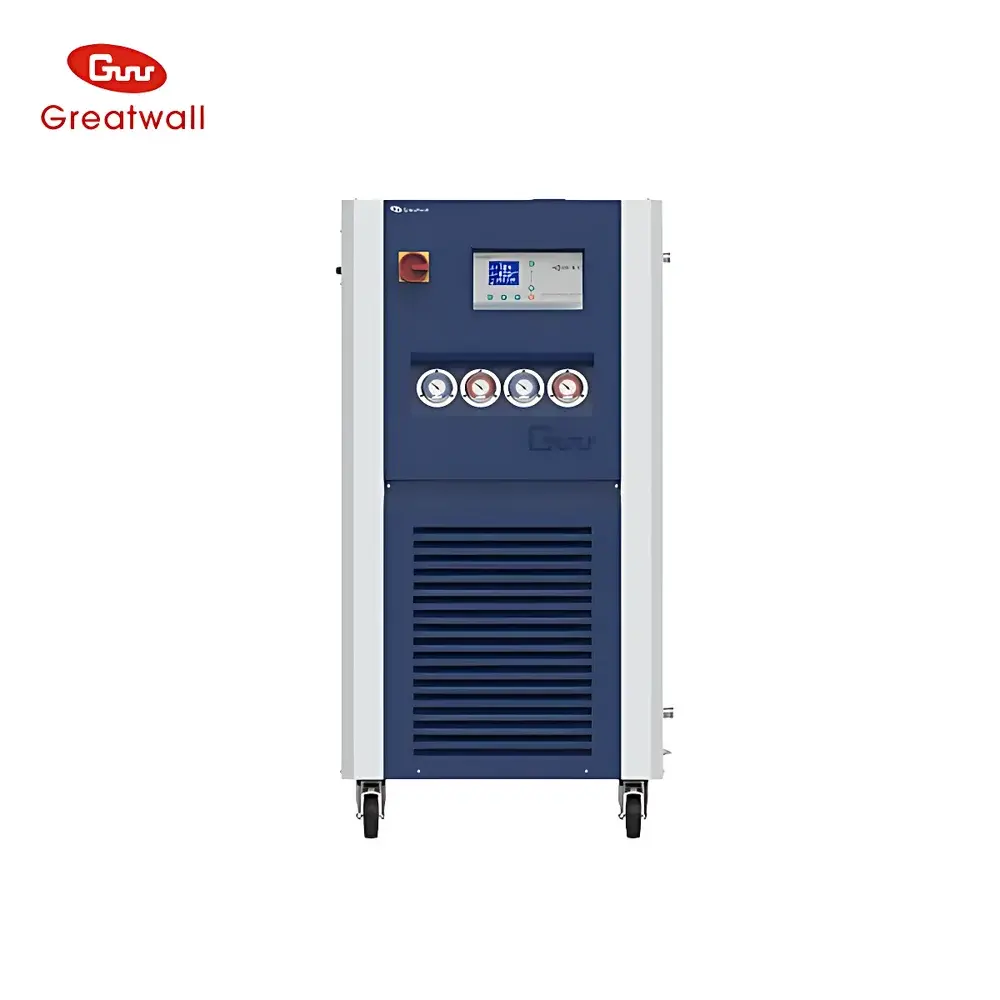
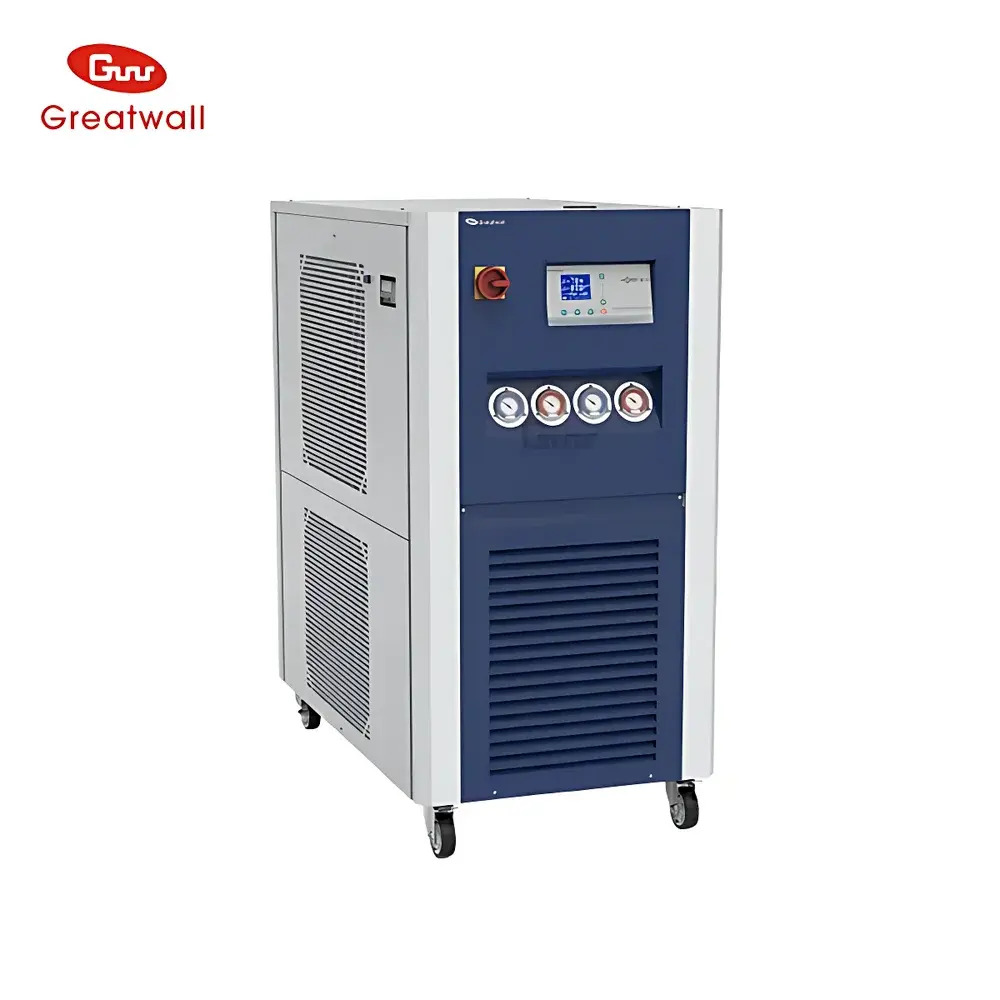
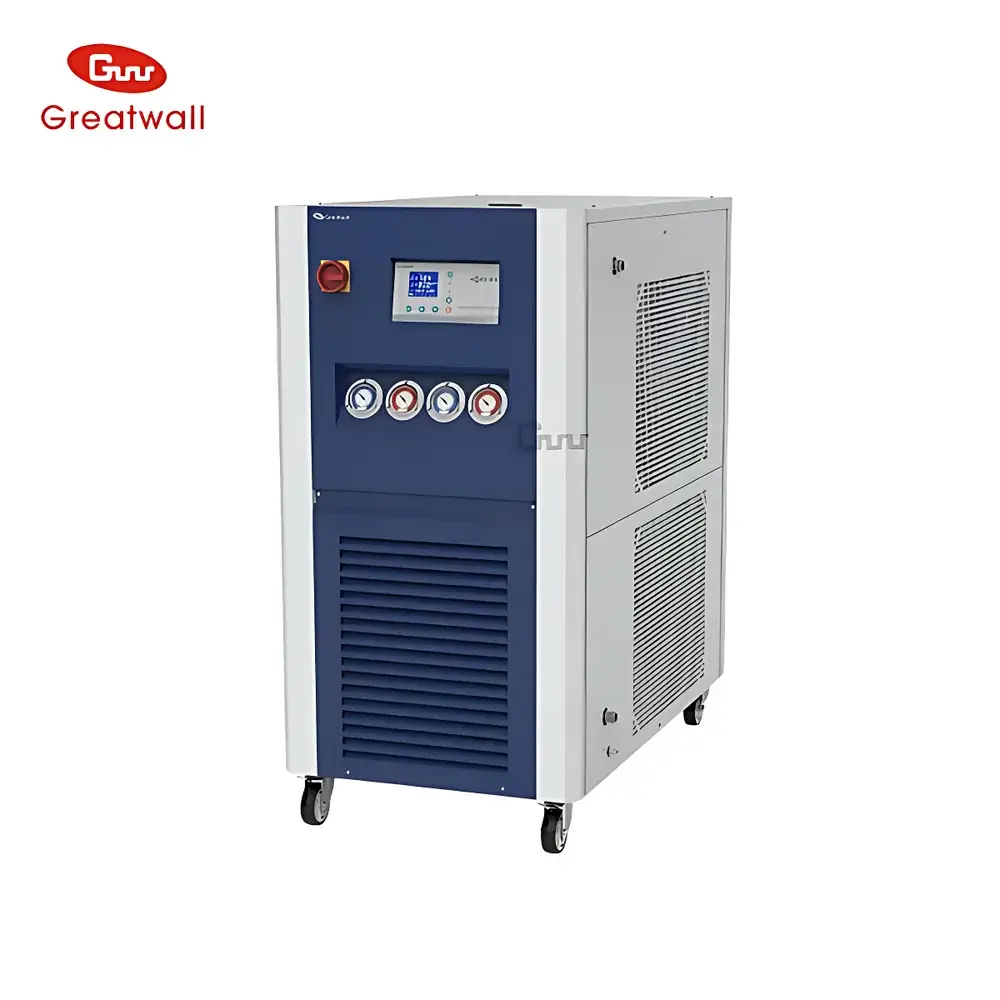
ZHENGZHOU GREAT WALL LT-50-80 Ultra-Low Temperature Circulating Chiller
| Brand | The Great Wall |
|---|---|
| Origin | Henan, China |
| Manufacturer Type | Direct Manufacturer |
| Equipment Type | Integrated Circulating Chiller |
| Temperature Range | −80 °C to −40 °C |
| Cooling Capacity | 1000 W (at −80 °C) / 3000 W (at −60 °C) / 5000 W (at −40 °C) |
| Temperature Stability | ±2 °C |
| Circulation Pump Pressure | 1 bar |
| Flow Rate | 30 L/min |
| Power Consumption | 9800 W |
| Rated Current | 17.5 A |
| Refrigerants | R404A & R23 |
| Reservoir Volume | 10 L |
| Reservoir Material | SUS304 Stainless Steel |
| Dimensions (W×D×H) | 710 × 1230 × 1380 mm |
| Net Weight | 350 kg |
| Power Supply | 3-phase, 380 V, 50 Hz |
| Ambient Operating Conditions | 5–35 °C, ≤70% RH |
| Sensor Type | Pt100 |
| External Port | Rc 1/2 internal thread |
| Fill Opening Diameter | Ø60 mm |
Overview
The ZHENGZHOU GREAT WALL LT-50-80 Ultra-Low Temperature Circulating Chiller is an integrated, industrial-grade refrigeration system engineered for precise thermal management in demanding laboratory and pilot-scale process applications. It operates on a dual-refrigerant cascade compression cycle—utilizing R404A in the high-stage and R23 in the low-stage—to achieve stable, continuous cooling output from −80 °C to −40 °C. Unlike single-stage chillers, this cascade architecture ensures thermodynamic efficiency and operational reliability at cryogenic setpoints, critical for exothermic reaction control, low-temperature material characterization, and synthetic chemistry requiring extended sub-zero dwell times. Designed for direct integration with jacketed reactors, calorimeters, spectroscopic cells, and environmental test chambers, the LT-50-80 delivers consistent heat extraction via a closed-loop circulation of heat-transfer fluid (e.g., ethanol/water or silicone oil blends), minimizing vapor loss and moisture ingress through its hermetically sealed reservoir and inert gas-compatible fill port.
Key Features
- Hermetic stainless steel (SUS304) reservoir with Ø60 mm fill opening and overfill drainage mechanism—prevents fluid degradation by limiting exposure to ambient humidity and oxygen
- Cascade refrigeration system with independent high- and low-stage compressors, each equipped with dedicated safety controls including high/low pressure switches, phase sequence monitoring, and thermal overload protection
- Compressor soft-start delay logic (≥3 min interlock) to prevent mechanical stress and grid current surges during repeated cycling
- Digital PID temperature controller with Pt100 RTD sensor, offering ±2 °C stability across the full operating range and real-time display of outlet fluid temperature
- High-capacity circulation pump (280 W, 30 L/min @ 1 bar) with corrosion-resistant wetted parts, compatible with common low-temperature heat transfer fluids
- Comprehensive electrical protection suite: earth leakage detection, overcurrent cutoff, motor phase-loss monitoring, and automatic shutdown upon fault condition detection
Sample Compatibility & Compliance
The LT-50-80 supports compatibility with a broad spectrum of heat-transfer media—including aqueous glycol mixtures, ethanol-based solutions, and low-viscosity silicone oils—enabling safe operation down to −80 °C without freezing or phase separation. Its sealed loop design meets ISO 17025-relevant requirements for traceable thermal stability in accredited testing laboratories. While not certified to UL/CSA or CE for standalone medical device use, the unit conforms to IEC 61000-6-2 (immunity) and IEC 61000-6-4 (emission) standards for industrial environments. All safety interlocks—including refrigerant pressure thresholds, compressor winding temperature limits, and reservoir level sensors—are documented per manufacturer’s risk assessment protocol and support GLP-compliant audit trails when integrated with external logging systems.
Software & Data Management
The chiller features a standalone digital interface with non-volatile parameter storage; no embedded firmware or network connectivity is provided. For regulatory-aligned data integrity, users may connect the analog 4–20 mA temperature output signal or RS485 Modbus RTU port (optional accessory) to validated third-party SCADA or LIMS platforms. When interfaced with systems compliant with FDA 21 CFR Part 11, the LT-50-80 supports electronic record generation—including timestamped setpoint changes, alarm events, and runtime logs—provided the host software implements appropriate audit trail, user authentication, and electronic signature controls. Configuration parameters are protected by password-level access control on the front panel.
Applications
- Temperature control of jacketed glass or stainless steel reactors in pharmaceutical API synthesis, where sustained −70 °C to −80 °C conditions are required for lithiation, Grignard, or cryo-Grignard reactions
- Stabilization of detector housings and optical benches in FTIR, Raman, and XRD instrumentation to reduce thermal drift and improve signal-to-noise ratio
- Environmental simulation for polymer crystallinity studies, battery electrolyte freezing point analysis, and superconducting material testing
- Calibration of low-temperature reference probes and thermocouples in metrology labs operating under ISO/IEC 17025 scope
- Process validation support for freeze-drying cycle development, where precise condenser temperature mapping below −60 °C is essential
FAQ
What is the minimum achievable temperature at full load?
At rated cooling capacity (5000 W), the system maintains −40 °C. At 1000 W load, it achieves and holds −80 °C with ±2 °C stability under specified ambient conditions (25 °C, ≤70% RH).
Can this chiller be used with flammable heat-transfer fluids?
Yes—provided the selected fluid has a flash point above 60 °C and is chemically compatible with SUS304 and nitrile elastomers used in seals; users must conduct compatibility testing and implement local explosion-proof safeguards per ATEX or NEC Class I Div 2 guidelines.
Is remote monitoring supported out of the box?
No native Ethernet or Wi-Fi interface is included; however, optional RS485 Modbus RTU output enables integration with PLCs or centralized HVAC/BMS systems using standard industrial protocols.
How often does the refrigerant require servicing?
Under normal operation and leak-free installation, the sealed cascade system requires no scheduled refrigerant recharge; annual verification of charge integrity and oil level is recommended as part of preventive maintenance per ISO 5149.
Does the unit comply with energy efficiency regulations such as EU Ecodesign?
As a specialized industrial chiller intended for laboratory use—not general climate control—it falls outside the scope of EU Regulation (EU) 2016/2281; however, its dual-stage design inherently improves seasonal COP compared to single-refrigerant alternatives at sub-zero setpoints.



