
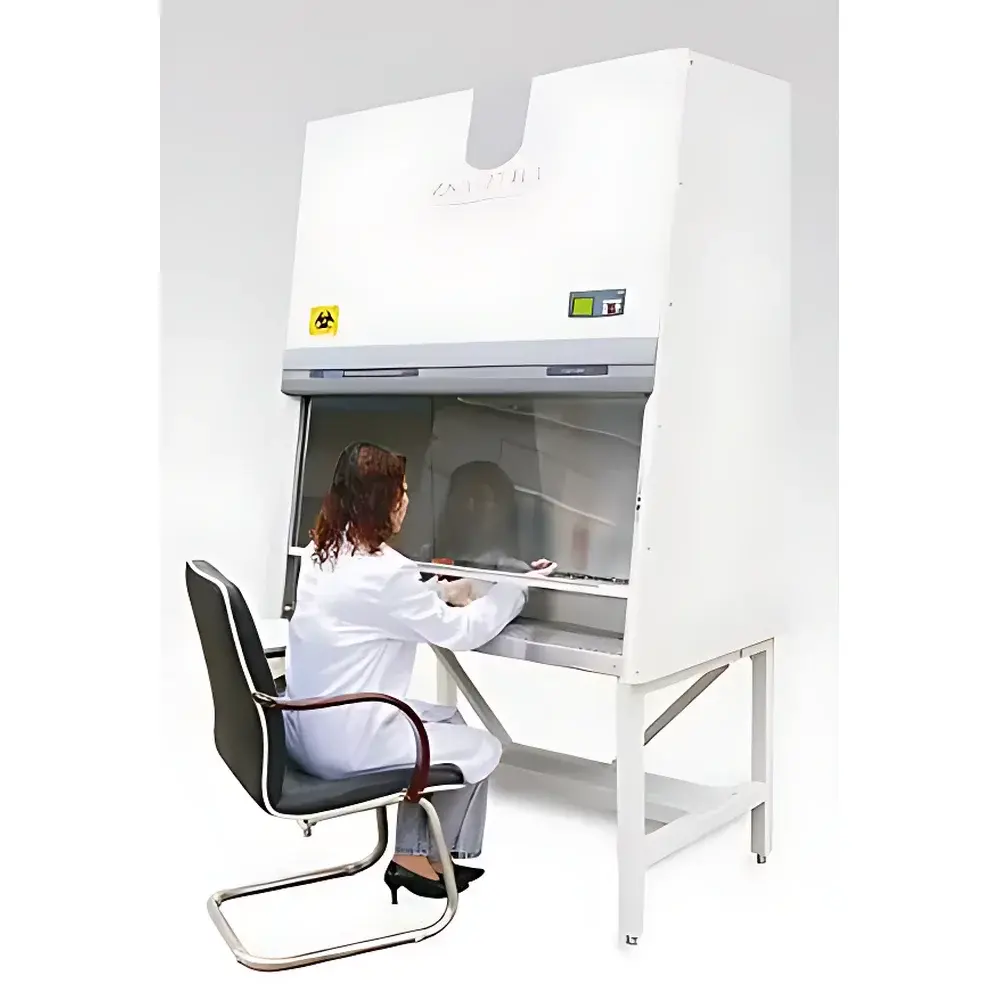
Zhicheng ZSB-1200ⅡB2 Total Exhaust Class II B2 Biological Safety Cabinet
| Brand | Zhicheng |
|---|---|
| Origin | Shanghai, China |
| Manufacturer Type | Direct Manufacturer |
| Product Category | Domestic |
| Model | ZSB-1200ⅡB2 |
| Pricing | Upon Request |
| Airflow Type | 100% Exhaust (No Recirculation) |
| Primary Filter | ULPA (≥99.999% @ 0.1–0.2 µm) |
| Exhaust Filter | HEPA (≥99.99% @ 0.3 µm) |
| Inflow Velocity | 0.5–0.6 m/s |
| Downflow Velocity | 0.25–0.5 m/s |
| Downflow Control Accuracy | ±0.015 m/s |
| Velocity Resolution | 0.01 m/s |
| Differential Pressure Range | 0–500 Pa |
| Pressure Accuracy | ±1% |
| Noise Level | <67 dB(A) |
| Vibration Half-Peak | ≤5 µm |
| Illumination | ≥650 lx |
| Working Chamber Dimensions (W×D×H) | 1230 × 635 × 655 mm |
| External Dimensions (W×D×H) | 1420 × 805 × 2370 mm |
| Net Weight | 280 kg |
| Power Supply | AC 220 V, 50/60 Hz |
| Rated Power | 1150 W |
| UV Lamp | Quartz High-Efficiency Germicidal UV Lamp |
| Compliance | Meets NSF/ANSI 49–2022 and EN 12469:2000 requirements for Class II B2 cabinets |
Overview
The Zhicheng ZSB-1200ⅡB2 is a certified Class II, Type B2 total-exhaust biological safety cabinet engineered for maximum personnel, environmental, and product protection in high-containment life science laboratories. Unlike recirculating Class II A2 cabinets, the ZSB-1200ⅡB2 operates with 100% exhausted airflow—drawing ambient air through the front work opening, passing it across the work surface, and expelling all air externally via dedicated ductwork. This configuration eliminates any risk of cross-contamination from recirculated air and ensures complete removal of aerosolized biohazards, volatile chemicals, and radionuclides. Its aerodynamic architecture employs a precisely balanced dual-fan system: one dedicated to inward inflow (personnel protection), the other to downward laminar downflow (product protection), both dynamically regulated to maintain ISO 14644-1 Class 5 (ISO Class 5) cleanliness within the work area. The cabinet complies fully with NSF/ANSI 49–2022 and EN 12469:2000 standards for Type B2 cabinets and is validated for use with Risk Group 2 and 3 agents under institutional biosafety protocols.
Key Features
- ULPA primary filter with ≥99.999% efficiency against 0.1–0.2 µm particles—including viruses, bacterial spores, and fine aerosols—integrated with real-time status monitoring and predictive failure alerts
- Dual independent centrifugal blowers: supply fan delivers stable downflow velocity (0.25–0.5 m/s, ±0.015 m/s control accuracy); exhaust fan maintains consistent inflow velocity (0.5–0.6 m/s) even under variable static pressure or filter loading
- Full-digital LCD interface displaying real-time metrics: inflow/downflow velocity, differential pressure across filters, cumulative runtime, UV lamp status, and alarm history with timestamped event logging
- Epoxy-coated stainless steel frame and seamless, radius-rounded 304 stainless steel interior chamber—electropolished finish for corrosion resistance and ease of decontamination
- Human-centered ergonomic design: 10° inclined sash window with anti-reflective, shatter-resistant laminated glass; integrated UV interlock prevents accidental exposure during operation
- Comprehensive alarm architecture: multi-layered redundancy including airflow deviation (±10% threshold), sash height violation, filter breakthrough detection, fan failure self-diagnosis, and power-loss recovery sequencing
- Pre-programmable UV disinfection cycle with adjustable duration and automatic post-cycle ventilation purge to remove ozone residues
- Integrated utility module with splash-proof GFCI outlets, recessed gas/water valves, and external-accessible drain valve for liquid containment management
Sample Compatibility & Compliance
The ZSB-1200ⅡB2 supports a broad range of biosafety-critical workflows—including cell culture, recombinant DNA manipulation, mycobacterial handling, viral transduction, and cytotoxic drug preparation—without compromising sterility or containment integrity. Its non-recirculating airflow path makes it uniquely suitable for simultaneous handling of biological and chemical hazards, satisfying dual-use requirements outlined in NIH Guidelines and CLSI MM12-A. All critical performance parameters—including inflow velocity uniformity, downflow turbulence (<10% ISO 14644-3 turbulence class), and containment integrity (via potassium iodide (KI) challenge testing per NSF/ANSI 49)—are factory-verified and documented in the Certificate of Conformance. The cabinet’s firmware and data logging functions support audit readiness for GLP, GMP, and FDA 21 CFR Part 11 compliance when paired with validated networked data archiving systems.
Software & Data Management
The embedded microcontroller runs deterministic real-time firmware with embedded EEPROM-based parameter retention and tamper-evident event logging. All operational parameters—including velocity readings, pressure differentials, UV exposure time, and alarm triggers—are timestamped and stored locally for ≥30 days. Optional RS-485 or Ethernet connectivity enables integration into centralized lab infrastructure monitoring platforms (e.g., LabVantage, Thermo Fisher SampleManager). Audit trails include user ID (via optional RFID badge reader), action type, timestamp, and pre/post-value states—fully compliant with ALCOA+ principles (Attributable, Legible, Contemporaneous, Original, Accurate, Complete, Consistent, Enduring, Available). Firmware updates are performed via secure USB authentication to prevent unauthorized modification.
Applications
This cabinet is routinely deployed in pharmaceutical QC/QA labs performing aseptic processing validation, academic virology cores handling lentiviral vectors, clinical microbiology labs processing TB sputum specimens, and contract research organizations conducting GLP-compliant toxicology assays. Its robust construction and calibrated airflow stability make it ideal for long-duration procedures such as stem cell expansion, CRISPR-Cas9 editing, and monoclonal antibody purification. Regulatory submissions referencing this model have been accepted by EMA, PMDA, and NMPA for biosimilar manufacturing facility qualification. It is also specified in WHO Laboratory Biosafety Manual (4th ed.) Annex C for BSL-3 adjunct containment where chemical compatibility is required.
FAQ
Does the ZSB-1200ⅡB2 require external ducting?
Yes. As a Class II B2 cabinet, it must be connected to a dedicated hard-ducted exhaust system with balanced make-up air supply to maintain negative room pressure and avoid backdrafting.
Can it be used for volatile organic compound (VOC) handling?
Yes—its 100% exhaust design and corrosion-resistant interior make it suitable for low-to-moderate VOC applications when paired with appropriate exhaust treatment (e.g., carbon scrubbers).
Is the ULPA filter certified to ISO 29463?
Yes—the installed ULPA filter is tested per ISO 29463-3:2017 and supplied with individual filter test reports showing fractional efficiency at MPPS (Most Penetrating Particle Size) of 0.12 µm.
What maintenance intervals are recommended?
ULPA filter replacement every 5–7 years (dependent on usage and particulate load); annual third-party certification per NSF/ANSI 49; biannual velocity and containment verification using calibrated anemometers and tracer gas methods.
Does it support remote monitoring via SNMP or Modbus?
Standard model includes Modbus RTU over RS-485; SNMP gateway integration is available via optional communication module with TLS 1.2 encrypted data transmission.
Related Products




