
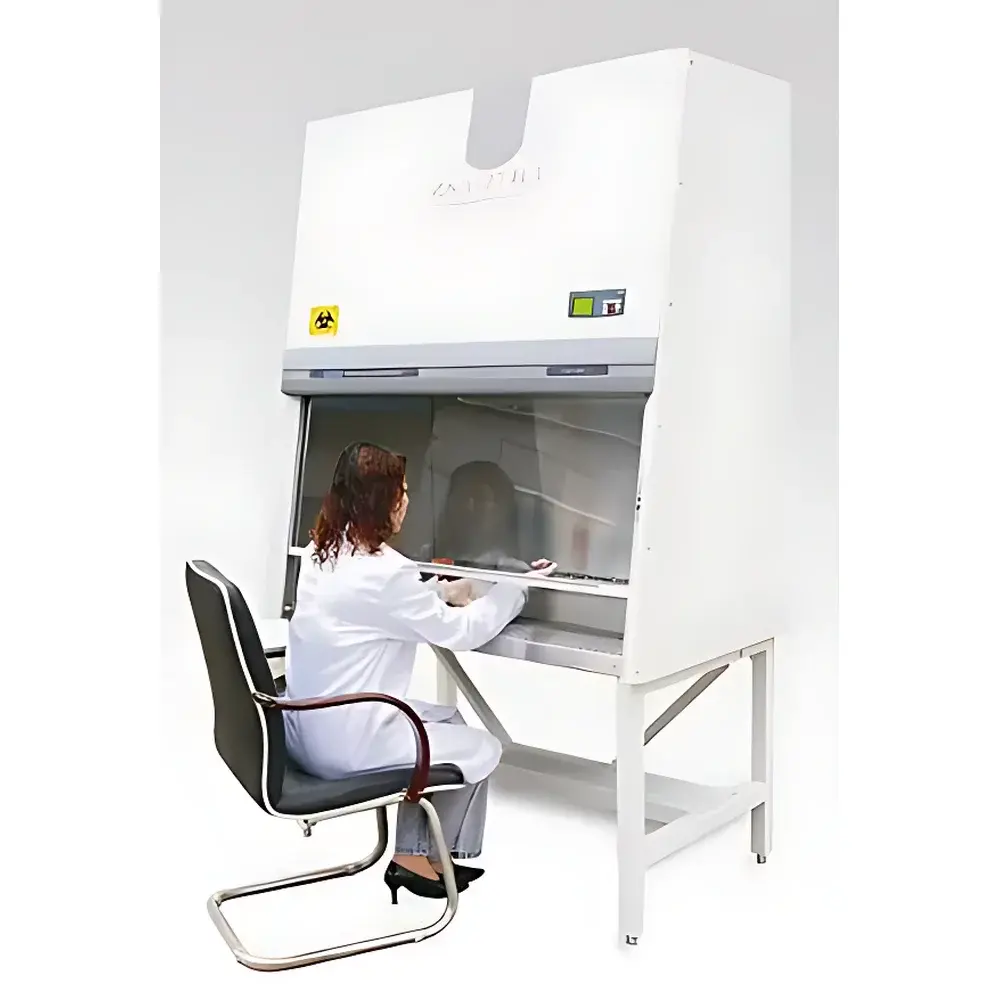
Zhicheng ZSB-1500ⅡB2 Total Exhaust Biological Safety Cabinet
| Brand | Zhicheng |
|---|---|
| Origin | Shanghai, China |
| Manufacturer Type | Direct Manufacturer |
| Product Category | Domestic |
| Model | ZSB-1500ⅡB2 |
| Pricing | Upon Request |
| Airflow Type | 100% Exhaust (Type B2) |
| Primary Filter | ULPA (≥99.999% @ 0.1–0.2 µm) |
| Exhaust Filter | HEPA (≥99.99% @ 0.3 µm) |
| Inflow Velocity | 0.5–0.6 m/s |
| Downflow Velocity | 0.25–0.5 m/s |
| Downflow Control Accuracy | ±0.015 m/s |
| Velocity Resolution | 0.01 m/s |
| Differential Pressure Range | 0–500 Pa |
| Pressure Accuracy | ±1% |
| Noise Level | <67 dB(A) |
| Vibration Half-Peak | ≤5 µm |
| Illumination | ≥650 lx |
| Work Area Dimensions (W×D×H) | 1540 × 635 × 655 mm |
| Overall Dimensions (W×D×H) | 1730 × 805 × 2370 mm |
| Net Weight | 330 kg |
| Power Supply | AC 220 V, 50/60 Hz |
| Rated Power | 1400 W |
| Operating Ambient | 10–30 °C, ≤85% RH (at 25 °C), 80–105 kPa |
Overview
The Zhicheng ZSB-1500ⅡB2 Total Exhaust Biological Safety Cabinet is a Class II, Type B2 (100% exhaust) biosafety enclosure engineered for maximum personnel, environmental, and product protection in high-containment life science laboratories. Unlike recirculating or partially exhausted cabinets, the ZSB-1500ⅡB2 draws all airflow from the laboratory environment, passes it through a ULPA primary filter to remove airborne biological agents, then directs 100% of the contaminated air—both inflow and downflow—through a dedicated ducted exhaust system. This configuration eliminates any risk of recirculation and ensures compliance with stringent biosafety requirements for work involving Risk Group 2 and 3 agents, volatile chemicals, and cytotoxic compounds. Its aerodynamic architecture is based on dual-fan, dual-duct laminar flow control, maintaining stable inflow and downflow velocities under variable lab conditions—including voltage fluctuations and increasing filter resistance—via intelligent constant-velocity regulation.
Key Features
- ULPA filtration system with ≥99.999% efficiency against particles sized 0.1–0.2 µm, certified per ISO 14644-1 Class 3 (ISO Class 3) cleanroom performance standards
- Dual independent centrifugal blowers: supply blower maintains precise downflow velocity (0.25–0.5 m/s, ±0.015 m/s control accuracy); exhaust blower delivers total airflow at >2× initial filter resistance to extend filter service life and reduce operational cost
- Full-parameter real-time monitoring via 7-inch backlit LCD interface: inflow velocity, downflow velocity, differential pressure across filters, total airflow volume, and ULPA/HEPA operational status
- Integrated safety interlock architecture: UV lamp activation is physically and electrically interlocked with sash position; exhaust and supply fans are mutually dependent with audible/visual fault alarms; sash height deviation triggers immediate alert
- Structural integrity assurance: seamless stainless steel interior with radius-rounded corners (no crevices), epoxy-coated structural frame, and dual-layer anti-reflective, UV-blocking, shatter-resistant safety glass with 10° ergonomic tilt
- Comprehensive alarm suite: ULPA/HEPA failure pre-warning and post-failure alarm, filter rupture detection, airflow instability audiovisual alert, motor self-diagnostic reporting, and scheduled UV decontamination cycle with countdown timer
- Utility integration: recessed spill-proof power outlets with protective covers, standardized water/gas quick-connect ports, and external-mounted fluorescent lighting to prevent contamination ingress
Sample Compatibility & Compliance
The ZSB-1500ⅡB2 supports open-vessel manipulations of cell cultures, recombinant DNA constructs, viral vectors, clinical specimens, and chemotherapeutic agents without cross-contamination risk. Its 100% exhaust design meets NSF/ANSI 49–2022 (Class II, Type B2) and EN 12469:2000 certification requirements for biosafety cabinet performance. The cabinet’s negative-pressure containment chamber, verified by smoke visualization and tracer gas testing, complies with ISO 15189 and CLIA guidelines for diagnostic laboratory infrastructure. All electronic controls—including audit trail-capable event logging, user-access levels, and time-stamped parameter records—support GLP and GMP environments aligned with FDA 21 CFR Part 11 data integrity expectations.
Software & Data Management
The embedded microcontroller firmware provides non-volatile storage of up to 12 months of operational logs, including date/time stamps, sash position history, airflow deviations, filter pressure differentials, and alarm events. Data export is supported via USB port in CSV format for integration into LIMS or QA documentation systems. Optional RS-485 Modbus RTU interface enables remote monitoring and centralized HVAC coordination in multi-cabinet facilities. Firmware updates are performed via secure authenticated protocol, preserving calibration integrity and traceability per ISO/IEC 17025 Clause 5.9.
Applications
This cabinet is deployed in biosafety level 2+ and level 3 laboratories conducting molecular cloning, monoclonal antibody production, vaccine development, clinical microbiology diagnostics, environmental pathogen screening, and pharmaceutical stability testing. Its chemical compatibility—validated for use with ethanol, isopropanol, formaldehyde vapor, and low-concentration hydrogen peroxide—makes it suitable for hybrid workflows combining biological and chemical hazard containment. Academic core facilities, contract research organizations (CROs), and biomanufacturing QC labs rely on its reproducible performance for ASTM D1356-20 aerosol challenge validation and routine ISO 14644-3 operational testing.
FAQ
Does the ZSB-1500ⅡB2 require external ducting?
Yes. As a Type B2 cabinet, it must be connected to a dedicated, hard-ducted exhaust system with balanced static pressure compensation to maintain certified inflow and downflow velocities.
Can this unit operate safely in rooms with variable HVAC pressure?
Yes. Its dual-blower feedback loop dynamically compensates for room pressure drift, sustaining inflow velocity within ±0.015 m/s tolerance per NSF/ANSI 49–2022 Annex A.4.3.
Is ULPA filter replacement supported on-site without specialized tools?
Yes. Filter access panels are tool-free, and gasketed retention frames ensure leak-tight reinstallation. Filter change procedures are documented in the CE-marked technical manual and include post-replacement integrity verification steps.
What regulatory documentation is provided with shipment?
Each unit ships with a Factory Acceptance Test (FAT) report, ISO 17025-accredited airflow calibration certificate, ULPA/HEPA filter test reports (per IEST-RP-CC001.4), and full NSF/ANSI 49 compliance dossier.
How is user authentication managed for critical functions like UV scheduling?
The system supports three-tier access control (Operator / Technician / Administrator) with password-protected parameter modification and mandatory electronic signature logging for all decontamination cycles.
Related Products





