
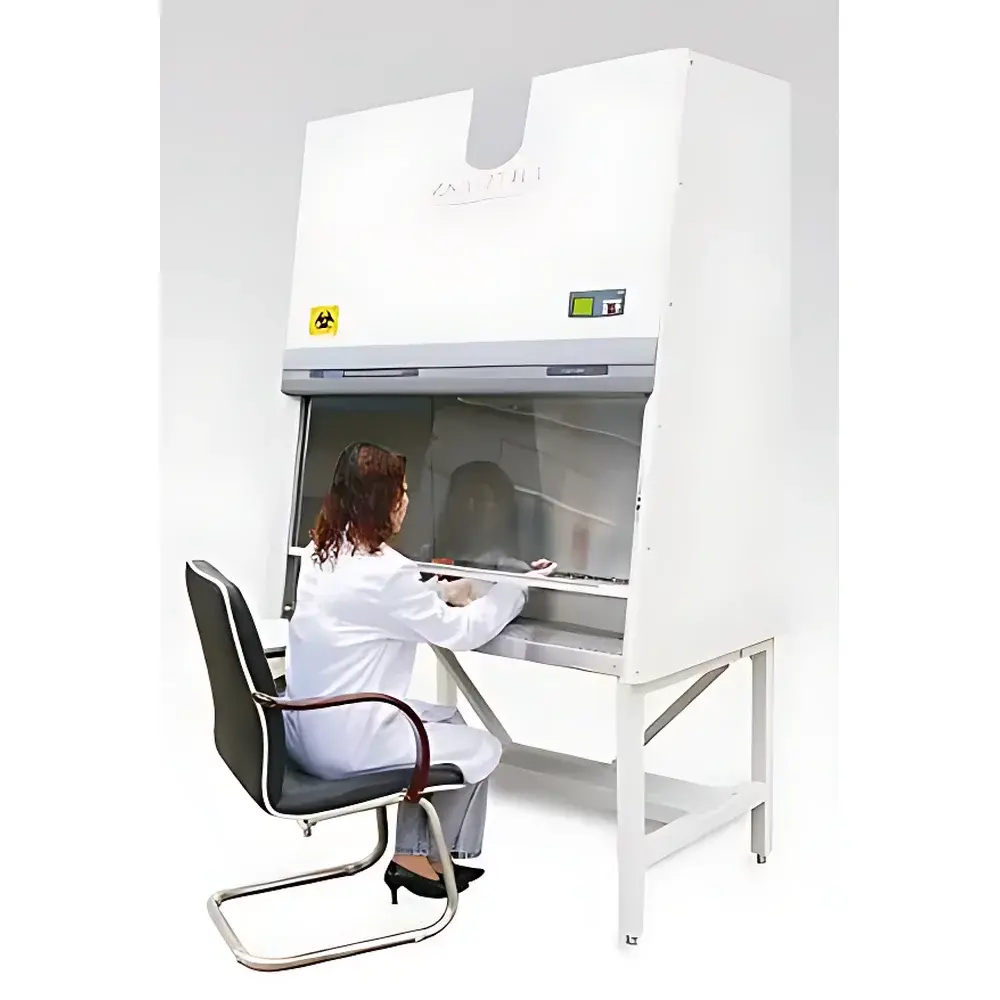
Zhicheng ZSB-1800ⅡB2 Total Exhaust Biological Safety Cabinet
| Brand | Zhicheng |
|---|---|
| Origin | Shanghai, China |
| Manufacturer Type | Direct Manufacturer |
| Product Category | Domestic |
| Model | ZSB-1800ⅡB2 |
| Pricing | Upon Request |
| Airflow Type | 100% Exhaust (No Recirculation) |
| Primary Filter | ULPA (≥99.999% @ 0.1–0.2 µm) |
| Exhaust Filter | HEPA (≥99.99% @ 0.3 µm) |
| Inflow Velocity | 0.5–0.6 m/s |
| Downflow Velocity | 0.25–0.5 m/s |
| Downflow Control Accuracy | ±0.015 m/s |
| Velocity Resolution | 0.01 m/s |
| Pressure Differential Range | 0–500 Pa |
| Pressure Accuracy | ±1% |
| Noise Level | <67 dB(A) |
| Vibration Half-Peak | ≤5 µm |
| Illumination | ≥650 lx |
| Work Area Dimensions | 1840 × 635 × 655 mm |
| Overall Dimensions | 2030 × 805 × 2370 mm |
| Net Weight | 390 kg |
| Power Supply | AC 220 V, 50/60 Hz |
| Rated Power | 1800 W |
| Operating Temperature | 10–30 °C |
| Relative Humidity | ≤85% RH (at 25 °C) |
| Atmospheric Pressure | 80–105 kPa |
Overview
The Zhicheng ZSB-1800ⅡB2 Total Exhaust Biological Safety Cabinet is a Class II, Type B2 (100% exhaust) biosafety enclosure engineered for maximum personnel, environmental, and sample protection in high-containment life science laboratories. Unlike recirculating Class II A2 cabinets, the ZSB-1800ⅡB2 draws 100% of intake air from the laboratory environment, passes it through a ULPA filter to remove airborne contaminants—including viruses, bacteria, spores, and nanoparticles—and then expels all air externally via dedicated ductwork. This configuration eliminates any risk of cross-contamination between samples or re-aerosolization of hazardous agents within the work area. The cabinet operates under continuous negative pressure relative to the surrounding lab space, ensuring inward airflow at the front access opening (inflow velocity 0.5–0.6 m/s) and laminar downward airflow (0.25–0.5 m/s) across the work surface—both dynamically maintained via constant air volume (CAV) control with real-time feedback. Its structural integrity, sealed epoxy-coated stainless steel frame, and double-layer anti-UV safety glass meet international design expectations for long-term containment reliability under ISO 14644-1 cleanroom classification and NSF/ANSI 49:2022 compliance frameworks.
Key Features
- ULPA primary filtration (≥99.999% efficiency for 0.1–0.2 µm particles) coupled with HEPA exhaust filtration (≥99.99% @ 0.3 µm), providing dual-stage particulate and microbial removal
- Constant inflow/downflow velocity regulation with ±0.015 m/s control accuracy and 0.01 m/s resolution, mitigating performance drift due to filter loading or voltage fluctuation
- Integrated multi-parameter LCD display showing real-time inflow velocity, downflow velocity, static pressure differential (0–500 Pa), filter status, UV lamp operation, and alarm history
- Dual independent fan system with interlocked supply/exhaust operation and self-diagnostic fault detection—including motor failure, belt slippage, and airflow deviation alerts
- Five-tier engineered biological safety barrier architecture: (1) physical containment via sealed stainless steel chassis; (2) negative-pressure envelope; (3) ULPA/HEPA redundancy; (4) UV interlock preventing accidental exposure during sash movement; (5) automated disinfection scheduling with timer-based irradiation cycles
- Ergonomic 10° inclined sash with anti-glare, shatter-resistant, UV-blocking laminated glass; seamless rounded-corner stainless steel interior (304 grade); removable one-piece work surface for decontamination
- Integrated liquid collection trough with drain valve; splash-proof GFCI outlets; standardized gas/water ports; external fluorescent lighting mounted outside the sterile zone to prevent contamination and simplify maintenance
Sample Compatibility & Compliance
The ZSB-1800ⅡB2 supports a broad spectrum of biosafety level (BSL)-2 and BSL-3 applications involving infectious agents, recombinant DNA constructs, cytotoxic compounds, and aerosol-generating procedures. Its fully exhausted airflow path ensures compatibility with volatile chemicals when used in conjunction with appropriate external fume hood integration per OSHA 1910.1450 and ANSI Z9.5 standards. The cabinet conforms to key regulatory benchmarks including NSF/ANSI 49:2022 (Class II, Type B2), EN 12469:2000, and GB 50346-2011 (Chinese national standard for biosafety laboratories). All electronic controls support audit-ready event logging—including door position, UV activation, filter runtime, and alarm triggers—enabling alignment with GLP, GMP, and FDA 21 CFR Part 11 data integrity requirements where applicable. Optional calibration certificates traceable to NIST standards are available upon request.
Software & Data Management
While the ZSB-1800ⅡB2 operates via embedded microcontroller logic without cloud connectivity, its onboard firmware provides comprehensive local data governance. All operational parameters—including airflow velocity trends, pressure differentials, filter usage hours, and alarm timestamps—are stored in non-volatile memory with timestamped event logs retained for ≥12 months. The system supports manual export via USB interface (optional module) for integration into institutional LIMS or electronic lab notebooks (ELN). Alarm conditions trigger simultaneous visual indicators on the LCD and audible tones (adjustable volume), with priority escalation for critical faults such as loss of inflow, sash over-height, or ULPA breach detection. User-accessible service menus allow password-protected calibration verification, sensor zeroing, and firmware version interrogation—facilitating internal QA audits and third-party validation protocols.
Applications
- Cell culture manipulation involving lentiviral transduction, CRISPR-Cas9 editing, or mycoplasma-sensitive lines
- Preparation and handling of clinical specimens (e.g., blood, sputum, tissue homogenates) in diagnostic microbiology and virology labs
- Pharmaceutical aseptic processing of monoclonal antibodies, mRNA-LNPs, and other biologics requiring chemical compatibility with ethanol, isopropanol, or hydrogen peroxide vapor
- Environmental monitoring workflows involving airborne pathogen sampling, bioaerosol characterization, and filter-based collection assays
- Electronics-grade cleanroom operations requiring ultra-low particle emission and metal-free interior surfaces for semiconductor or nanomaterial synthesis
FAQ
Does the ZSB-1800ⅡB2 require external ducting?
Yes. As a Type B2 cabinet, it must be connected to a dedicated hard-ducted exhaust system with balanced static pressure compensation to maintain certified inflow and downflow velocities.
Can this cabinet be used for volatile organic compound (VOC) work?
It is suitable for low-to-moderate VOC applications when paired with an appropriately rated external exhaust system; however, for high-concentration solvents, consult engineering controls per ANSI Z9.5 and conduct site-specific risk assessment.
What maintenance intervals are recommended for ULPA and HEPA filters?
Filter replacement frequency depends on usage intensity and ambient particulate load; typical service life ranges from 18–36 months, with mandatory integrity testing (e.g., DOP/PAO scan) performed semiannually per NSF/ANSI 49.
Is the cabinet compatible with GLP/GMP documentation requirements?
Yes—the built-in event log captures time-stamped operational and alarm data, supporting traceability; optional USB data export enables integration into validated electronic record systems.
How is UV lamp safety enforced during operation?
The UV lamp automatically deactivates when the sash is raised above the designated operating height, and manual override requires dual-key authentication to prevent unintended exposure.




