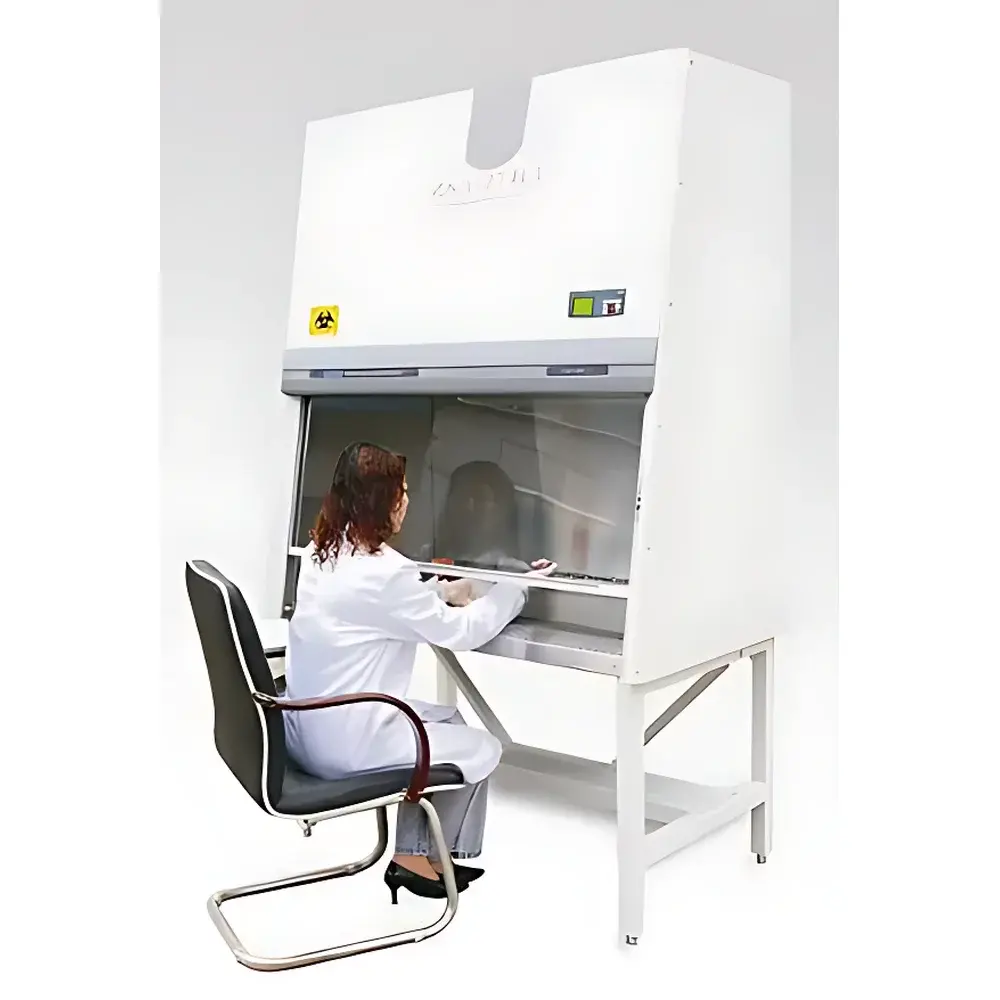
Zhicheng ZSB-900II B2 Total Exhaust (Type B2) Class II Biological Safety Cabinet
| Brand | Zhicheng |
|---|---|
| Origin | Shanghai, China |
| Manufacturer Type | Direct Manufacturer |
| Product Category | Domestic |
| Model | ZSB-900II B2 |
| Pricing | Upon Request |
| Airflow Type | 100% Exhaust (No Recirculation) |
| Primary Filter | ULPA (≥99.999% @ 0.1–0.2 µm) |
| Exhaust Filter | HEPA (≥99.99% @ 0.3 µm) |
| Inflow Velocity | 0.5–0.6 m/s |
| Downflow Velocity | 0.25–0.5 m/s |
| Downflow Control Accuracy | ±0.015 m/s |
| Velocity Resolution | 0.01 m/s |
| Differential Pressure Range | 0–500 Pa |
| Pressure Accuracy | ±1% |
| Noise Level | <67 dB(A) |
| Vibration Half-Peak | ≤5 µm |
| Illumination | ≥650 lx |
| Working Area Dimensions (W×D×H) | 930 × 635 × 655 mm |
| External Dimensions (W×D×H) | 1120 × 805 × 2370 mm |
| Net Weight | 220 kg |
| Power Consumption | 1100 W |
| Electrical Supply | AC 220 V, 50/60 Hz |
Overview
The Zhicheng ZSB-900II B2 is a fully ducted, total-exhaust Class II Biological Safety Cabinet (BSC) engineered for maximum personnel, environmental, and product protection in high-containment biosafety applications. As a Type B2 cabinet per NSF/ANSI 49–2022 and EN 12469:2000 standards, it operates with zero recirculation—100% of the air drawn into the work area is exhausted externally via dedicated ductwork. This configuration eliminates cross-contamination risk between samples and ensures absolute containment of hazardous aerosols generated during open-vessel procedures involving volatile chemicals, radionuclides, or pathogenic agents requiring Biosafety Level 2 (BSL-2) or BSL-3 compliance. The cabinet employs a dual-fan system: a dedicated supply blower delivers downward laminar airflow across the work surface at precisely controlled velocities (0.25–0.5 m/s), while an exhaust blower removes all contaminated air through a ULPA primary filter and secondary HEPA exhaust filter—both continuously monitored for integrity, pressure drop, and failure events.
Key Features
- ULPA filtration system with ≥99.999% efficiency for particles 0.1–0.2 µm, providing superior protection against viruses, mycoplasma, and ultrafine biological aerosols
- Dual independent fan architecture: supply fan maintains stable downflow velocity within ±0.015 m/s tolerance; exhaust fan generates static pressure >2× initial filter resistance to ensure long-term airflow stability and extended filter service life
- Real-time multi-parameter monitoring via high-resolution LCD display: inflow velocity, downflow velocity, cabinet differential pressure, total airflow volume, and real-time ULPA/HEPA operational status
- Patented negative-pressure containment envelope: internal chamber maintained at sustained negative pressure relative to ambient lab space; any potential leak path is actively surrounded and captured by inward-directed airflow
- Epoxy-coated stainless steel frame with integrated door gasketing ensures structural integrity and gas-tight sealing under dynamic operational conditions
- Comprehensive alarm architecture including dual-redundant low-velocity detection, sash-height violation alerts, ULPA/HEPA failure pre-warning and catastrophic breach alarms, interlocked UV lamp activation (deactivated when sash is open), and exhaust/supply fan fault diagnostics with automatic shutdown protocols
- Ergonomic design: 10° inclined, anti-glare, laminated safety glass sash with UV-blocking properties; seamless, radius-curved stainless steel interior surfaces; removable one-piece stainless steel work surface; integral liquid collection trough with drain valve
Sample Compatibility & Compliance
The ZSB-900II B2 supports open-vessel manipulations of infectious agents up to BSL-3, cytotoxic compounds, and volatile organic solvents—provided appropriate facility exhaust infrastructure is in place. It complies with international biosafety standards including NSF/ANSI 49–2022 (Class II, Type B2), EN 12469:2000, and ISO 14644-1 Class 5 (ISO Class 5) cleanroom performance criteria for downflow uniformity and particle removal efficiency. All electrical components meet IEC 61010-1 safety requirements for laboratory equipment. The cabinet’s alarm logs, parameter history, and filter lifecycle data are timestamped and stored locally, supporting GLP/GMP documentation requirements and facilitating FDA 21 CFR Part 11-compliant audit trails when integrated with validated LIMS or ELN systems.
Software & Data Management
The embedded microcontroller enables continuous logging of critical operational parameters—including airflow velocity, pressure differentials, filter delta-P, UV exposure time, and alarm event timestamps—at user-configurable intervals (1–60 min). Data export is supported via USB interface in CSV format for traceability and quality assurance review. Optional RS-485 Modbus RTU integration allows centralized monitoring across multiple cabinets in shared core facilities. All alarm states trigger visual (LED) and audible (85 dB tone) notifications, with priority escalation logic ensuring immediate operator response to critical failures such as loss of inflow velocity or ULPA breach. The system retains >30 days of historical data without external storage.
Applications
This cabinet is deployed in pharmaceutical R&D laboratories conducting sterile formulation development, clinical diagnostic sample processing under CLIA/CAP guidelines, vaccine production workflows involving live-attenuated pathogens, molecular biology labs performing CRISPR-based genome editing with airborne transfection reagents, and environmental microbiology facilities handling waterborne enteric viruses. Its total-exhaust configuration makes it suitable for concurrent use with volatile disinfectants (e.g., formaldehyde, hydrogen peroxide vapor) and for integration into HVAC systems with dedicated make-up air handling units (MAUs) to maintain room pressure cascades in BSL-2+ containment suites.
FAQ
What distinguishes a Type B2 (total exhaust) BSC from Type A2 or Type C1?
Type B2 cabinets exhaust 100% of air externally with no recirculation, eliminating cross-contamination risk and enabling safe handling of volatile toxic chemicals alongside biological agents. Type A2 recirculates ~70% of air internally; Type C1 offers partial recirculation with higher inflow velocity but still requires external ducting.
Does this cabinet require dedicated ductwork?
Yes. The ZSB-900II B2 must be connected to a hard-ducted exhaust system with balanced make-up air supply to prevent lab depressurization and ensure stable airflow performance.
Can the ULPA filter be replaced in situ without tools?
ULPA and HEPA filters are housed in quick-release frames with gasketed access panels; replacement is performed using standard PPE and follows a validated filter change protocol documented in the OEM manual.
Is the cabinet compatible with automated decontamination cycles?
Yes. The built-in timer-controlled UV sterilization function supports programmable start/stop sequences, and the sash interlock prevents UV activation unless the sash is fully closed.
What validation documentation is provided?
Each unit ships with a Factory Acceptance Test (FAT) report, airflow mapping summary, filter certification (test reports per IEST-RP-CC001), and full compliance statement referencing NSF/ANSI 49 and EN 12469 test protocols.
Related Products