
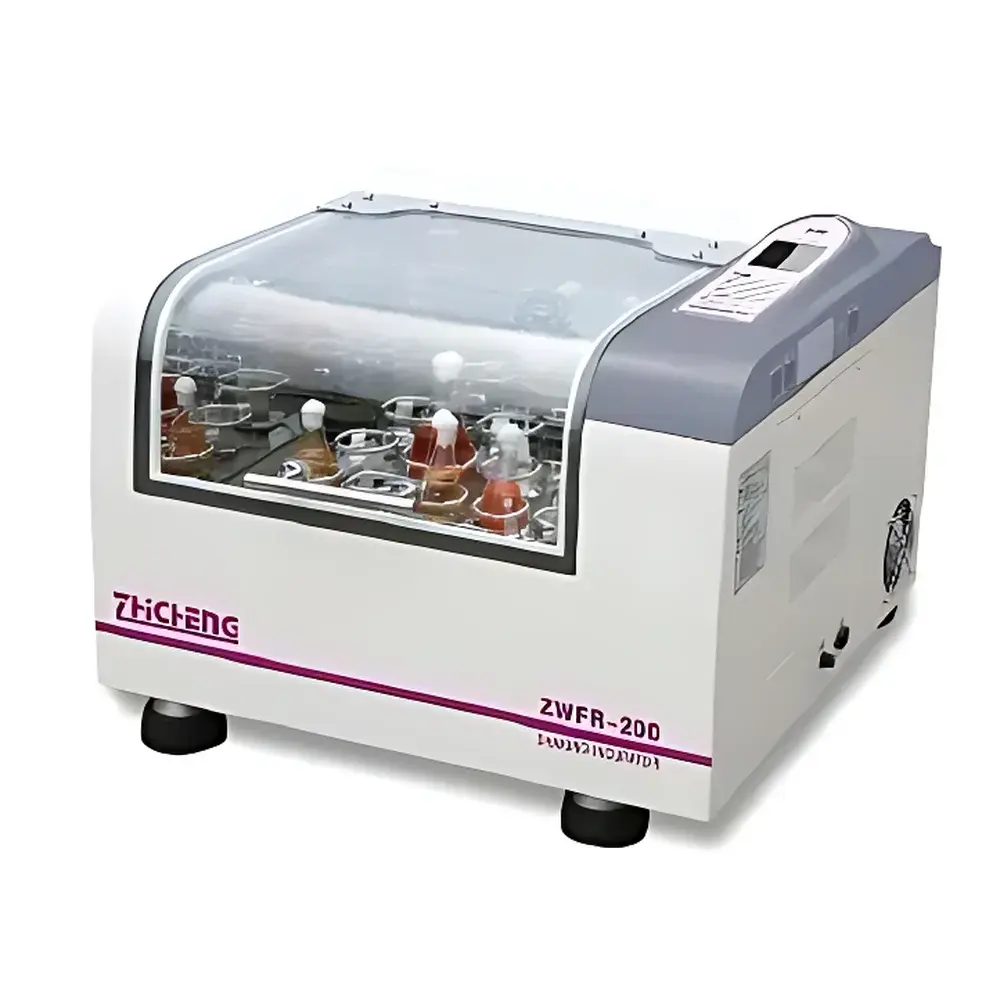
Zhicheng ZWFR-200 Benchtop Full-Color Touchscreen Reciprocal Shaker
| Brand | Zhicheng |
|---|---|
| Origin | Shanghai, China |
| Manufacturer Type | Direct Manufacturer |
| Product Category | Domestic (China-made) |
| Model | ZWFR-200 |
| Instrument Type | Reciprocal Shaker |
| Timer Range | 0–9999 min |
| Oscillation Frequency | 30–240 rpm |
| Oscillation Amplitude | 40 mm |
| Temperature Control Range | 4–60 °C |
| Shelf Quantity | 1 |
Overview
The Zhicheng ZWFR-200 Benchtop Full-Color Touchscreen Reciprocal Shaker is an engineered solution for precise, programmable, and thermally stable oscillatory incubation in life science laboratories. It operates on the principle of linear reciprocating motion—driven by a robust orbital drive mechanism—to generate uniform shear and mixing forces ideal for suspension-based biological cultures, enzymatic reactions, hybridization protocols, and cell-based assays. Unlike rotary or orbital shakers, the ZWFR-200’s reciprocating motion (±20 mm displacement per direction, total 40 mm amplitude) ensures consistent agitation across low-viscosity to moderately viscous media without vortex formation or excessive foaming. Its integrated P.I.D.-controlled forced-air thermal system maintains temperature stability within ±0.1 °C at 37 °C (typical setpoint), with uniformity ≤ ±1.0 °C across the 435 × 420 mm stainless-steel platform—enabling reproducible conditions required for GLP-compliant cell culture expansion, microbial fermentation kinetics, and molecular hybridization workflows.
Key Features
- 4.3-inch full-color TFT touchscreen (480 × 272 pixels, 65K color depth) with intuitive graphical interface supporting animated status feedback and multilingual menu navigation (English UI available via firmware configuration)
- Nine-segment, eighteen-step programmable protocol engine: each segment supports ramp (linear slope) or hold (isothermal/isofrequency) modes; time resolution 0.1 min up to 999.9 min per step; up to 99 cycles per program
- Dual-mode control architecture: selectable between fixed-parameter operation (constant temperature/frequency/timer) and dynamic program execution with temperature ramping, frequency stepping, or combined thermal–mechanical profiles
- Triple-layer safety system: (1) Personnel protection via earth-leakage circuit interrupter (ELCI) and overcurrent cutoff; (2) Sample integrity safeguard through independent hardware watchdog that halts motion/temperature if primary controller fails; (3) Equipment protection via redundant overtemperature cut-off (mechanical bimetallic limiter + electronic P.I.D. override)
- Embedded thermal printer (receipt-style, non-thermal ribbon) and RS-232 serial port for audit-trail data export—compatible with LIMS integration and 21 CFR Part 11–compliant record archiving when paired with validated software clients
- Intelligent refrigeration subsystem using R134a refrigerant with variable-speed compressor control and frost-free air-cooling design—enables uninterrupted operation down to 4 °C ambient-compensated
Sample Compatibility & Compliance
The ZWFR-200 accommodates standard laboratory vessels including Erlenmeyer flasks (up to 2 L), deep-well microplates, test tubes (13–25 mm OD), and custom-sized culture bottles secured via universal clamping rails. Its 69 L internal chamber (490 × 450 × 315 mm) and 435 × 420 mm platform support heterogeneous vessel arrangements without cross-contamination risk. The unit complies with IEC 61010-1:2010 for electrical safety in laboratory equipment and meets EN 61326-1:2013 electromagnetic compatibility requirements. Temperature and speed calibration traceability aligns with ISO/IEC 17025 principles when performed using NIST-traceable reference standards. Routine validation protocols—including temperature mapping (ASTM E2875), speed accuracy verification (ISO 20816-1), and alarm response testing—are supported by built-in diagnostics and parameter logging.
Software & Data Management
All operational parameters—including real-time temperature, actual rpm, elapsed time, and active program stage—are continuously logged to non-volatile memory with timestamping (RTC-backed). Data export occurs via RS-232 to external PCs running terminal emulation or custom Python/Excel VBA scripts; CSV-formatted output includes column headers for traceability. The embedded printer generates time-stamped hardcopy reports containing start/stop timestamps, setpoints, deviations, and alarm events—serving as primary records under FDA-regulated environments where electronic signatures are not yet implemented. Firmware supports password-protected parameter encryption (AES-128), user-level access tiers (Operator/Engineer/Admin), and power-failure recovery with automatic resumption from last valid step.
Applications
This shaker serves critical roles in regulated and research-intensive workflows: bacterial growth curve analysis (E. coli, Bacillus spp.) under controlled thermal–oscillatory stress; yeast fermentation optimization with dissolved oxygen correlation; DNA/RNA hybridization in northern/southern blotting; antibody-antigen binding kinetics in ELISA development; stem cell monolayer maintenance during expansion; and environmental microbiology (e.g., biodegradation assays under varying temperature gradients). Its programmable ramp-and-hold capability enables simulation of diurnal temperature shifts in ecological studies or gradual acclimation protocols for thermosensitive cell lines.
FAQ
What is the maximum flask size supported on the ZWFR-200 platform?
Standard configuration supports up to two 2 L Erlenmeyer flasks or four 1 L flasks using optional dual-flask clamps.
Does the unit support remote monitoring via Ethernet or Wi-Fi?
No native Ethernet/Wi-Fi module is included; however, RS-232 output can be bridged to TCP/IP networks using third-party serial-to-Ethernet converters compliant with Modbus RTU protocol.
Is calibration documentation provided with shipment?
A factory calibration certificate (traceable to CNAS-accredited lab) is included, covering temperature uniformity at 25 °C and 37 °C, speed accuracy at 100 rpm and 200 rpm, and timer linearity across 10–999 min range.
Can the shaker operate unattended overnight with safety assurance?
Yes—the triple safety architecture, combined with 9999-minute timer capacity and auto-restart after brief power interruption, permits fully autonomous 24+ hour operation under validated SOPs.
What maintenance intervals are recommended for long-term reliability?
Compressor oil inspection every 24 months; fan filter cleaning every 3 months; platform rail lubrication every 12 months using food-grade silicone grease (ISO 21469 certified).





