
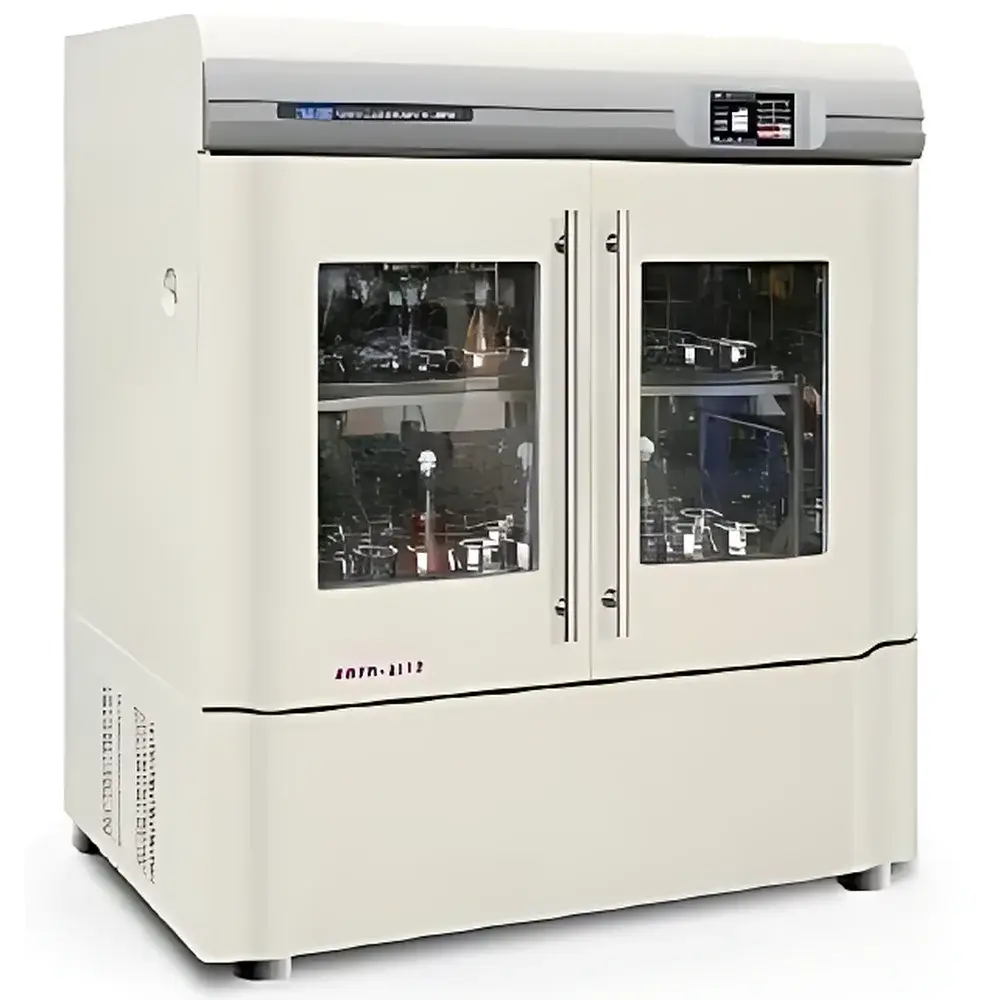
Zhicheng ZWFR-2112 Dual-Layer Full-Color Touchscreen Reciprocal Shaker
| Brand | Zhicheng |
|---|---|
| Origin | Shanghai, China |
| Manufacturer Type | Direct Manufacturer |
| Product Category | Domestic (China-Made) |
| Model | ZWFR-2112 |
| Instrument Type | Reciprocal Shaker |
| Display | 5.6-inch 640×480-pixel 65K-color TFT touchscreen |
| Control System | PID-based microcomputer environmental scanning processor |
| Temperature Range | 4–60 °C |
| Temp. Resolution | ±0.1 °C |
| Temp. Stability | ≤±0.1 °C at 37 °C |
| Temp. Uniformity | ≤±1 °C at 37 °C |
| Oscillation Mode | Reciprocal (linear back-and-forth) |
| Drive Mechanism | Orbital drive with adjustable amplitude |
| Frequency Range | 30–240 rpm |
| Speed Accuracy | ±1 rpm |
| Amplitude Adjustment | 0–50 mm, stepless |
| Timing Range | 0–9999 min |
| Programmability | 9-segment × 2-step (18-step total), each segment up to 999.9 min, up to 99 cycles |
| Safety Features | Independent overtemperature cutoff, door-open stop, leakage current protection, overload current cutoff, refrigeration compressor overload protection, dual-limit temp/speed deviation alarms |
| Cooling System | Air-cooled, R134a refrigerant, frost-free, power-regulated |
| Chamber Volume | 543 L |
| Inner Chamber Dimensions | 1106 × 625 × 850 mm |
| Shelf Dimensions | 940 × 580 mm × 2 shelves |
| Net Weight / Gross Weight | 486 kg / 562 kg |
| External Dimensions | 1430 × 865 × 1710 mm |
| Power Supply | AC 220 V, 50/60 Hz |
| Power Consumption | 1420 W |
| Additional Interfaces | Built-in thermal printer, RS-232 serial port |
Overview
The Zhicheng ZWFR-2112 Dual-Layer Full-Color Touchscreen Reciprocal Shaker is an advanced benchtop incubator-shaker engineered for high-precision, long-duration cell culture, microbial fermentation, and biochemical reaction workflows requiring simultaneous temperature control and linear oscillatory motion. Unlike orbital or rotary shakers, the ZWFR-2112 employs a precisely calibrated reciprocal (back-and-forth) oscillation mechanism—ideal for applications where shear-sensitive samples (e.g., mammalian cell monolayers, tissue explants, or immobilized enzyme reactors) demand uniform yet low-turbulence agitation. Its dual-layer chamber architecture supports independent loading of two large-format platforms (each 940 × 580 mm), enabling parallel processing of heterogeneous sample sets under identical thermal and mechanical conditions. Temperature regulation is achieved via a forced-air convection system coupled with a PID-controlled Peltier-assisted cooling module using R134a refrigerant, delivering stable setpoint maintenance across the full 4–60 °C range—with verified stability of ≤±0.1 °C at 37 °C and uniformity of ≤±1 °C across the 543 L working volume.
Key Features
- 5.6-inch high-resolution (640 × 480) 65K-color TFT touchscreen interface with intuitive graphical navigation, animated status feedback, and multilingual support (default English UI available)
- PID-based microcomputer environmental scanning controller with real-time adaptive compensation for ambient drift (5–25 °C operational environment)
- Comprehensive triple-layer safety architecture: personnel protection (leakage current interruption, overcurrent cutoff), sample protection (redundant emergency shutdown on speed/temp runaway), and equipment protection (independent overtemperature cutoff, frost-free compressor overload safeguard)
- Nine-segment, eighteen-step programmable protocol engine supporting ramp-hold sequences, repeated cycling (up to 99 iterations), temperature gradients, and time-synchronized oscillation modulation
- Six configurable operational modes: constant vs. programmed control; heating-only vs. heating/cooling; door interlock activation; power-fail recovery; parameter encryption; and embedded thermal print-on-demand
- Stepless amplitude adjustment (0–50 mm) and precise frequency control (30–240 rpm, ±1 rpm accuracy) optimized for suspension cultures, hybridization assays, and viscous media mixing
- Integrated RS-232 interface and built-in thermal printer for GLP-compliant audit trails—data export supports CSV formatting for downstream LIMS or ELN integration
Sample Compatibility & Compliance
The ZWFR-2112 accommodates standard laboratory vessels including Erlenmeyer flasks (up to 5 L), deep-well plates, roller bottles, and custom bioreactor cartridges—secured via non-slip silicone matting or optional clamping fixtures. Its large internal dimensions (1106 × 625 × 850 mm) and dual-tier design facilitate high-throughput screening without cross-contamination risk. The unit complies with IEC 61010-1:2010 for electrical safety in laboratory equipment and meets EN 61326-1:2013 electromagnetic compatibility requirements. While not certified to ISO/IEC 17025, its traceable calibration protocols—including speed verification via optical tachometer and temperature mapping per ASTM E2251-22—support internal validation under GLP and GMP frameworks. All firmware logs include timestamped event records (e.g., door openings, alarm triggers, setpoint changes), satisfying FDA 21 CFR Part 11 data integrity prerequisites when paired with validated electronic signatures.
Software & Data Management
No proprietary PC software is required for basic operation; all configuration, monitoring, and reporting are handled locally via the onboard HMI. However, the RS-232 port enables bidirectional communication with third-party laboratory information systems (LIS) or SCADA platforms using ASCII-based command protocols (documentation provided). Thermal printouts include date/time stamps, user ID (if configured), active program ID, and real-time temperature/frequency readouts—formatted to align with ISO/IEC 17025 Annex A.3 record retention standards. Parameter memory retains up to 20 user-defined profiles with password-protected access levels (administrator/operator), and automatic power-loss recovery resumes interrupted programs from last valid checkpoint—critical for unattended overnight runs exceeding 16 hours.
Applications
This shaker serves core functions in academic, clinical, and industrial life science laboratories: aerobic bacterial culture (E. coli, Bacillus spp.), yeast fermentation kinetics, hybridization stringency optimization in Southern/Northern blotting, antigen-antibody binding assays under controlled thermal ramping, and temperature-dependent protein solubilization studies. Its low-shear reciprocal motion is particularly suited for adherent cell detachment protocols, collagen gel contraction assays, and microcarrier-based stem cell expansion—where orbital motion may induce undesirable shear stress. In pharmaceutical QC labs, it supports dissolution testing per USP , extractable/leachable studies, and stability-indicating method development under ICH Q1A(R2) guidelines.
FAQ
Does the ZWFR-2112 support remote monitoring via Ethernet or Wi-Fi?
No—connectivity is limited to RS-232 serial interface. Ethernet/Wi-Fi modules are not integrated and no OEM add-ons are available.
Can the two shelves operate at different temperatures or shaking frequencies?
No—the system maintains uniform temperature and synchronized motion across both platforms; independent zone control is not supported.
Is the R134a refrigeration system serviceable in the field?
Yes—refrigerant charge and compressor diagnostics can be performed by certified HVAC-R technicians using standard manifold gauges and EPA-certified recovery equipment.
What validation documentation is supplied with the instrument?
Factory calibration certificates for temperature (NIST-traceable RTD) and speed (laser tachometer), IQ/OQ protocol templates, and a complete set of electrical safety test reports per IEC 61010-1 are included in the shipment dossier.
Are replacement thermal printer rolls available through Zhicheng’s global distribution network?
Yes—part number ZP-PRN-01 (57 mm wide, direct thermal, 30 m length) is stocked by authorized distributors in North America, EU, and APAC regions.




