
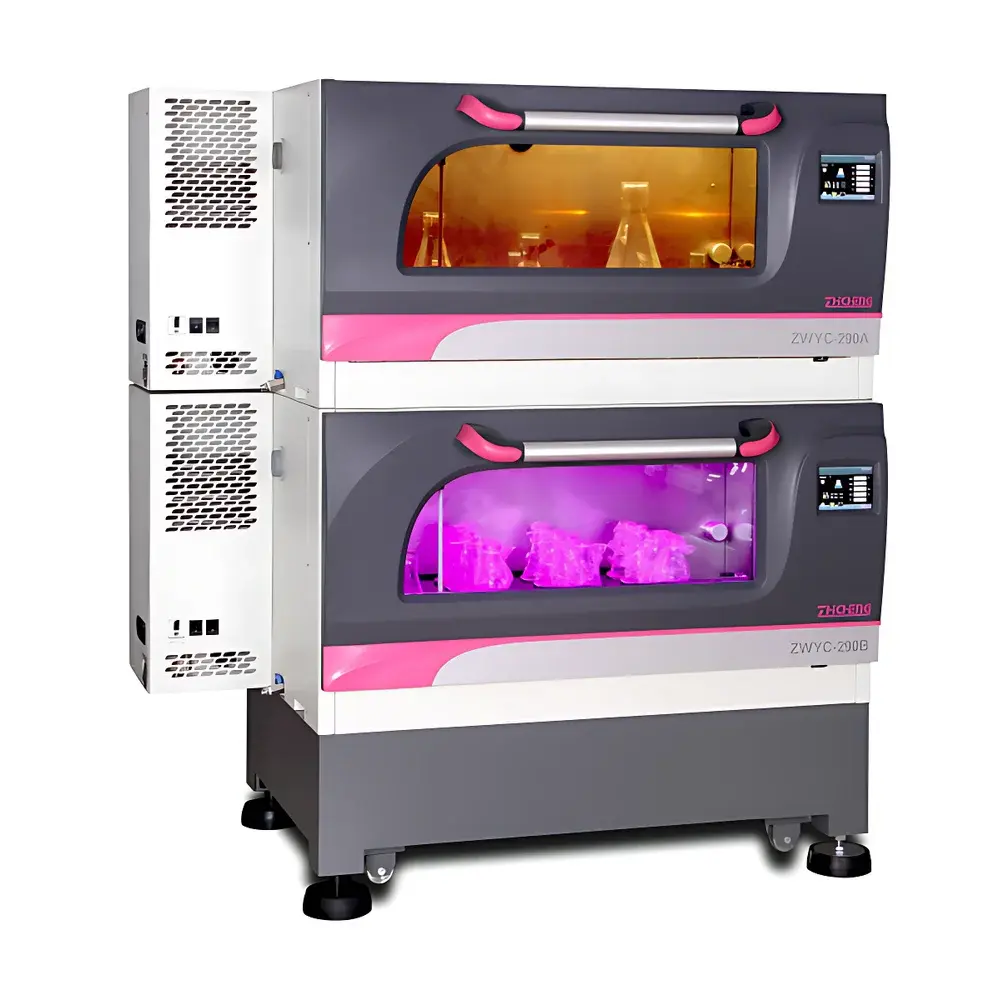
ZHICHENG ZWYC-290 Precision Cell Culture Orbital Shaker
| Brand | ZHICHENG |
|---|---|
| Origin | Shanghai, China |
| Manufacturer Type | Direct Manufacturer |
| Product Category | Domestic |
| Model | ZWYC-290 |
| Pricing Range | USD 14,000–28,000 (FOB Shanghai) |
| Instrument Type | Orbital Incubator Shaker |
| Timer Range | 0–9999 min |
| Oscillation Frequency | 30–300 rpm |
| Orbital Amplitude | 12.5 mm, 25 mm, or 50 mm (selectable) |
| Temperature Control Range | 4–60 °C |
| Shelf Capacity | 1–3 independently configurable shaker platforms |
Overview
The ZHICHENG ZWYC-290 Precision Cell Culture Orbital Shaker is an engineered platform for controlled, long-duration suspension culture of mammalian, insect, plant, and microbial cells under tightly regulated thermal, gaseous, and mechanical conditions. It operates on the principle of orbital shaking—generating uniform, low-shear fluid motion via a circular horizontal displacement of the platform—to promote efficient oxygen transfer, nutrient homogenization, and metabolite dispersion without inducing damaging hydrodynamic stress. Designed specifically for upstream bioprocessing workflows—including seed train expansion, clone screening, media optimization, and bioreactor inoculum preparation—the ZWYC-290 integrates incubation-grade temperature control with programmable oscillation dynamics, enabling reproducible cultivation across scales from microliter-scale screening to multi-liter flasks. Its architecture conforms to fundamental requirements of GLP-compliant cell banking, QC release testing, and early-stage process development in biopharmaceutical R&D laboratories.
Key Features
- Triple-amplitude orbital drive system (12.5 mm, 25 mm, 50 mm) with PID-controlled speed regulation (30–300 rpm ±1 rpm), optimized for shear-sensitive suspension cultures.
- Single-axis suspended slide-rod five-point self-balancing drive unit—engineered for continuous operation at full load, minimal energy consumption, and tolerance to asymmetric loading.
- Forced-air convection system delivering 360 m³/h airflow, ensuring ≤±0.1 °C temperature fluctuation and ≤0.2 °C uniformity at 37 °C across the chamber volume.
- Dual-stage overtemperature protection: audible/visual alarm at user-defined threshold + independent cut-off heater activation at safety limit; same logic applied to overspeed events.
- Monolithic high-density polyurethane insulated enclosure with integrated door-seal interlock and vibration-dampened mounting—reducing external noise transmission to ≤70 dB(A) at 1 m distance.
- 5.6-inch 65K-color capacitive touchscreen interface supporting curve programming (9 segments / 18 steps), timer scheduling (0–9999 min), and parameter encryption for audit-trail integrity.
Sample Compatibility & Compliance
The ZWYC-290 accommodates standard laboratory vessels including Erlenmeyer flasks (up to 3 L), roller bottles, deep-well plates, and custom bioreactor bags mounted on adhesive silicone trays (8 per shelf). Each of its 1–3 independently controllable shelves supports up to 60 × 250 mL flasks or 10 × 2000 mL vessels. The system meets essential environmental compliance benchmarks for life science instrumentation: ISO 13485-aligned manufacturing traceability, CE marking per Directive 2014/30/EU (EMC) and 2014/35/EU (LVD), and design conformity with IEC 61000-6-2/6-3 immunity/emission standards. Optional CO₂ control utilizes NDIR dual-wavelength infrared sensors certified to ASTM D6348 for gas concentration accuracy (±0.2% at 5% CO₂), while humidity modules comply with ISO 8573-1 Class 4 purity specifications for sterile air delivery. All firmware supports 21 CFR Part 11–compliant electronic signatures and audit logs when configured with optional data logging modules.
Software & Data Management
Embedded microprocessor firmware implements real-time environmental scanning and adaptive PID feedback loops for temperature, humidity, CO₂, and rotational speed. Optional wireless data acquisition enables secure TLS-encrypted transmission of operational parameters—including OD₆₀₀ readings from up to 16 parallel photometric channels—to local servers or cloud-based LIMS platforms. The system supports RS-485 Modbus RTU protocol for integration into centralized facility monitoring systems. All logged data include timestamps, operator IDs, configuration versions, and change history—fully traceable for GMP audits. Remote alerting via SMS or email is available through GSM-enabled add-on modules, triggered by deviation thresholds (e.g., temperature excursion >0.5 °C for >2 min) or hardware fault codes.
Applications
- Mammalian cell line expansion for monoclonal antibody production and viral vector manufacturing.
- High-throughput screening of recombinant protein expression hosts under varied O₂/CO₂/pH regimes.
- Plant protoplast culture and secondary metabolite induction studies requiring precise light spectrum control (LED red/blue or daylight-cycle modes).
- Microbial strain isolation and fermentation optimization using OD₆₀₀ kinetics-driven DOE experiments (4–16 channel configurations).
- Environmental microbiology applications involving aerobic wastewater consortia or biofilm precursor cultures.
- Academic teaching labs performing kinetic modeling of microbial growth, enzyme kinetics, or photosynthetic efficiency assays.
FAQ
What is the maximum allowable flask volume per shelf?
Each shelf supports up to 3000 mL total working volume—configurable as 10 × 2000 mL flasks, 18 × 1000 mL, or equivalent combinations—subject to center-of-mass balance constraints.
Does the system support sterilization-in-place (SIP) protocols?
Yes: the integrated 140 °C steam generator, UV-C irradiation duct, and drainable condensate channel enable validated chamber decontamination cycles compliant with ISO 14644-1 Class 5 cleanroom pre-use qualification.
Can multiple shelves operate at different temperatures or speeds?
No—temperature and oscillation parameters are synchronized across all active shelves; however, individual shelves may be deactivated or loaded with non-uniform vessel configurations without affecting stability.
Is the OD₆₀₀ measurement calibrated against NIST-traceable standards?
Calibration is performed using certified neutral density filters and validated against ISO 8573-1 reference suspensions; users may apply custom correction factors per wavelength (600 nm default, optional 450/540/660 nm modules available).
What power redundancy options exist for uninterrupted operation?
The unit includes automatic restart-on-power-resume functionality with non-volatile memory retention; for mission-critical applications, integration with external UPS systems (≥1500 VA) is recommended and fully supported.
Related Products




