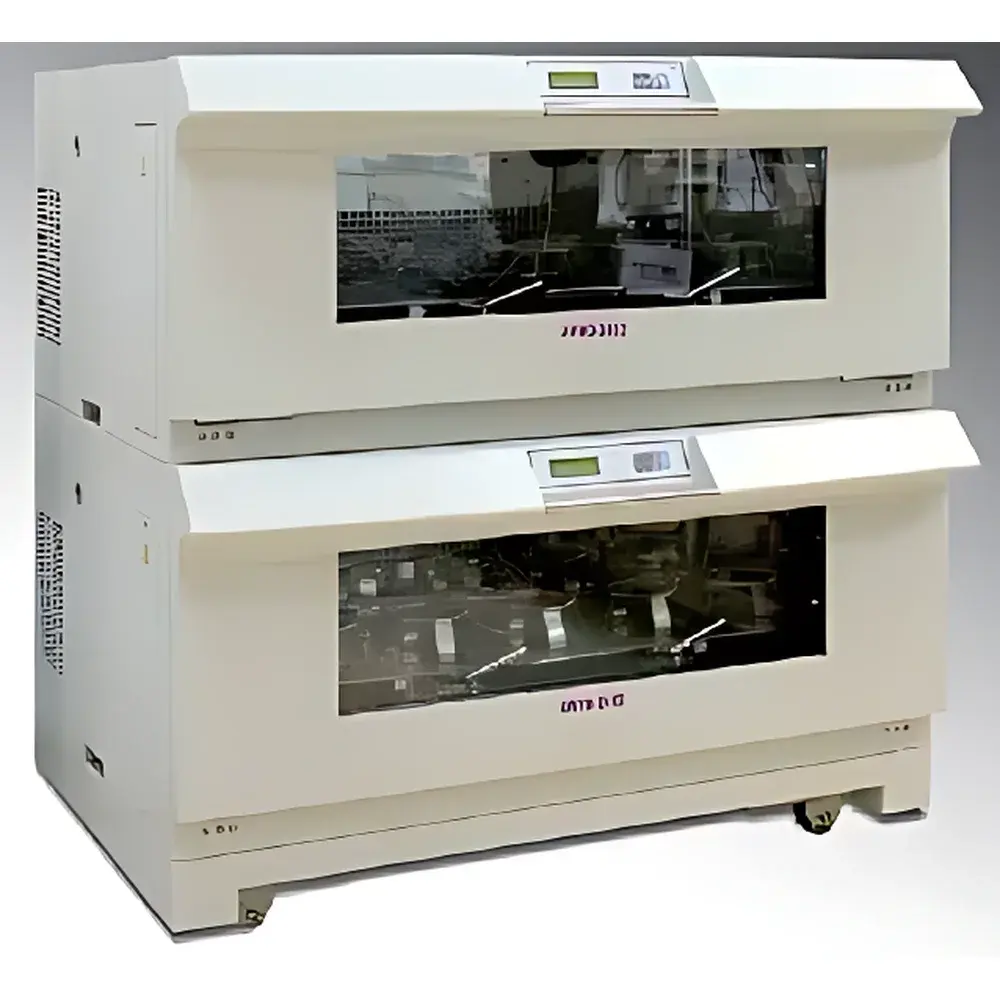
Zhicheng ZWYD-2402 Dual-Stacked Orbital Incubator Shaker
| Brand | Zhicheng |
|---|---|
| Origin | Shanghai, China |
| Manufacturer Type | Direct Manufacturer |
| Product Category | Domestic (China-Made) |
| Model | ZWYD-2402 |
| Instrument Type | Dual-Unit Stacked Orbital Shaker with Independent Temperature Control |
| Display | LCD (Chinese UI) |
| Control System | PID Microprocessor-Based Environmental Scanning Controller |
| Chamber Count | 2 Independent Units |
| Temperature Range | 4–60 °C |
| Temp. Resolution | 0.1 °C |
| Temp. Stability | ±0.1 °C at 37 °C |
| Temp. Uniformity | ±1.0 °C at 37 °C |
| Orbital Speed Range | 30–300 rpm |
| Speed Accuracy | ±1 rpm |
| Orbit Diameter | 0–50 mm (Continuously Adjustable) |
| Tray Dimensions | 800 × 430 mm |
| Max Load Capacity | 250 mL × 64 or 500 mL × 52 or 1000 mL × 28 or 2000 mL × 16 |
| External Dimensions (W×D×H) | 1100 × 950 × 1310 mm |
| Net Weight | 407 kg |
| Power Supply | AC 220 V, 50/60 Hz |
| Total Power Consumption | 2400 W |
| Cooling Method | Air-Cooled R134a Refrigeration System with Frost-Free Operation |
| Safety Features | Dual Independent Over-Temp Protection, Leakage & Over-Current Circuit Breaker, Emergency Shutdown via Backup Actuator, Door Interlock Switch, Low-Water & Sensor-Fault Alarms |
| Programmability | 9-segment / 18-step temperature & speed ramping |
| Timer | 0–9999 min |
| Optional Interfaces | RS-232 Serial Port, Embedded Thermal Printer |
| Construction | 304 Stainless Steel Interior with Rounded Corners |
| Acceleration Profile | Soft-Start Ramp Control |
Overview
The Zhicheng ZWYD-2402 Dual-Stacked Orbital Incubator Shaker is an engineered solution for space-constrained laboratories requiring high-density, multi-condition cultivation and mixing capabilities. Designed around a vertically integrated dual-chamber architecture, this instrument delivers two fully independent orbital shaker environments within a single footprint—effectively doubling throughput without expanding floor space. Each chamber operates with autonomous control over temperature (4–60 °C), orbital speed (30–300 rpm), and oscillation amplitude (0–50 mm continuous adjustment), enabling parallel experiments under divergent physiological or biochemical conditions. Its measurement principle relies on precision-controlled orbital motion combined with forced-air convection heating and refrigeration, ensuring thermal homogeneity and mechanical reproducibility critical for sensitive cell cultures, microbial fermentations, and enzyme kinetics studies. The system employs a PID-based microprocessor controller with environmental scanning logic to dynamically compensate for ambient fluctuations (10–35 °C operating range), maintaining stability of ±0.1 °C at 37 °C and uniformity within ±1.0 °C across the chamber volume.
Key Features
- Dual independent incubation chambers stacked vertically—maximizes lab space efficiency while preserving experimental isolation.
- LCD display with native Chinese interface for intuitive real-time monitoring and parameter entry (setpoint vs. actual values).
- PID microprocessor controller with environmental scanning algorithm ensures adaptive thermal regulation and speed consistency.
- Three-tier safety architecture: personnel protection (leakage/over-current circuit breaker), sample integrity (backup emergency shutdown upon speed/temperature runaway), and facility safeguarding (independent over-temperature cutoff, frost-free refrigeration with R134a).
- 304 stainless steel interior with seamless rounded corners and corrosion-resistant construction compliant with GLP-aligned cleaning protocols.
- Patented soft-closing door mechanism reduces mechanical shock during loading/unloading and enhances sealing integrity.
- High-torque, low-noise drive system with programmable soft-start acceleration minimizes shear stress on fragile samples.
- Orbital amplitude continuously adjustable from 0 to 50 mm—supports diverse vessel types including flasks, deep-well plates, and bioreactor bags.
- Comprehensive programmability: up to 9 segments / 18 steps for temperature-speed profiles; timer range 0–9999 minutes; automatic power recovery after interruption.
- Configurable security layer: password-protected parameter modification, encrypted data retention, and audit-ready operational logs.
Sample Compatibility & Compliance
The ZWYD-2402 accommodates standard laboratory vessels ranging from 250 mL Erlenmeyer flasks (64 units per tray) to 2000 mL carboys (16 units), with tray dimensions of 800 × 430 mm supporting custom adapter plates. Its 304 stainless steel chamber and non-porous gasket design meet ISO 14644-1 Class 7 cleanroom compatibility requirements for controlled environment applications. While not certified to IEC 61000-6-3 or UL 61010-1 out-of-the-box, the unit incorporates design elements aligned with FDA 21 CFR Part 11 data integrity expectations—including parameter memory with timestamped recall, tamper-evident configuration locks, and optional RS-232 output for external logging. It is routinely deployed in GLP-compliant QC labs for microbial growth validation, vaccine adjuvant mixing, and recombinant protein expression workflows where traceable, repeatable agitation is mandatory.
Software & Data Management
Data handling is implemented through embedded firmware rather than external PC software. All operational parameters—including setpoints, real-time sensor readings, alarm events, and timer states—are retained in non-volatile memory and persist through power cycles. The LCD interface provides direct access to calibration offset adjustments for temperature sensors (±5.0 °C range), enabling on-site verification against NIST-traceable reference probes. Optional RS-232 serial connectivity supports integration with LIMS or SCADA systems for automated data capture, while the embedded thermal printer generates time-stamped hardcopy records of run completion, fault triggers, and final condition snapshots—satisfying documentation requirements under ISO/IEC 17025 Clause 7.7 and USP analytical instrument qualification frameworks.
Applications
This shaker serves as a core platform in academic research labs studying aerobic bacterial metabolism, mammalian suspension cell expansion, and yeast-based bioproduction. In pharmaceutical development, it supports dissolution testing of extended-release formulations, antigen-antibody conjugation under controlled shear, and stability-indicating assays per ICH Q5C guidelines. Food safety labs utilize its dual-zone capability for comparative pathogen growth modeling (e.g., Salmonella vs. Listeria at differential temperatures), while environmental microbiology groups apply it to soil slurry enrichment and bioremediation kinetic profiling. Its precise amplitude control and low vibration transmission also make it suitable for hybridization steps in nucleic acid purification kits and gentle resuspension of cryopreserved primary cells.
FAQ
Does the ZWYD-2402 support remote monitoring or Ethernet connectivity?
No—network connectivity is limited to optional RS-232 serial output. Ethernet, Wi-Fi, or cloud-based telemetry are not supported.
Can both chambers operate at different temperatures and speeds simultaneously?
Yes—each chamber has fully independent PID controllers, allowing concurrent operation at distinct setpoints for temperature, speed, and amplitude.
Is the refrigeration system validated for sub-ambient operation?
The unit achieves stable operation down to 4 °C using air-cooled R134a compression; however, no factory-issued IQ/OQ documentation is provided for sub-ambient validation.
What maintenance intervals are recommended for the drive mechanism and refrigeration system?
Zhicheng recommends biannual inspection of belt tension and condenser coil cleaning; compressor oil analysis is advised every 24 months under continuous operation.
Are third-party calibration certificates available for purchase?
Yes—NIST-traceable temperature and speed calibration certificates can be ordered separately, including uncertainty budgets per ISO/IEC 17025 requirements.
Related Products