
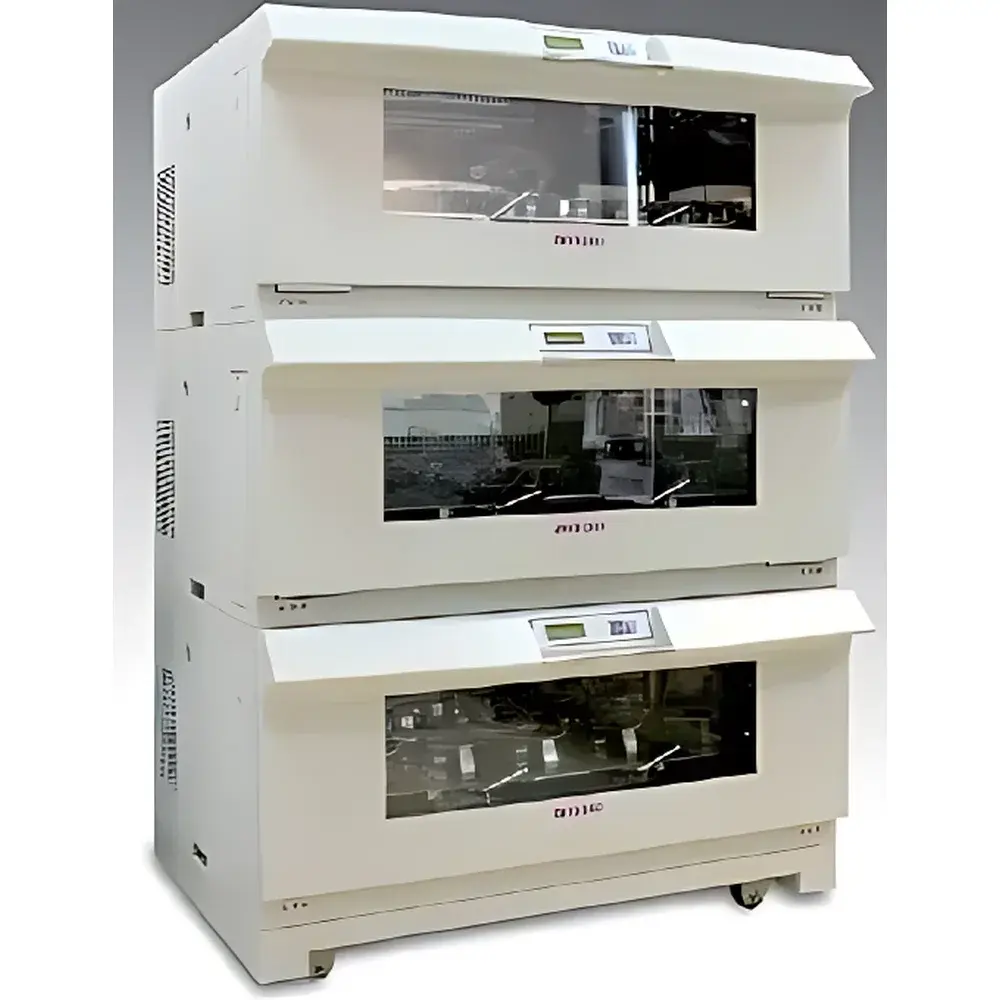
Zhicheng ZWYD-2403 Triple-Stacked LCD-Controlled Orbital Shaker
| Brand | Zhicheng |
|---|---|
| Origin | Shanghai, China |
| Manufacturer Type | Direct Manufacturer |
| Product Category | Domestic (China-Made) |
| Model | ZWYD-2403 |
| Instrument Type | Multi-Unit Stacked Orbital Shaker |
| Display | LCD with Full Chinese UI (Operator Interface) |
| Control System | PID Microprocessor-Based Environmental Scanning Controller |
| Chamber Material | 304 Stainless Steel with Rounded Corners |
| Drive Mechanism | Single-Axis Balanced Drive |
| Air-Cooled Refrigeration | R134a, Frost-Free, Power-Modulated |
| Temperature Range | 4–60 °C |
| Temp. Resolution | 0.1 °C |
| Temp. Uniformity | ±1 °C @ 37 °C |
| Temp. Stability | ±0.5 °C @ 37 °C |
| Orbit Diameter | Φ0–50 mm (Continuously Adjustable) |
| Speed Range | 30–300 rpm |
| Speed Accuracy | ±1 rpm |
| Programmable Ramp/Soak | 999.9 min/segment |
| Timer Range | 9999 min |
| Chamber Count | 3 Independent Units |
| Tray Dimensions | 800 × 430 mm per unit |
| Max Load Capacity | 96 × 250 mL or 78 × 500 mL or 42 × 1000 mL flasks |
| External Dimensions (W×D×H) | 1100 × 950 × 1620 mm |
| Net Weight | 550 kg |
| Power Supply | AC 220 V, 50/60 Hz |
| Total Power Consumption | 3600 W |
| Safety Systems | Dual Independent Overtemperature Cutouts (Adjustable & Fixed), Leakage Current Protection, Overcurrent Trip, Motor Overspeed Lockout, Door Interlock, Low-Water Alarm, Sensor Fault Detection, Compressor Overload Protection, Auto-Recovery After Power Failure |
| Optional Accessories | Embedded Thermal Printer, RS232 Communication Port |
Overview
The Zhicheng ZWYD-2403 Triple-Stacked LCD-Controlled Orbital Shaker is an engineered solution for space-constrained laboratories requiring high-density, multi-zone environmental control in microbial culture, enzymatic assays, hybridization protocols, and cell-based studies. Unlike conventional single-chamber shakers, this system integrates three independent orbital shaking units vertically stacked into a single footprint—effectively tripling throughput without expanding floor space. Each chamber operates autonomously with full PID-regulated temperature control (4–60 °C), programmable orbital motion (30–300 rpm), and continuously adjustable amplitude (Φ0–50 mm), enabling simultaneous optimization of disparate experimental conditions within one instrument. Its forced-air refrigeration system—utilizing environmentally compliant R134a and frost-free power-modulated cooling—ensures stable low-temperature operation down to 4 °C, critical for cold-sensitive protein expression or synchronized bacterial growth phases. The unit employs a single-axis balanced drive mechanism with soft-start acceleration to minimize mechanical stress on cultures and reduce long-term wear. All operational parameters—including real-time temperature, speed, elapsed time, and alarm status—are displayed via a high-contrast LCD interface with native Chinese language support, facilitating intuitive use in domestic research and QC environments.
Key Features
- Triple independent orbital chambers with fully decoupled PID temperature and speed control per unit
- LCD operator interface with bilingual (Chinese-English firmware-ready) display and real-time parameter feedback
- Continuous amplitude adjustment (Φ0–50 mm) via patented mechanical linkage—enabling precise tuning of shear forces for suspension cultures or biofilm formation studies
- 304 stainless steel interior with seamless rounded corners and electropolished finish for corrosion resistance and simplified cleaning under GLP-compliant workflows
- Three-tier safety architecture: personnel protection (leakage current cutoff, overcurrent trip), sample integrity safeguards (backup emergency shutdown upon sensor failure or thermal runaway), and asset protection (dual-stage overtemperature cutouts, compressor overload monitoring)
- Fully programmable ramp-and-soak profiles (999.9 min/segment) and extended timer function (up to 9999 min) for unattended overnight or multi-day incubation cycles
- Door interlock system with buffered closure mechanism to prevent accidental opening during high-speed operation
- Drawer-style removable trays (800 × 430 mm each) supporting standardized flask configurations: up to 96 × 250 mL, 78 × 500 mL, or 42 × 1000 mL vessels per chamber
- Power-fail recovery mode with automatic restart and parameter retention, ensuring protocol continuity after grid interruptions
- RS232 serial port for external data logging and integration with LIMS or laboratory automation platforms
Sample Compatibility & Compliance
The ZWYD-2403 accommodates a broad range of biological containers—from Erlenmeyer flasks and baffled bottles to deep-well plates and custom bioreactor vessels—thanks to its large tray surface area and adjustable clamping options. Its uniform temperature distribution (±1 °C at 37 °C) and tight speed regulation (±1 rpm) meet the reproducibility requirements of ISO 20387:2018 (Biobanking) and ASTM E2500-13 (Verification of Pharmaceutical Equipment). While not certified to IEC 61010-1 or UL 61010B out-of-the-box, the device incorporates design elements aligned with these standards—including reinforced grounding, double-insulated heating circuits, and Class I electrical protection. Its embedded safety logic supports audit-ready documentation when paired with optional thermal printer output or RS232-connected data acquisition systems compliant with FDA 21 CFR Part 11 (electronic records/signatures) when validated in-house.
Software & Data Management
The onboard microcontroller implements a deterministic real-time loop for closed-loop temperature and speed regulation, eliminating reliance on external PCs for core functionality. Parameter settings—including setpoints, timers, and alarm thresholds—are stored in non-volatile memory with password-protected access levels (operator vs. administrator). Optional RS232 connectivity enables bidirectional communication with third-party software for automated calibration logging, trend analysis, and electronic batch record generation. When equipped with the embedded thermal printer, the system generates time-stamped hardcopy reports containing start/stop timestamps, maximum deviation alerts, and final equilibrium status—supporting traceability in GMP-aligned microbiology labs and academic core facilities.
Applications
- Bacterial and yeast fermentation under controlled oxygen transfer rates (via amplitude/speed modulation)
- Low-temperature induction of recombinant protein expression in E. coli strains
- Hybridization kinetics in nucleic acid probe development
- Enzyme activity profiling across thermal gradients and agitation intensities
- Cell suspension culture for monoclonal antibody production screening
- Environmental microbiology assays requiring parallel incubation at differential temperatures (e.g., psychrophilic vs. mesophilic isolates)
- Pharmaceutical stability testing per ICH Q1A(R2) guidelines using multi-point temperature mapping
- Food safety validation studies involving pathogen enrichment under variable shear conditions
FAQ
Is the ZWYD-2403 suitable for CO₂-controlled applications?
No—this model lacks gas-tight sealing and CO₂ injection capability. It is designed for ambient-air orbital shaking only.
Can all three chambers operate at different temperatures simultaneously?
Yes—each chamber features independent PID controllers, allowing discrete setpoints across the 4–60 °C range.
What is the maximum flask size supported per tray?
The standard configuration accommodates up to forty-two 1000 mL Erlenmeyer flasks per chamber, secured using universal spring-loaded clamps.
Does the unit comply with electromagnetic compatibility (EMC) directives for EU deployment?
As a domestically certified instrument, it carries CCC marking but does not hold CE or UKCA certification; users must perform local EMC verification per EN 61326-1 prior to installation in regulated EU facilities.
How is temperature calibration performed?
The system includes user-accessible offset correction (±9.9 °C range) against a NIST-traceable reference thermometer; full factory calibration requires authorized service technician intervention.




