
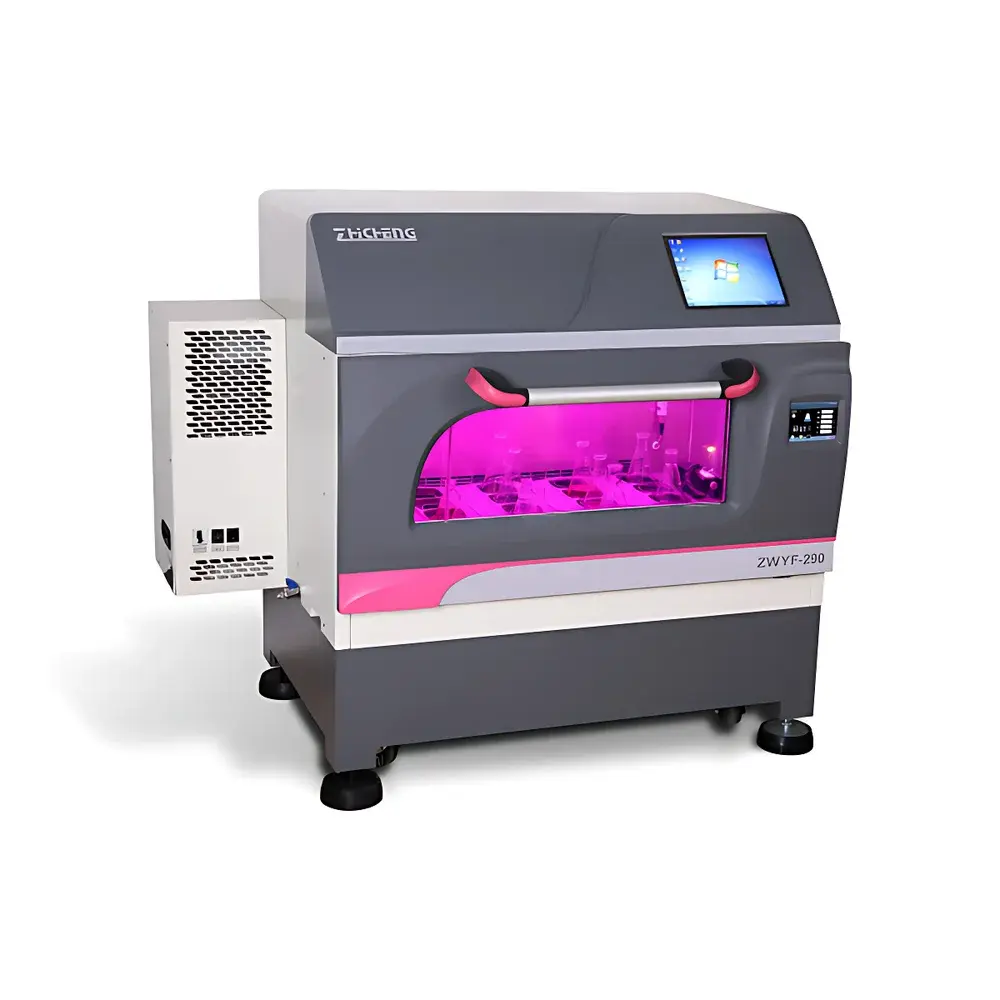
Zhicheng ZWYF-290 Intelligent OD Monitoring Bioreactor with Integrated Shaking Platform
| Brand | Zhicheng |
|---|---|
| Origin | Shanghai, China |
| Manufacturer Type | Direct Manufacturer |
| Instrument Category | Benchtop Incubated Orbital Shaker with In Situ Optical Density Detection |
| Model | ZWYF-290 |
| Pricing Range | USD 28,000 – 70,000 |
| Timer Range | 0–500 h |
| Oscillation Frequency | 30–300 rpm |
| Orbit Diameter | Φ0–50 mm (infinitely adjustable) |
| Temperature Control Range | 4–60 °C |
| Shelf Configuration | Single-tier platform |
| Optical Detection Channels | 4 / 8 / 12 / 16 (user-selectable) |
| Light Source Wavelength | 580–600 nm (narrowband LED or laser diode) |
| OD₆₀₀ Measurement Range | 0.03–2.5 |
| OD₆₀₀ Accuracy at OD = 1.0 | ±0.03 |
| OD Stability (8 h, OD = 1.0) | ≥95% |
| Sampling Interval | Configurable down to 2 min |
| Continuous Data Logging Duration | >10 h |
| Display | 5.6″ 640×480 65K-color TFT touchscreen |
| Control Algorithm | PID with environmental scan microprocessor |
| Air Circulation | Forced convection |
| Cooling System | R134a-based refrigeration, frost-free, power-regulated |
| Safety Features | Dual independent overtemperature cutoffs, overspeed alarm, sensor fault detection, leakage protection, current trip, door–platform interlock, auto-restart after power recovery |
| Power Input | AC 220 V, 50/60 Hz |
| Rated Power | 1400 W |
| Net Weight | 93 kg |
| Internal Chamber Dimensions (L×W×H) | 937 × 572 × 420 mm |
| External Dimensions (L×W×H) | 1320 × 960 × 590 mm |
Overview
The Zhicheng ZWYF-290 Intelligent OD Monitoring Bioreactor integrates precision orbital shaking with non-invasive, real-time optical density (OD) measurement for microbial, mammalian, and plant cell culture under controlled temperature and agitation conditions. Unlike conventional shakers requiring manual sampling and off-line spectrophotometric analysis, the ZWYF-290 employs a multi-channel, in situ photometric detection system operating in the 580–600 nm spectral band—optimized for bacterial and yeast growth monitoring at OD600. The system utilizes collimated light transmission through standard 150 mL or 250 mL conical flasks placed directly on the oscillating platform, enabling continuous, contactless quantification of suspended biomass without perturbation to culture integrity or sterility. Its engineered optical path compensates for mechanical vibration-induced signal noise, maintaining ≥95% measurement stability over 8-hour continuous operation even at 250 rpm—a critical performance benchmark for kinetic studies under dynamic bioprocessing conditions.
Key Features
- Non-invasive, multi-channel OD600 monitoring (4/8/12/16 configurations) enabling parallel experimental design including DoE, orthogonal arrays, and uniformity testing
- PID-controlled temperature regulation (4–60 °C) with ≤±0.1 °C setpoint accuracy, ≤±0.2 °C uniformity, and ≤±0.1 °C short-term fluctuation—validated per ISO 20387 Annex B for biobanking-grade thermal consistency
- Orbital shaking with infinitely adjustable orbit diameter (Φ0–50 mm) and precise speed control (30–300 rpm, ±1 rpm tolerance), supporting both low-shear suspension cultures and high-aeration microbial fermentations
- Integrated 5.6″ high-resolution touchscreen interface with embedded data logging, curve visualization, and parameter encryption—designed for GLP-compliant experimental documentation
- Frost-free refrigeration using R134a with power-modulated cooling, ensuring stable sub-ambient operation down to 4 °C without condensation or thermal shock to cultures
- Comprehensive safety architecture: dual independent overtemperature cutoffs, overspeed alarm, sensor diagnostics, leakage protection, and door–platform interlock compliant with IEC 61010-1:2010 for laboratory equipment
- RS-485 serial interface with EMI-hardened signal conditioning, enabling robust integration into centralized lab automation networks and LIMS environments
Sample Compatibility & Compliance
The ZWYF-290 is validated for use with standard microbiological and cell culture vessels—including 150 mL and 250 mL borosilicate conical flasks—without modification to vessel geometry or material. Its optical detection system maintains linearity across OD600 = 0.03–2.5, meeting the dynamic range requirements specified in ASTM E275-22 (Standard Practice for Describing and Measuring Performance of Spectrophotometers). The instrument conforms to ISO/IEC 17025:2017 general requirements for competence of testing and calibration laboratories when used in method validation workflows. Its firmware supports audit-trail-enabled data capture, satisfying FDA 21 CFR Part 11 criteria for electronic records and signatures when deployed in regulated biopharmaceutical development settings. The device operates within ambient temperature limits of 5–35 °C and meets electromagnetic compatibility (EMC) standards per EN 61326-1:2013 for laboratory use in shared instrumentation suites.
Software & Data Management
Data acquisition and visualization are managed via an embedded Linux-based OS with timestamped, CSV-exportable logs synchronized to internal RTC. Each channel records OD600, temperature, RPM, and elapsed time at user-defined intervals (minimum 2-minute resolution). The system supports up to 10 hours of continuous logging without external storage; extended sessions require RS-485 connection to a host PC running Zhicheng’s optional BioTrack Suite—compatible with Windows 10/11 and MATLAB® scripting interfaces. All datasets include metadata tags (operator ID, experiment name, protocol version) and support post-acquisition normalization against blank baselines. Exported files comply with MIAME (Minimum Information About a Microarray Experiment) metadata conventions for cross-platform reproducibility. Audit trails record all parameter changes, user logins, and system events with immutable timestamps—enabling full traceability during regulatory inspections.
Applications
- Kinetic modeling of microbial growth phases (lag, exponential, stationary, decline) under varying nutrient, pH, or oxygen transfer conditions
- High-throughput strain screening and media optimization via multi-channel parallel cultivation
- Process parameter mapping for fermentation scale-up, including agitation–aeration interaction studies
- Cell viability correlation assays when paired with fluorescent dyes (e.g., propidium iodide) using wavelength-flexible detector modules
- Enzyme activity profiling via absorbance shifts at alternative wavelengths (optional 405 nm or 340 nm source upgrades)
- Teaching laboratory implementation for undergraduate bioprocess engineering curricula requiring real-time quantitative feedback
- Environmental microbiology applications including wastewater biofilm kinetics and bioremediation consortium monitoring
FAQ
What flask types and volumes are supported for OD measurement?
Standard 150 mL and 250 mL borosilicate Erlenmeyer flasks are validated; custom geometries require recalibration using Zhicheng’s OD Reference Kit.
Can the system operate unattended for multi-day experiments?
Yes—continuous operation up to 500 hours is supported with battery-backed RTC and automatic power-resume functionality after grid interruption.
Is the optical detection system compatible with turbid or pigmented cultures?
The 580–600 nm band minimizes interference from common culture pigments (e.g., carotenoids); for highly colored samples, users may apply baseline correction algorithms embedded in BioTrack Suite.
Does the instrument support 21 CFR Part 11 compliance out-of-the-box?
Electronic signature and audit trail features meet core technical requirements; full compliance requires site-specific validation protocols and administrator-defined role-based access controls.
How is temperature uniformity verified across the platform?
Zhicheng provides a factory-issued thermal mapping report (per ISO 13485 Annex D) documenting spatial variance across the full 850 × 450 mm shelf surface at three representative setpoints (25 °C, 37 °C, 55 °C).
Related Products




