
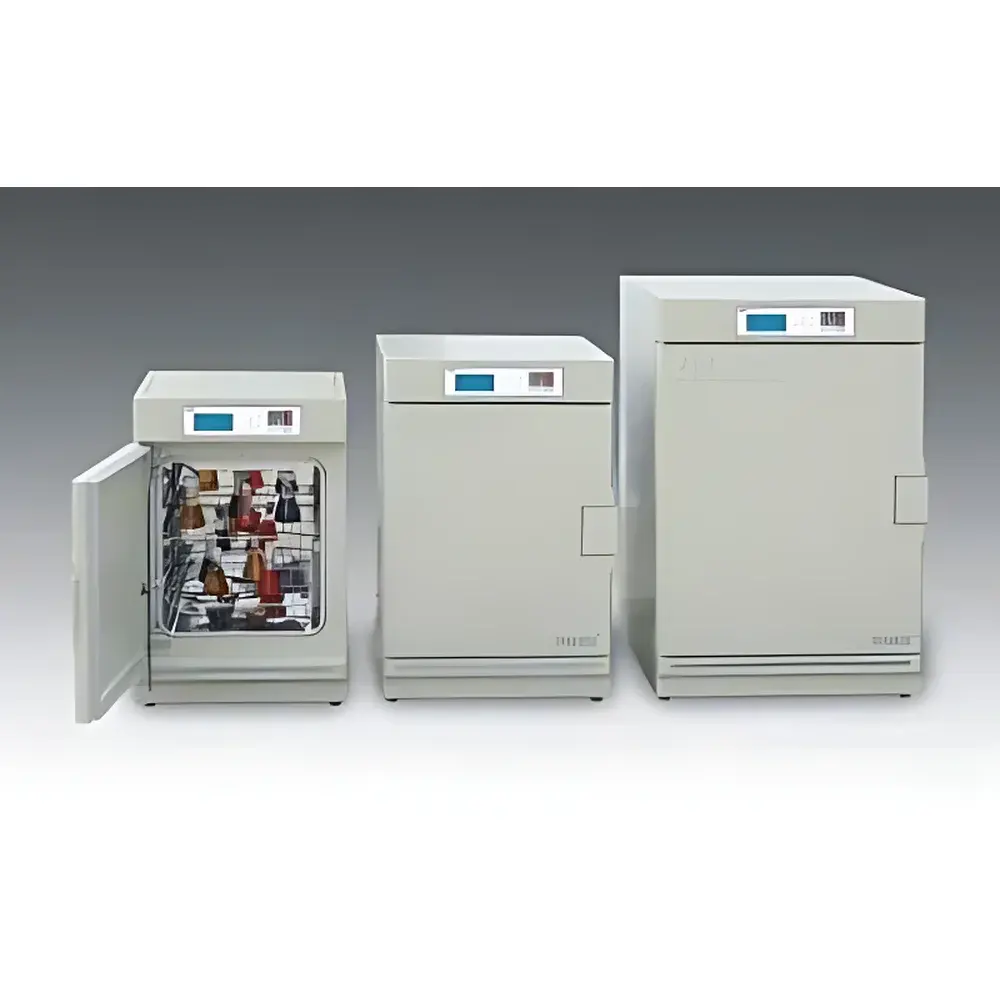
Zhicheng ZXGP-A2080 Water-Jacketed Programmable Incubator with 10-Stage Temperature Profile Control
| Brand | Zhicheng |
|---|---|
| Origin | Shanghai, China |
| Manufacturer Type | Direct Manufacturer |
| Product Category | Domestic |
| Model | ZXGP-A2080 |
| Quotation | Upon Request |
| Heating Method | Water-jacketed |
| Temperature Range | Ambient +5°C to 60°C |
| Temperature Resolution | 0.1°C |
| Temperature Uniformity | ≤ ±1.0°C (at 37°C) |
| Temperature Fluctuation | ≤ ±0.5°C |
| Chamber Capacity | 80 L |
| Internal Dimensions (W×D×H) | 400 × 400 × 500 mm |
| External Dimensions (W×D×H) | 560 × 525 × 870 mm |
| Net Weight | 45 kg |
| Power Supply | AC 220 V, 50/60 Hz |
| Rated Power | 810 W |
| Control Logic | Fuzzy Logic Algorithm |
| Display | LCD |
| Air Circulation | Top-mounted micro-airflow system |
| Door Configuration | Dual-door (outer insulated door + inner tempered glass observation door) |
| Programming Capability | 10 segments / 18 steps, step duration 1–999 minutes |
| Safety Systems | Independent over-temperature protection (adjustable 30–80°C), independent overheat prevention device, leakage current & overcurrent circuit breaker, power failure alarm, sensor fault detection, upper/lower temperature limit alarms |
| Data Interface | RS-232 serial port |
| Optional Output | Embedded thermal printer |
| Additional Functions | Auto-start/auto-stop, clock display, power recovery mode, parameter memory with password protection, temperature display calibration, monitoring timer |
Overview
The Zhicheng ZXGP-A2080 is a precision-engineered water-jacketed programmable incubator designed for stable, uniform, and reproducible thermal environments in life science laboratories. Unlike forced-air incubators, its water-jacketed architecture provides superior thermal inertia and insulation—minimizing internal temperature fluctuations during ambient variations or door openings. The unit employs fuzzy logic control to dynamically adjust heating output based on real-time feedback from high-response platinum resistance temperature sensors (PT100-class equivalent), ensuring rapid stabilization and long-term drift-free operation. Its 10-segment, 18-step programmable profile capability enables complex thermal protocols—including ramp-hold cycles, stepwise gradients, and timed transitions—making it suitable for applications requiring precise temporal control of biological processes such as cell differentiation, enzyme kinetics, microbial growth phase studies, and stability testing per ICH Q1 guidelines.
Key Features
- Water-jacketed thermal enclosure with dual-wall construction and integrated water reservoir, delivering exceptional temperature stability (≤ ±0.5°C fluctuation) and uniformity (≤ ±1.0°C at 37°C)
- Fuzzy logic temperature controller with adaptive PID tuning, eliminating overshoot and reducing settling time by up to 40% compared to conventional ON/OFF or basic PID systems
- 10-segment programmable interface supporting up to 18 discrete steps; each step configurable for target temperature, dwell time (1–999 min), and transition mode (ramp or jump)
- Dual-door design: outer insulated door minimizes heat loss; inner tempered glass door permits non-intrusive visual monitoring without compromising chamber integrity
- Top-mounted micro-airflow circulation system ensures laminar, low-velocity air movement—critical for minimizing shear stress on sensitive cultures and preventing condensation on Petri dishes
- Mirror-finish stainless steel interior (electropolished shelves included), seamless corner welds, and optimized cavity geometry meet ISO 14644-1 Class 5 cleanroom-compatible surface requirements for contamination-sensitive workflows
- Comprehensive safety architecture: three independent thermal safeguards (adjustable over-temperature cutoff, fixed overheat prevention, and sensor-failure-triggered shutdown), plus leakage current protection and automatic circuit interruption on overcurrent events
Sample Compatibility & Compliance
The ZXGP-A2080 supports a broad range of sample formats including flasks (up to 2 L), Petri dishes, multi-well plates, roller bottles, and serum vials. Its 80 L chamber accommodates up to four electropolished stainless steel shelves (standard configuration: two), each load-rated to 15 kg. The unit complies with IEC 61010-1:2010 for laboratory electrical equipment safety and meets EN 60335-1 essential requirements for temperature-controlled appliances. While not certified for GMP manufacturing environments out-of-the-box, its parameter memory with password protection, audit-ready event logging (via RS-232), and traceable temperature calibration support GLP-compliant documentation practices. It is routinely deployed in academic labs, QC microbiology units, and preclinical research facilities conducting ASTM E2925-22 (standard practice for incubator performance verification) and USP environmental control validation.
Software & Data Management
The embedded microcontroller logs operational parameters—including setpoint, actual temperature, alarm status, and door-open events—at user-defined intervals (default: 1 minute). All data are exportable via RS-232 serial interface to external PCs running terminal emulation software (e.g., Tera Term, PuTTY) or custom LabVIEW-based acquisition platforms. An optional built-in thermal printer provides hard-copy records of temperature profiles and alarm histories—supporting 21 CFR Part 11-aligned record retention when paired with timestamped operator ID entry. Firmware supports firmware-upgradable calibration coefficients and allows field-adjustable display offset correction (±5.0°C range, 0.1°C resolution) to compensate for sensor aging or installation-specific thermal gradients.
Applications
This incubator serves critical roles across multiple regulated and research-intensive domains: microbial culture maintenance (e.g., *E. coli*, *S. aureus*, fungal isolates) under CLSI M22-A3 conditions; mammalian cell line expansion at 37°C/5% CO₂ (when integrated with compatible gas modules); vaccine stability assessment per WHO TRS 992 Annex 5; seed germination and plant tissue culture under controlled thermoperiodicity; BOD incubation per EPA Method 5210B; and long-term storage of heat-labile reagents including monoclonal antibodies and recombinant enzymes. Its programmability also facilitates accelerated aging studies (ASTM F1980), thermal denaturation assays, and circadian rhythm modeling in chronobiology experiments.
FAQ
What is the difference between water-jacketed and air-jacketed incubators?
Water-jacketed designs use a surrounding layer of heated water to insulate the chamber—providing higher thermal mass, reduced energy consumption during ambient fluctuations, and improved recovery after door openings. Air-jacketed units rely on convection heating, offering faster initial warm-up but greater susceptibility to external temperature changes.
Can the ZXGP-A2080 be validated for ISO/IEC 17025-compliant laboratories?
Yes—its traceable temperature control, documented calibration procedures, and RS-232 data logging enable full IQ/OQ/PQ execution. Users must perform periodic verification using NIST-traceable reference thermometers per ISO/IEC 17025 clause 6.4.6.
Is remote monitoring supported?
The RS-232 interface supports integration with building management systems (BMS) or SCADA platforms via serial-to-Ethernet converters. No native Wi-Fi or Ethernet port is provided.
What maintenance is required for the water jacket?
The water reservoir must be refilled with deionized water every 3–6 months; biocide additives are not recommended. Annual inspection of the water-level sensor and jacket seal integrity is advised.
Does the unit meet FDA requirements for clinical lab use?
It satisfies general laboratory equipment requirements under 21 CFR Part 820 but requires site-specific risk assessment and procedural controls to fulfill predicate device equivalency for diagnostic use.




