
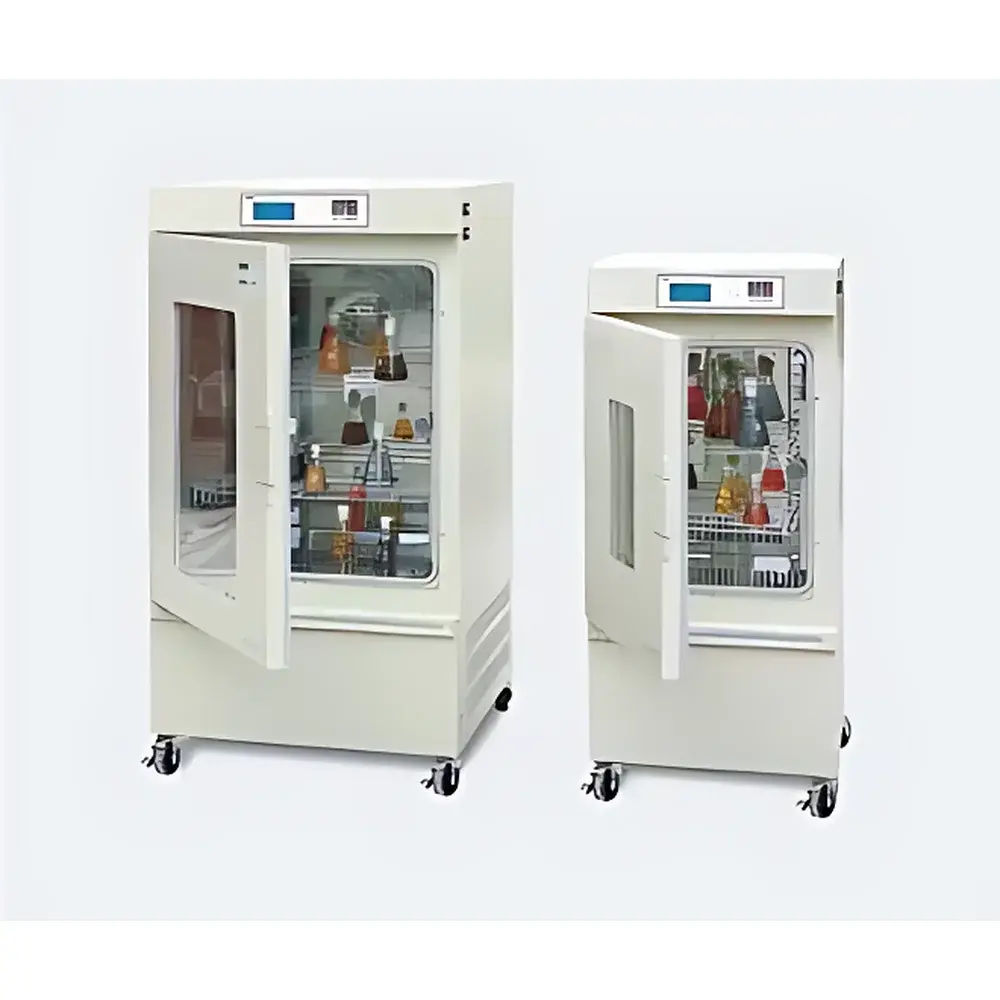
Zhicheng ZXSD-A1160 Ten-Stage Programmable Biochemical Incubator
| Brand | Zhicheng |
|---|---|
| Origin | Shanghai, China |
| Manufacturer Type | Direct Manufacturer |
| Country of Origin | China |
| Model | ZXSD-A1160 |
| Quotation | Upon Request |
| Temperature Range | 4–65 °C |
| Temperature Resolution | 0.1 °C |
| Temperature Uniformity | ≤±1 °C (at 37 °C) |
| Temperature Fluctuation | ≤±0.5 °C |
| Chamber Volume | 160 L |
| Interior Dimensions (W×D×H) | 500×500×650 mm |
| External Dimensions (W×D×H) | 630×640×1360 mm |
| Net Weight | 98 kg |
| Power Supply | AC 220 V, 50/60 Hz |
| Rated Power | 700 W |
| Control Method | Fuzzy Logic Control |
| Display | LCD |
| Air Circulation | Forced Convection |
| Door Design | Dual-layer door with tempered glass inner window |
| Programmability | 10 segments (0 = preset standby |
| step duration | 1–999 minutes per step |
| Cooling System | Air-cooled, R134a refrigerant, frost-free operation with power modulation |
| Safety Features | Independent overtemperature protection (adjustable 30–80 °C), independent overheat prevention device, leakage current protection, overcurrent circuit breaker, compressor overload protection, power failure alarm, sensor fault detection, upper/lower temperature limit alarms |
| Additional Functions | Auto-start/auto-stop, clock display, power recovery after outage, parameter memory, temperature display calibration, Φ50 mm access port, RS-232 interface |
| Optional Accessories | Embedded thermal printer |
| Interior Material | Mirror-finish stainless steel |
| Shelving | 2 standard polished stainless steel shelves (max. 4) |
| Heating Technology | Full-dimensional uniform heating |
| Airflow Design | Optimized laminar micro-airflow duct system |
Overview
The Zhicheng ZXSD-A1160 Ten-Stage Programmable Biochemical Incubator is an engineered platform for precise, reproducible, and compliant temperature-controlled incubation in research and quality control environments. Designed around a dual-mode thermal architecture—supporting both ambient and low-temperature operation—the unit integrates fuzzy logic control with high-fidelity thermal sensing to maintain stable setpoints across its full operating range of 4 °C to 65 °C. Its core function relies on real-time feedback from high-response platinum resistance thermometers (Pt100-class equivalent), coupled with adaptive heating and modulated air-cooled R134a refrigeration. This ensures consistent chamber dynamics under variable load conditions and ambient fluctuations between 5 °C and 35 °C. The incubator meets fundamental requirements for GLP-compliant laboratory workflows, including traceable parameter retention, power-loss recovery, and hardware-level safety redundancy—making it suitable for applications where thermal integrity directly impacts biological viability, enzymatic activity, or stability-indicating assays.
Key Features
- Ten-segment programmable control with up to 18 discrete thermal steps, enabling complex protocols such as ramp-hold-cool cycles, diurnal simulations, or multi-phase microbial growth studies
- Frost-free refrigeration system utilizing R134a with variable compressor output—eliminates manual defrost cycles and minimizes thermal disturbance during long-term operation
- Full-dimensional heating architecture combined with a precision-engineered airflow duct system ensures ≤±1 °C uniformity at 37 °C (per ISO 15277:2016 Annex B methodology)
- Dual-layer door assembly with low-emissivity tempered glass inner window reduces radiant heat loss while maintaining visual sample monitoring without opening the chamber
- Triple-layer safety architecture: independent adjustable overtemperature cutoff (30–80 °C), fixed overheat prevention device, and electrical protections including leakage current interruption and overcurrent tripping
- Self-diagnostic firmware that logs and alerts for sensor faults, power interruptions, and upper/lower temperature excursions—critical for audit readiness under FDA 21 CFR Part 11 and ISO/IEC 17025 frameworks
- LCD interface with real-time clock, parameter password lock, and display calibration capability to support metrological traceability
Sample Compatibility & Compliance
The ZXSD-A1160 accommodates diverse sample formats—including Petri dishes, flasks, multiwell plates, and serum vials—within its 160 L chamber (500 × 500 × 650 mm internal volume). The mirror-polished stainless-steel interior and electropolished shelving resist corrosion and facilitate decontamination using ethanol, hydrogen peroxide vapor, or validated liquid sporicides. Its geometry supports laminar airflow distribution, minimizing turbulence-induced condensation and cross-contamination risk—a design consideration aligned with ISO 14644-1 Class 8 cleanroom-compatible practices. The unit complies with IEC 61010-1:2010 for laboratory equipment safety and incorporates electromagnetic compatibility (EMC) shielding per EN 61326-1. While not certified to UL 61010-1 or CE for clinical use, its functional safety features meet baseline requirements for non-invasive research-grade incubation under ISO 13485-aligned QMS environments.
Software & Data Management
Data integrity is maintained through built-in non-volatile parameter memory and automatic power-recovery functionality—retaining all user-defined programs and setpoints following unexpected outages. The RS-232 serial interface enables bidirectional communication with external PCs or LIMS platforms for remote monitoring, script-based protocol loading, and time-stamped event logging (e.g., temperature deviations, door openings, alarm triggers). Optional embedded thermal printing provides hard-copy records of runtime profiles, supporting 21 CFR Part 11-compliant recordkeeping when paired with appropriate electronic signature controls. All temperature data are resolved to 0.1 °C and sampled at ≥2 Hz internally, though export resolution is configurable via host software. Audit trails—including operator ID, timestamp, and action type—are retained in volatile memory for ≥72 hours, sufficient for routine QA review cycles.
Applications
- Bacterial and fungal culture maintenance under defined thermal regimes (e.g., E. coli at 37 °C, psychrotrophs at 10 °C)
- Enzyme kinetics and protein stability studies requiring precise ramp-and-hold temperature transitions
- Seed germination and plant tissue culture under controlled diurnal cycling
- Pharmaceutical stability testing per ICH Q1A(R2) guidelines for intermediate storage conditions
- Media preparation and serum thawing with programmable warming gradients to prevent thermal shock
- Environmental simulation for ecotoxicology assays (e.g., OECD 201, 210)
- Long-term storage of temperature-sensitive reagents, antibodies, and cell lines within validated 4–8 °C or 25–37 °C ranges
FAQ
What is the maximum number of programmable temperature segments supported?
The ZXSD-A1160 supports up to ten segments (labeled 0 through 9), with segment “0” designated for initial preset standby and segments 1–9 configured for sequential thermal steps—totaling up to 18 discrete actions per program.
Does the incubator comply with FDA 21 CFR Part 11 requirements?
The unit provides foundational elements for Part 11 compliance—including audit-trail-capable event logging, parameter password protection, and electronic record export—but requires integration with validated third-party software and procedural controls to achieve full compliance.
Can the temperature uniformity specification be verified independently?
Yes. Uniformity is specified per ISO 15277:2016 Annex B test methodology at 37 °C using nine calibrated Pt100 sensors placed on a 3×3 grid at working height; users may replicate this using accredited calibration services.
Is the R134a refrigerant system serviceable in the field?
Refrigerant charging and leak diagnostics require certified HVAC-R technicians due to pressure-rated components and regulatory handling requirements under EPA Section 608.
What is the minimum ambient temperature for reliable refrigeration performance?
The unit is rated for continuous operation in ambient environments between 5 °C and 35 °C; below 5 °C, compressor oil viscosity and refrigerant saturation pressure may impair cooling capacity and cycle stability.



