
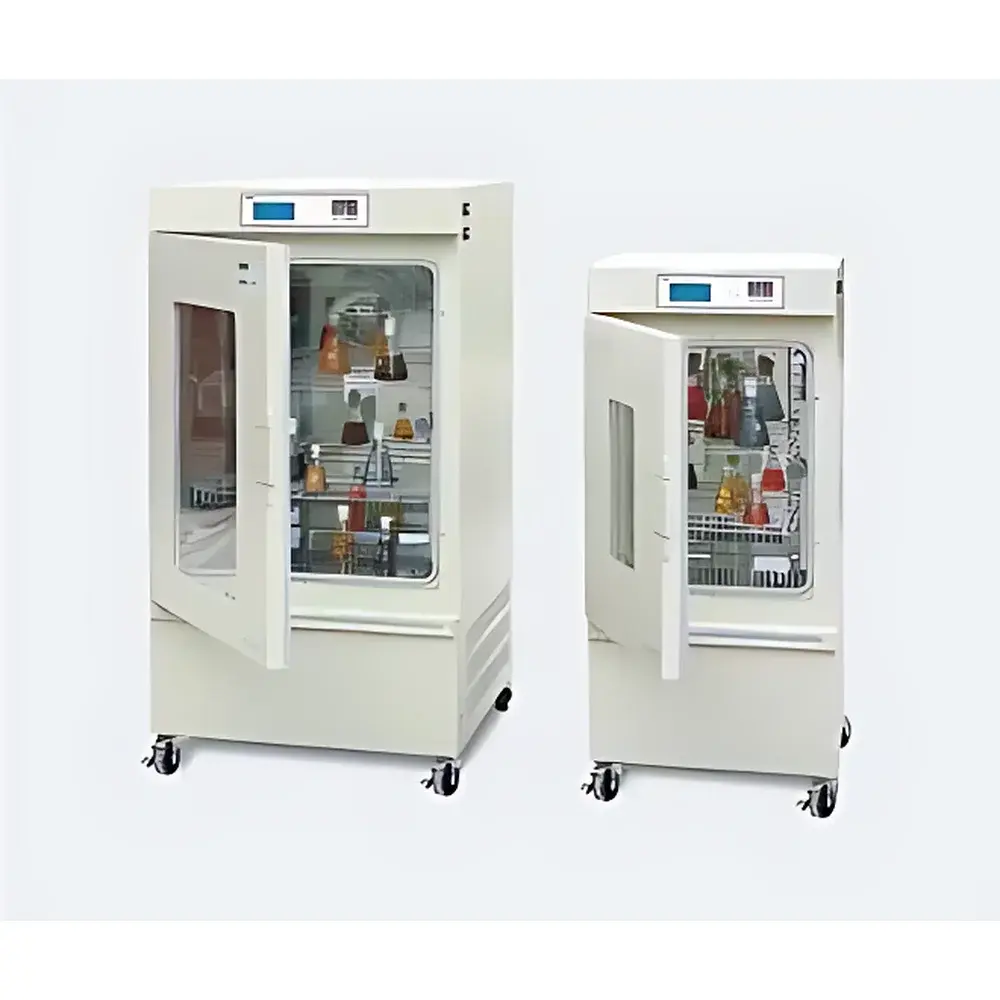
Zhicheng ZXSP-A0160 Ten-Stage Programmable Biochemical Incubator
| Brand | Zhicheng |
|---|---|
| Origin | Shanghai, China |
| Manufacturer Type | Direct Manufacturer |
| Product Category | Domestic |
| Model | ZXSP-A0160 |
| Pricing | Upon Request |
| Temperature Range | −10 °C to 65 °C |
| Temperature Resolution | 0.1 °C |
| Temperature Uniformity | ≤ ±1 °C (at 37 °C) |
| Temperature Fluctuation | ≤ ±0.5 °C |
| Chamber Volume | 160 L |
| Interior Dimensions (W×D×H) | 500 × 500 × 650 mm |
| External Dimensions (W×D×H) | 650 × 680 × 1360 mm |
| Net Weight | 98 kg |
| Power Supply | AC 220 V, 50/60 Hz |
| Rated Power | 750 W |
| Control Method | Fuzzy Logic Control |
| Display | LCD |
| Air Circulation | Forced Convection |
| Door Type | Single-layer Tempered Glass Door |
| Programmability | 10 Segments / 18 Steps (Segment “0” = Pre-set Timing |
| Step Duration | 1–999 min per step |
| Cooling System | Air-Cooled, R134a Refrigerant, Frost-Free, Power-Modulated Compression |
| Safety Features | Independent Over-Temperature Protection (adjustable 30–80 °C), Independent Over-Heat Prevention Device, Leakage Current & Over-Current Circuit Breaker, Compressor Overload Protection, Power-Failure Alarm, Sensor Fault Detection, Upper/Lower Limit Temperature Alarms |
| Additional Functions | Auto Start/Stop, Power Recovery Mode, Parameter Memory, Password Protection, Temperature Display Calibration, Φ50 mm Access Port, RS-232 Communication Interface |
| Optional Accessories | Embedded Thermal Printer |
| Interior Construction | Mirror-Finish Stainless Steel Chamber, Electro-Polished Stainless Steel Shelving (2 standard, up to 4), Sterile Geometric Cavity Design |
| Heating Technology | Full-Directional Uniform Heating with Microcomputer-Controlled Environmental Scanning |
Overview
The Zhicheng ZXSP-A0160 Ten-Stage Programmable Biochemical Incubator is an engineered environmental control platform designed for precise, reproducible, and uninterrupted thermal conditioning of biological samples in research and quality-controlled laboratory settings. Utilizing fuzzy logic control architecture, the incubator dynamically regulates heating and refrigeration outputs based on real-time feedback from high-response platinum resistance temperature sensors (PT100-class equivalent), enabling stable operation across a wide temperature range of −10 °C to +65 °C. Its air-cooled, R134a-based refrigeration system operates in frost-free mode with modulated compressor power delivery—eliminating manual defrost cycles while maintaining consistent chamber humidity profiles during low-temperature operation. The unit integrates full-directional heating elements and a micro-engineered airflow duct system that ensures uniform thermal distribution (≤ ±1 °C at 37 °C) and minimal turbulence—critical for sensitive cell cultures, enzymatic assays, and long-term microbial propagation.
Key Features
- Ten-segment programmable controller supporting up to 18 discrete thermal steps, with Segment “0” reserved for pre-timed activation and Segments 1–9 enabling multi-phase experimental protocols (e.g., cold shock → ramped recovery → sustained incubation)
- Frost-free refrigeration with adaptive power modulation—reducing thermal stress on samples during transitional cooling phases and minimizing condensation buildup
- Independent dual-stage over-temperature safeguards: adjustable mechanical over-heat prevention device (30–80 °C range) and electronic over-temperature cut-off—both certified to IEC 61000-4-5 surge immunity standards
- Mirror-finish stainless steel interior with electro-polished shelving (2 included, expandable to 4) and sterilizable geometric cavity geometry to minimize microbial harborage points
- RS-232 serial interface compliant with ANSI/TIA/EIA-232-F specifications for bidirectional data exchange with LIMS or lab automation systems
- Power-failure recovery function retaining all setpoints and active program state; automatic resumption upon grid restoration without user intervention
- Comprehensive self-diagnostic suite including sensor fault detection, upper/lower limit deviation alerts, and compressor overload monitoring—log entries timestamped and retained in non-volatile memory
Sample Compatibility & Compliance
The ZXSP-A0160 supports a broad spectrum of life science applications requiring defined thermal environments: bacterial and fungal culture maintenance (e.g., E. coli, S. cerevisiae), mammalian cell line expansion, enzyme stability profiling, serum and reagent storage (−10 °C to +8 °C), and accelerated stability testing per ICH Q1A(R2). Its chamber design conforms to ISO 13485-aligned cleanability requirements, with seamless welds, rounded internal corners, and corrosion-resistant hardware suitable for routine ethanol or hydrogen peroxide vapor decontamination. While not certified to UL 61010-1 or EN 61010-1 as a standalone medical device, its safety architecture meets Class II laboratory equipment criteria under GB 4793.1–2007 (Chinese national standard equivalent to IEC 61010-1). For GLP/GMP-regulated workflows, optional RS-232 logging enables integration with 21 CFR Part 11-compliant audit trail software when paired with validated third-party data acquisition platforms.
Software & Data Management
The embedded firmware provides native support for time-stamped parameter logging via RS-232 at user-defined intervals (1 min to 60 min resolution). All operational events—including temperature deviations exceeding ±0.5 °C, power interruptions, door openings (detected via magnetic switch), and alarm activations—are recorded with UTC timestamps and stored in circular buffer memory (retains ≥72 h of continuous data). When connected to external PC-based monitoring tools (e.g., LabVIEW, MATLAB, or custom Python scripts using pySerial), raw sensor values, setpoint history, and alarm logs can be exported in CSV format. Optional embedded thermal printer outputs real-time strip charts or event-triggered hardcopy reports—each page bearing firmware version, serial number, and calibration date metadata. No proprietary cloud service or vendor-hosted platform is required; local data sovereignty is preserved by default.
Applications
- Microbiological cultivation and strain preservation under controlled thermal gradients
- Biochemical reaction kinetics studies requiring multi-step temperature ramps (e.g., PCR master mix optimization, ligase fidelity assessment)
- Environmental simulation for ecotoxicology assays (e.g., OECD 201 algal growth inhibition tests)
- Stability testing of biologics, vaccines, and diagnostic reagents per USP <1151> and ICH guidelines
- Plant tissue culture initiation and callus induction under sub-ambient conditions
- Long-duration BOD (Biochemical Oxygen Demand) incubation per ASTM D5210–19
- Pre-incubation of ELISA plates and Western blot membranes prior to hybridization
FAQ
What is the maximum number of temperature segments supported?
The ZXSP-A0160 supports up to 10 programmable segments, with Segment “0” designated for pre-timed activation and Segments 1–9 configured for sequential thermal profiles.
Can the incubator maintain temperatures below 0 °C continuously?
Yes—the unit achieves and sustains temperatures from −10 °C to +65 °C with ≤ ±0.5 °C fluctuation, verified per ISO 16770:2018 Annex A calibration procedures.
Is the RS-232 interface compatible with modern Windows/Linux systems?
Yes—standard TTL-level RS-232 output (±12 V compliant) interfaces directly with USB-to-serial adapters (FTDI or CH340 chipset) and supports ASCII command protocol documented in the technical manual.
How many shelves are included, and what is the maximum load per shelf?
Two electro-polished stainless steel shelves are supplied; each supports up to 15 kg uniformly distributed load. Up to four shelves may be installed using factory-supplied mounting rails.
Does the unit meet electromagnetic compatibility (EMC) requirements for shared lab environments?
Yes—it complies with GB/T 18268.1–2010 (equivalent to IEC 61326-1:2012 Class A emissions and immunity), ensuring stable operation near centrifuges, spectrophotometers, and analytical balances.



