
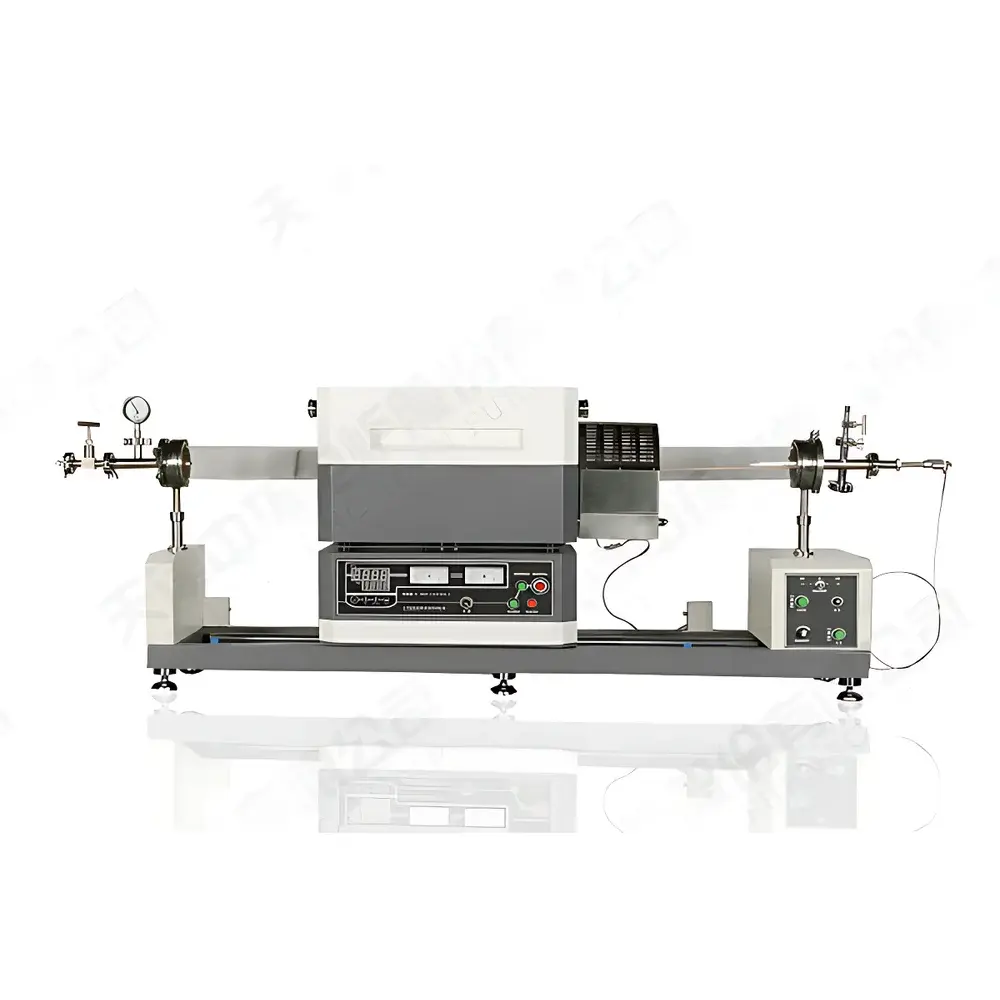
ZHONGHUAN FURNACE 1200°C Sliding Dual-Zone Tube Furnace
| Brand | ZHONGHUAN FURNACE |
|---|---|
| Origin | Tianjin, China |
| Model | 1200°C Sliding Dual-Zone Tube Furnace |
| Maximum Temperature | 1200°C |
| Temperature Control Accuracy | ±1°C |
| Total Rated Power | 3.2 kW |
| Heating Rate (to max temp) | ≤5°C/min below 500°C |
| Heating Element Material | High-Resistance Alloy Wire OCr27Al7Mo2 |
| Internal Chamber Dimensions | 1600 × 360 × 740 mm |
| Heating Configuration | Two independently controlled horizontal zones with synchronized sliding mechanism |
| Sealing Technology | Dual-ring flange sealing system |
| Cooling Safety System | Ambient-surface temperature-triggered axial cooling fan (activates at ≥50°C surface temp) |
| Control Interface | RS-485 port for PC connectivity and multi-furnace networked operation |
| Programmable Temperature Profile | Up to 50 segments (domestic controller) or 40 segments (imported controller) |
| Compliance | Designed for GLP-compliant lab environments |
Overview
The ZHONGHUAN FURNACE 1200°C Sliding Dual-Zone Tube Furnace is a precision-engineered thermal processing instrument designed for high-reproducibility solid-state synthesis, annealing, sintering, and controlled-atmosphere reactions in research and development laboratories. Its dual-zone architecture enables independent thermal control across two spatially separated furnace sections—each capable of maintaining stable setpoints from ambient to 1200°C—with ±1°C accuracy verified under steady-state conditions per IEC 60584-2 thermocouple calibration protocols. The furnace operates on the principle of resistive heating via OCr27Al7Mo2 alloy wire elements embedded within vacuum-formed polycrystalline mullite fiber insulation, delivering uniform radial and axial temperature distribution (±3°C over 300 mm hot zone length) while reducing standby heat loss by up to 50% compared to conventional ceramic board designs. The sliding mechanical configuration eliminates fixed-flange constraints, allowing full rearward rotation (110°) of the right-side heating zone for unobstructed sample access without disassembly—critical for iterative catalyst testing, fiber precursor pyrolysis, or multi-step thermal treatments requiring intermediate inspection.
Key Features
- Sliding dual-zone design with synchronized linear displacement and rotational access—enables rapid, non-invasive sample loading/unloading while preserving tube integrity and seal geometry.
- Dual-ring flange sealing system ensures leak rates <1×10⁻³ mbar·L/s under inert gas purge, validated per ISO 10961 for process-critical atmospheres (N₂, Ar, H₂, forming gas).
- Intelligent safety interlock suite: door-open power cutoff, independent overtemperature cutout (hardware-limited at 1250°C), and grounded-chassis leakage detection compliant with IEC 61000-6-3 EMC immunity standards.
- RS-485 communication interface supports Modbus RTU protocol for integration into centralized lab automation systems—enabling remote scheduling, real-time temperature logging, and synchronized operation of up to 200 units via single host PC.
- Active surface-cooling subsystem: thermally coupled sensor triggers axial fan activation when external casing exceeds 50°C, maintaining operator-safe surface temperatures during extended high-temperature runs.
- Modular auxiliary compatibility: pre-engineered mounting interfaces for optional vacuum pumping systems (10⁻³ to 10⁻⁶ mbar range), mass flow controllers (MFCs) with ±1% FS accuracy, and quartz or alumina tube variants (OD 60–120 mm).
Sample Compatibility & Compliance
This furnace accommodates cylindrical samples up to 300 mm in length and 100 mm in diameter within its 1600 mm long × 360 mm wide × 740 mm tall internal cavity. It supports standard quartz, high-purity alumina, and silicon carbide reaction tubes rated for continuous operation at 1200°C. The dual-zone thermal profile capability facilitates gradient heating applications such as zone refining, directional solidification, and thermal barrier coating development. From a regulatory standpoint, the system meets structural and electrical safety requirements outlined in UL 61010-1 and EN 61010-1 for laboratory equipment. When paired with NIST-traceable Type S thermocouples and validated calibration procedures, it satisfies data integrity expectations under FDA 21 CFR Part 11 for electronic records in GMP-regulated material qualification studies.
Software & Data Management
The integrated programmable temperature controller supports up to 50 user-defined ramp-hold segments (domestic firmware) or 40 segments (imported firmware), with soak time resolution of 1 second and ramp rate granularity of 0.1°C/min. All profiles are stored in non-volatile memory with timestamped version control. The RS-485 interface enables bidirectional communication using open-standard Modbus registers, permitting direct integration with LabVIEW, MATLAB, or custom SCADA platforms. Data export options include CSV-formatted time-series logs (T, P, Q, status flags) with millisecond-level timestamping. Audit trail functionality—including operator ID, parameter change history, and session start/end markers—is available when deployed with third-party compliance software meeting ALCOA+ principles for analytical instrument qualification.
Applications
- Semiconductor precursor annealing and dopant diffusion profiling under controlled N₂/H₂ mixtures.
- Nanomaterial synthesis including graphene oxide reduction, metal–organic framework (MOF) activation, and carbon nanotube growth via CVD.
- Ceramic matrix composite sintering with graded thermal cycles to mitigate interfacial stress cracking.
- Battery electrode material calcination (e.g., LiCoO₂, NMC, LFP) under oxygen-controlled or vacuum-dehydrated conditions.
- Thermal stability assessment of polymer-derived ceramics and aerospace-grade composites per ASTM E2550 mass-loss protocols.
- Calibration source for infrared radiometry and blackbody reference validation in metrology labs.
FAQ
What tube materials are compatible with this furnace at 1200°C?
Quartz (fused silica), high-purity alumina (99.8%), and recrystallized silicon carbide tubes have been validated for continuous use at 1200°C. Quartz is recommended for oxidizing or inert atmospheres; alumina for mildly reducing conditions; SiC for aggressive reducing or carburizing environments.
Can the two zones operate at different temperatures simultaneously?
Yes—the left and right heating zones feature fully independent PID controllers, thermocouple inputs, and power regulation circuits, enabling precise thermal gradients (e.g., 800°C/1200°C) across the tube length.
Is vacuum compatibility built-in or requires add-on modules?
Vacuum operation requires external pumping systems; however, the dual-ring flanges and reinforced end caps are pre-configured for KF-40 or CF-63 vacuum fittings, and the furnace chassis includes dedicated ports for vacuum gauge and feedthrough wiring.
How is temperature uniformity verified across the hot zone?
Uniformity mapping is performed using a 5-point axial/radial thermocouple array per ASTM E220 methodology, with results documented in the factory calibration report supplied with each unit.
Does the system support automated gas switching during a temperature program?
While the base unit does not include solenoid valve sequencing, its RS-485 interface allows synchronization with external PLC-controlled gas manifolds via discrete I/O triggers or Modbus register writes—enabling atmosphere transitions timed to specific ramp segments.



