
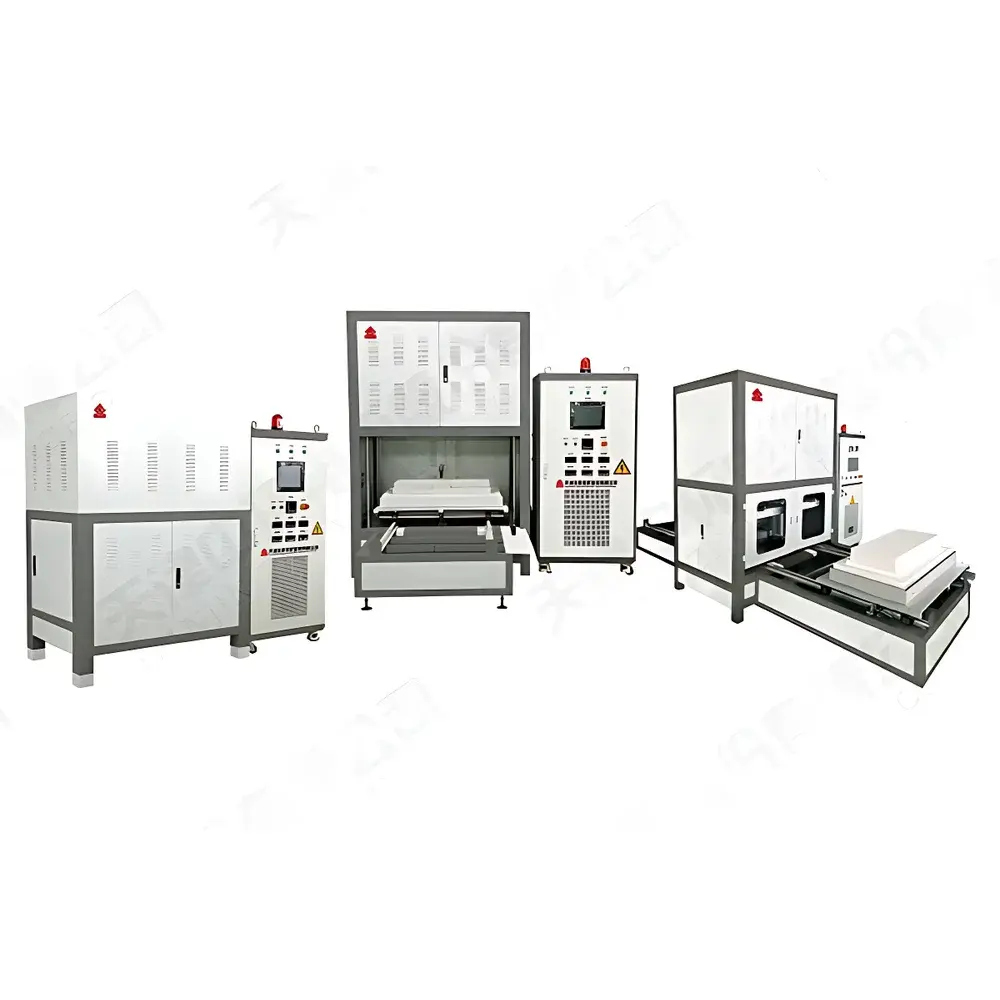
ZHONGHUAN FURNACE 1800°C Intelligent Programmable Box-Type Muffle Furnace for Sintering and Annealing
| Brand | ZHONGHUAN FURNACE |
|---|---|
| Origin | Tianjin, China |
| Model | 1800°C Medium-Sized Intelligent Automatic Sintering & Annealing Furnace |
| Type | Box-Type Muffle Furnace |
| Max Temperature | 1800°C |
| Temperature Control Accuracy | ±0.5°C |
| Max Power | 57 kVA |
| Heating Element | Silicon Molybdenum (MoSi₂) Rods |
| Internal Chamber Dimensions | 860 × 340 × 300 mm |
| Heating Configuration | Peripheral U-Shaped MoSi₂ Elements |
| Control System | 100-Stage PID Programmable Controller with Over-Temperature & Thermocouple Break Protection |
| 炉 Door Operation | Motor-Driven Automatic Vertical Lift (Bottom- or Top-Mounted Configurations Available) |
| Insulation Material | High-Purity Alumina-Silica Ceramic Fiber Modules |
| Energy Efficiency | >40% Reduction vs. Conventional Refractory Brick Furnaces |
Overview
The ZHONGHUAN FURNACE 1800°C Intelligent Programmable Box-Type Muffle Furnace is engineered for precision thermal processing in demanding high-temperature applications—including sapphire crystal annealing, advanced ceramic sintering, refractory material densification, and functional oxide synthesis. Operating on the principle of resistive heating via silicon molybdenum (MoSi₂) rods arranged in a peripheral U-configuration, the furnace delivers exceptional thermal uniformity across its 860 × 340 × 300 mm working chamber. Its core architecture integrates a dual-layer steel shell with high-density alumina-silica ceramic fiber insulation—minimizing surface temperature rise (<60°C at ambient), reducing standby heat loss, and enabling stable 1800°C operation under continuous duty cycles. The furnace complies with fundamental safety and performance expectations for Class I industrial laboratory equipment per IEC 61000-6-2 (EMC immunity) and IEC 61000-6-4 (EMC emission) standards, and supports integration into GLP-compliant workflows through traceable temperature logging and programmable ramp/soak profiles.
Key Features
- 100-stage PID programmable controller with independent voltage limiting per segment—enabling precise thermal profiling for complex multi-step processes such as controlled nucleation, stress-relief annealing, and phase-purification cycles.
- Motor-driven automatic vertical lift door mechanism—available in top-lift (for standard loading) or bottom-lift (for horizontal push-pull or conveyor-integrated configurations), minimizing operator exposure to radiant heat and improving workflow repeatability.
- Peripherally mounted U-shaped MoSi₂ heating elements—ensuring symmetrical radiant and convective heat distribution; measured axial and radial temperature gradients remain ≤±3°C at 1800°C across the usable chamber volume.
- Dual-shell structural design with low-thermal-conductivity fiber insulation—reducing external casing temperature to 40% energy savings compared to traditional brick-lined furnaces.
- Integrated safety architecture including over-temperature cutoff (setpoint +15°C), thermocouple break detection, and real-time current monitoring with audible/visual alarm—meeting essential requirements for unattended overnight operation.
- Modular heating element replacement system—elements are accessible from the base without disassembly of the roof or insulation lining, supporting rapid maintenance and extended service intervals.
Sample Compatibility & Compliance
The furnace accommodates crucibles and fixtures made from high-purity alumina, zirconia, graphite (in inert/vacuum environments), and molybdenum—compatible with air, argon, nitrogen, and forming gas atmospheres (with optional gas inlet/outlet ports). It meets material compatibility requirements for ASTM C1161 (flexural strength of advanced ceramics), ISO 14703 (vacuum sintering of technical ceramics), and USP (thermal treatment of pharmaceutical excipients requiring high-temperature stability verification). All electrical components conform to IP20 enclosure rating per IEC 60529, and thermal insulation materials are certified non-volatile and halogen-free per RoHS Directive 2011/65/EU.
Software & Data Management
The embedded control system records time-stamped temperature, voltage, current, and power data at user-defined intervals (1–60 sec), exporting CSV files via USB interface. Optional RS485 Modbus RTU or Ethernet TCP/IP communication enables integration with SCADA platforms (e.g., Ignition, Siemens Desigo) and LIMS systems. Audit-trail functionality—including operator ID tagging, parameter change logs, and calibration event timestamps—supports compliance with FDA 21 CFR Part 11 when paired with validated third-party software. Firmware updates are performed locally via SD card, with version rollback capability and checksum-verified integrity checks.
Applications
- Sapphire crystal rod and wafer annealing for defect reduction and lattice reconstruction prior to epitaxial growth.
- Sintering of SiC, AlN, YAG, and other ultra-refractory ceramics requiring ≥1700°C densification temperatures.
- Thermal treatment of battery cathode precursors (e.g., NMC, LNMO) to optimize crystallinity and oxygen stoichiometry.
- Heat treatment of aerospace-grade superalloys and metal-matrix composites for grain refinement and residual stress relief.
- Calcination of catalyst supports (e.g., γ-Al₂O₃, CeO₂-ZrO₂) under controlled oxidizing atmospheres.
- Research-scale pyrolysis and carbothermal reduction of transition metal oxides in materials discovery workflows.
FAQ
What atmosphere options are supported inside the furnace chamber?
Standard configuration operates in ambient air; optional quartz or stainless-steel gas-tight flanges allow purging with inert (Ar, N₂) or reducing (5% H₂/N₂) gases. Vacuum operation up to 10⁻² mbar requires separate diffusion pump integration.
Is the temperature uniformity verified and documented per industry standards?
Yes—uniformity mapping is performed per ASTM E2203 using a 9-point thermocouple array at 1600°C and 1800°C; certified reports (including deviation limits and measurement uncertainty) are supplied with each unit.
Can the furnace be integrated into an automated sample handling line?
Absolutely—the motorized lift door, programmable I/O signals (start/stop, door open/closed, fault status), and Modbus-compatible communication enable seamless synchronization with robotic arms, belt conveyors, or batch loaders.
What is the expected service life of the MoSi₂ heating elements under continuous 1800°C operation?
Typical operational lifetime exceeds 1,200 hours at 1800°C in clean air; lifespan increases significantly under intermittent cycling or lower peak temperatures (e.g., >3,000 hours at 1600°C).
Does the system support remote monitoring and control?
Yes—via optional Ethernet module with web-based HMI (HTML5), allowing real-time viewing of setpoints, actual temperatures, alarms, and historical trends from any authorized workstation within the local network.



