
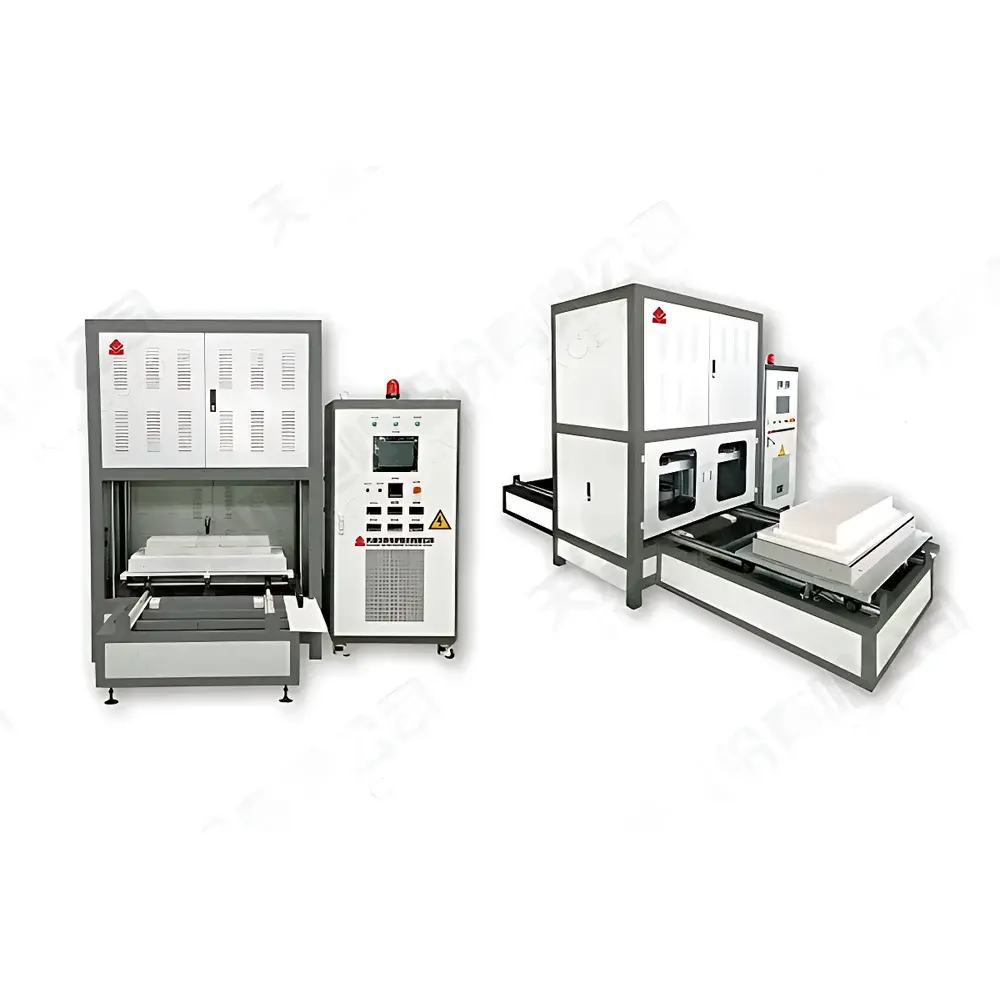
ZHONGHUAN FURNACE 1800°C Large-Scale Intelligent Automatic Sintering & Annealing Box Furnace
| Brand | ZHONGHUAN FURNACE |
|---|---|
| Origin | Tianjin, China |
| Instrument Type | Box-Type Muffle Furnace |
| Max Temperature | 1800°C |
| Temperature Control Accuracy | ±0.5°C |
| Max Power | 110 kVA |
| Heating Element | Silicon-Molybdenum (MoSi₂) Rods |
| Internal Chamber Dimensions | 1180 × 340 × 400 mm |
| Loading Configuration | Bottom-Opening Motorized Lift Door with Optional Unidirectional or Bidirectional Automated Material Handling System |
| Thermal Insulation | High-Density Alumina-Silica Ceramic Fiber Modules |
Overview
The ZHONGHUAN FURNACE 1800°C Large-Scale Intelligent Automatic Sintering & Annealing Box Furnace is engineered for high-temperature thermal processing in research and industrial quality control environments requiring precise, repeatable, and contamination-free heat treatment up to 1800°C. Based on the fundamental principles of resistive heating via silicon-molybdenum (MoSi₂) rod elements embedded within a multi-layered ceramic fiber insulation architecture, this furnace delivers exceptional thermal uniformity and long-term stability under sustained ultra-high-temperature operation. Its design adheres to core engineering requirements for materials science applications—including crystal annealing (e.g., sapphire boules and wafers), advanced ceramic sintering (e.g., alumina, zirconia, silicon carbide), refractory metal processing, and high-purity oxide synthesis—where thermal homogeneity, low outgassing, and minimal thermal mass drift are critical. The furnace employs a dual-zone structural layout separating electrical control cabinet from the heating chamber, minimizing electromagnetic interference and enhancing operator safety during extended duty cycles.
Key Features
- Bottom-mounted motorized lift door enables automated, gravity-assisted loading/unloading—reducing manual handling risks and improving process repeatability.
- Configurable material handling: unidirectional system supports sequential batch processing; bidirectional variant integrates forward and rearward motion mechanisms for continuous operation across sintering, cooling, and transfer stages.
- U-shaped MoSi₂ heating elements distributed circumferentially around the chamber ensure radial and axial temperature symmetry; measured thermal uniformity ≤ ±3°C at 1800°C across the working zone.
- Dual-shell steel enclosure with forced-air interstitial cooling maintains external shell surface temperature below 60°C at maximum operating temperature—complying with IEC 61000-6-3 EMC emission limits and OSHA thermal safety guidelines.
- 100-segment programmable PID controller with independent voltage output limiting per segment enables complex thermal profiles (ramp/soak/cool) while protecting heating elements from current surge damage.
- Integrated digital power monitoring panel displays real-time voltage, current, active power, and cumulative energy consumption (kWh); includes overcurrent alarm with automatic cut-off relay.
- High-purity alumina-silica ceramic fiber lining (≥95% Al₂O₃ content) provides low thermal conductivity (40% energy reduction versus traditional brick-lined furnaces.
Sample Compatibility & Compliance
This furnace accommodates standard crucibles (graphite, molybdenum, alumina, and zirconia) and custom fixtures up to 1100 mm in length. It is routinely deployed in ASTM C1161-compliant flexural strength testing prep, ISO 13384-2-compliant refractory characterization, and USP sintering validation for pharmaceutical excipient ceramics. All control firmware and data logging functions meet GLP/GMP documentation requirements, supporting audit-ready electronic records with timestamped event logs (power-on, ramp initiation, soak completion, cool-down termination). Optional 21 CFR Part 11-compliant software add-ons provide user access control, electronic signatures, and immutable audit trails.
Software & Data Management
The furnace operates via an embedded ARM-based controller running deterministic real-time firmware. Standard RS485 Modbus RTU interface allows integration into LabVIEW, MATLAB, or SCADA systems for centralized thermal process orchestration. Optional Ethernet/Wi-Fi module enables remote parameter upload/download, live temperature curve streaming, and predictive maintenance alerts based on heater resistance trending. All thermal profiles and operational logs are exportable in CSV format with ISO 8601 timestamps and UTC synchronization—facilitating cross-laboratory data correlation and regulatory submission packages.
Applications
- Crystallographic annealing of sapphire, silicon carbide, and lithium niobate substrates for optical and semiconductor applications.
- Sintering of nanostructured ceramics, piezoelectric composites, and solid electrolytes for battery R&D (e.g., LLZO, NASICON).
- Thermal gravimetric pre-treatment of catalyst supports prior to BET surface area analysis (ASTM D3663).
- High-temperature oxidation studies of refractory alloys under controlled atmosphere (with optional gas inlet manifold).
- Calibration and verification of thermocouples (Types B, S, R) and infrared pyrometers per ISO/IEC 17025-accredited protocols.
FAQ
What atmosphere options are supported?
Standard operation is in ambient air; optional quartz or stainless-steel gas manifolds support inert (N₂, Ar), reducing (H₂/N₂), or oxidizing (O₂-enriched) atmospheres up to 0.1 MPa gauge pressure.
Is vacuum capability available?
Vacuum operation is not integrated; however, the chamber is compatible with external mechanical or diffusion pump systems via CF-63 flanged ports (optional retrofit).
How is temperature uniformity validated?
Uniformity mapping is performed per ASTM E220 using three calibrated Type B thermocouples placed at geometric center and ±100 mm along X/Y/Z axes during soak at 1600°C and 1800°C.
What maintenance intervals are recommended for MoSi₂ elements?
Under typical intermittent use (≤8 h/day at ≤1700°C), MoSi₂ rods exhibit service life exceeding 1,200 hours; annual visual inspection and resistance measurement are advised.
Can the furnace be integrated into an automated production line?
Yes—digital I/O terminals support PLC-triggered start/stop, door position feedback, and fault status signaling; Modbus TCP implementation enables full MES-level integration.



