
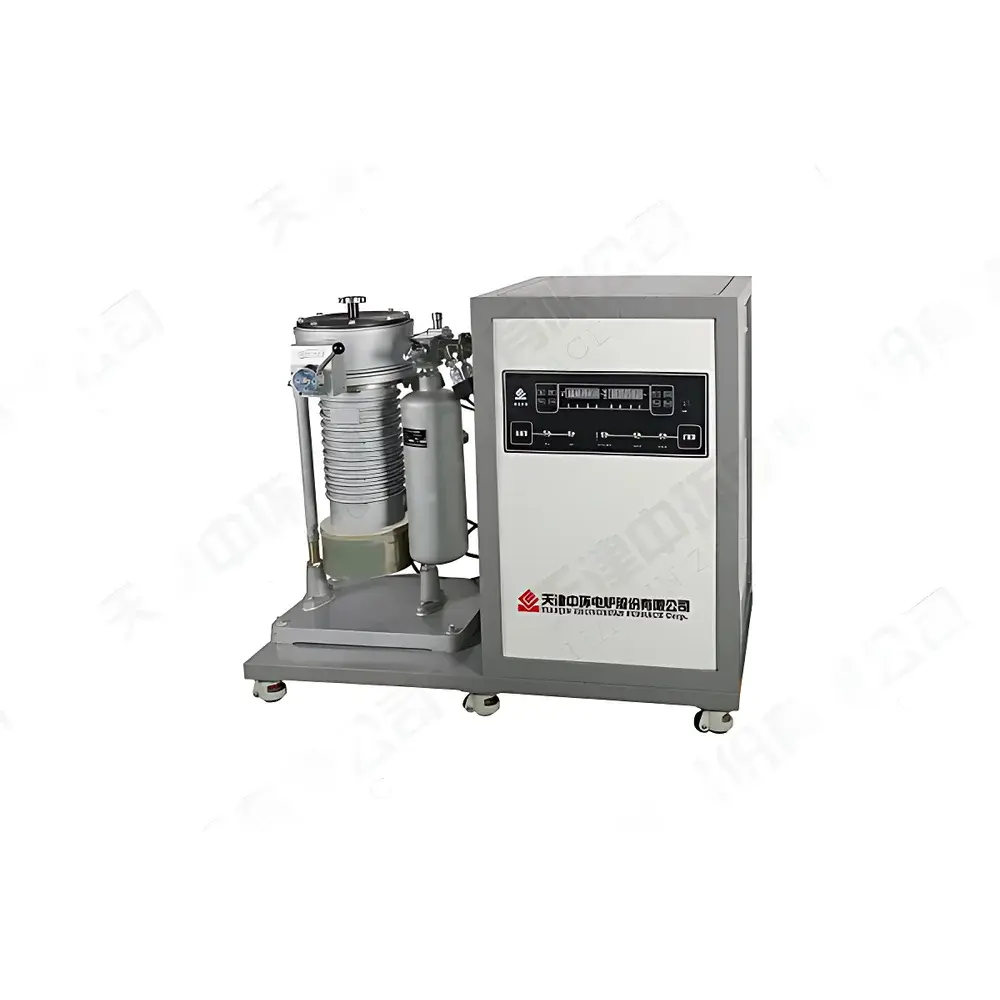
Zhonghuan Furnace High-Vacuum Diffusion Pump Control System
| Brand | Zhonghuan Furnace |
|---|---|
| Origin | Tianjin, China |
| Manufacturer Type | Authorized Distributor |
| Product Origin | Domestic (China) |
| Model | High-Vacuum Diffusion Pump Control System |
| Pricing | Upon Request |
Overview
The Zhonghuan Furnace High-Vacuum Diffusion Pump Control System is an integrated vacuum management platform engineered for precise, reliable, and automated operation in high-temperature thermal processing environments. It functions as a complete vacuum control assembly—combining vacuum generation, real-time pressure monitoring, and intelligent safety interlocking—specifically designed for integration with tube furnaces and box-type furnaces operating under vacuum or controlled atmosphere conditions. The system operates on the principle of sequential vacuum pumping: a two-stage rotary vane mechanical pump first achieves rough vacuum (typically 10⁻² to 10⁻¹ mbar), after which a diffusion pump—powered by a dedicated high-stability control power supply—takes over to reach high vacuum levels (down to ≤1×10⁻⁵ mbar). This staged architecture ensures robust performance across wide pressure ranges while maintaining thermal and electrical stability during furnace cycling. Unlike single-stage systems, this dual-pump configuration mitigates backstreaming risks and enhances long-term repeatability in vacuum-dependent processes such as sintering, annealing, thin-film deposition, and reactive synthesis.
Key Features
- KF-Flange Rapid Connection Interface: All gas inlet/outlet ports utilize standardized ISO-KF (Quick Flange) fittings, enabling tool-free, leak-tight connections via stainless-steel clamps—reducing installation time and minimizing alignment errors.
- Digital Vacuum Measurement: Equipped with a thermocouple gauge (TCG) paired with a high-resolution digital vacuum meter; displays vacuum level in scientific notation (e.g., 1.2×10⁻³ mbar), offering stable, low-drift readings with strong electromagnetic interference (EMI) immunity.
- Intelligent Safety Interlock Logic: Integrated pressure-sensing circuitry automatically suspends diffusion pump operation when chamber pressure exceeds safe threshold (e.g., >1×10⁻¹ mbar), preventing thermal shock or oil backstreaming; resumes operation only after vacuum integrity is restored and system stabilization is confirmed.
- Integrated Dual-Pump Architecture: Built-in two-stage rotary vane mechanical pump provides efficient pre-evacuation and serves as backing pump for the diffusion pump—eliminating external pump dependency and reducing footprint.
- Modular Structural Design: Rigid steel frame functions both as a vacuum control unit and a load-bearing platform—capable of supporting tube furnaces (up to Ø120 mm diameter) or box furnaces (up to 30 L volume) without additional mounting hardware.
Sample Compatibility & Compliance
The system is compatible with quartz, alumina, and stainless-steel vacuum chambers up to 600 mm in length and 150 mm in diameter. It supports continuous operation under inert (Ar, N₂), reducing (H₂/N₂ mix), or vacuum-only atmospheres. All internal wetted materials—including sealing elastomers (FKM/Viton®), stainless-steel piping, and diffusion pump oil (polyphenyl ether-based)—are selected for low outgassing and thermal stability up to 250 °C. The control electronics conform to IEC 61000-4 electromagnetic compatibility (EMC) standards. While not certified to UL/CE as a standalone appliance, the system meets functional safety requirements for laboratory-scale thermal equipment per ISO 12100 and aligns with GLP-compliant vacuum process documentation practices when used with audit-trail-capable data loggers.
Software & Data Management
The system operates via front-panel digital interface with no embedded software stack; however, analog output (0–10 VDC or 4–20 mA) is provided for vacuum pressure signal transmission to external PLCs, SCADA systems, or PC-based data acquisition platforms (e.g., LabVIEW, MATLAB). Optional RS-485 Modbus RTU communication enables remote monitoring and integration into centralized furnace control networks. When paired with Zhonghuan’s optional data logger module, it supports timestamped vacuum history logging compliant with 21 CFR Part 11 audit trail requirements—including user ID, event type (e.g., “pump start”, “interlock triggered”), and parameter values—facilitating traceability in regulated R&D and QA/QC workflows.
Applications
- Vacuum-assisted sintering of advanced ceramics (e.g., SiC, AlN) and metal matrix composites
- Controlled-atmosphere annealing of semiconductor wafers and photovoltaic substrates
- Graphene and 2D material synthesis via chemical vapor transport (CVT) under dynamic vacuum profiles
- Thermal gravimetric analysis (TGA) coupling where precise vacuum ramping is required
- Pre-treatment of catalyst supports prior to impregnation or calcination cycles
- Calibration and validation of vacuum gauges and leak detectors in metrology labs
FAQ
What vacuum level can this system achieve?
With proper maintenance and clean chamber conditions, the system achieves base pressures ≤1×10⁻⁵ mbar using the diffusion pump stage; ultimate pressure depends on chamber geometry, surface cleanliness, and ambient temperature.
Is the diffusion pump oil included?
Yes—the system ships with a factory-charged quantity of high-temperature polyphenyl ether diffusion pump oil, rated for continuous operation up to 220 °C.
Can the system operate without integration into a furnace?
Yes—it functions as a standalone high-vacuum source for vacuum chambers, coating systems, or electron microscopy sample prep stations.
Does it support automatic vacuum ramping profiles?
Not natively; profile-based control requires external programmable logic controller (PLC) or custom script integration via the analog/Modbus interface.
What maintenance intervals are recommended?
Mechanical pump oil should be changed every 500 operating hours; diffusion pump oil inspection is advised every 2,000 hours or after exposure to air ingress events. KF seals require replacement annually or after 50 thermal cycles.



