
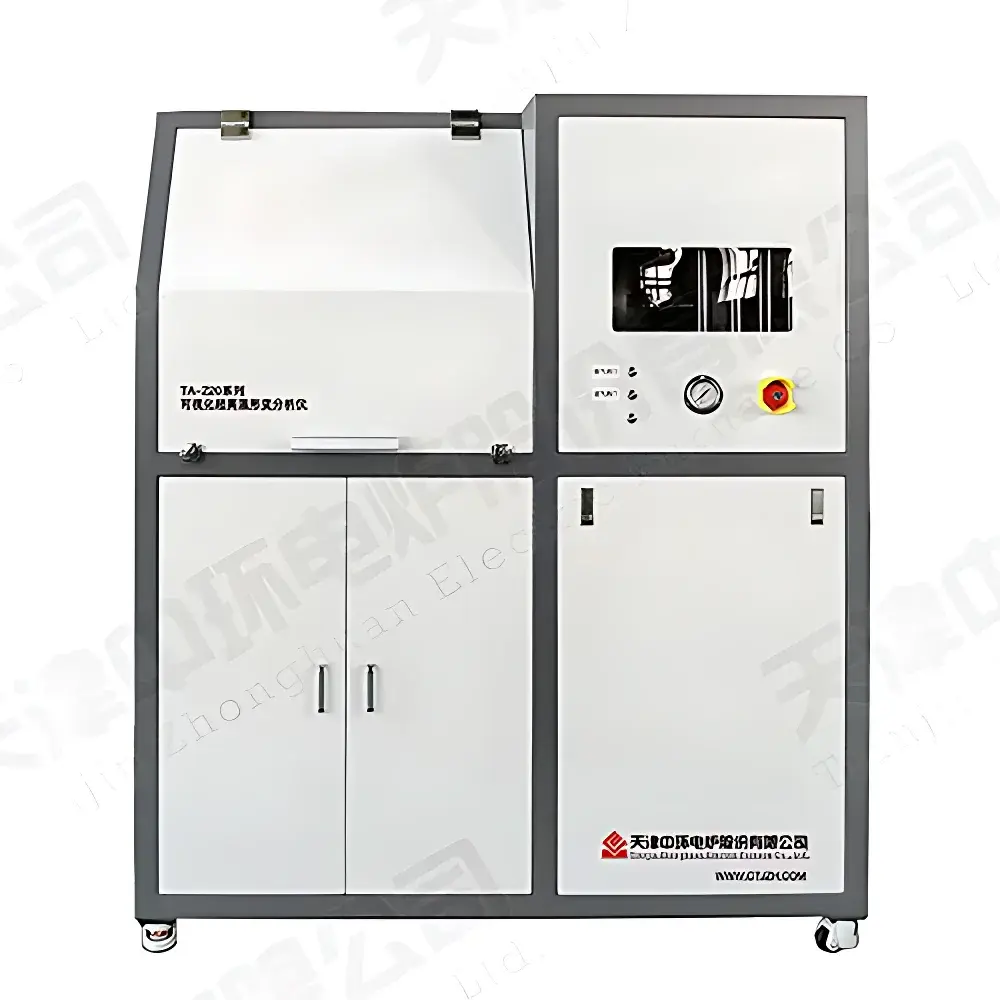
ZHONGHUAN FURNACE HTV-2000 Visual High-Temperature Dimensional Analyzer
| Brand | ZHONGHUAN FURNACE |
|---|---|
| Origin | Tianjin, China |
| Manufacturer Type | Authorized Distributor |
| Country of Origin | China |
| Model | HTV-2000 |
| Operating Temperature Range | Ambient to 2000 °C |
| Vacuum Level | ≤1×10⁻³ Pa |
| Atmosphere Options | High Vacuum or Inert Gas (Ar/N₂) |
| Heating Zone Dimensions | 550 mm × 60/50 mm (L×Φ) |
| Uniform Temperature Zone Length | 40 mm |
| Sample Size Range | 2×2 mm to 15×15 mm |
| Image Resolution | 10 µm/pixel |
| Dimensional Measurement Accuracy | ±10 µm per pixel |
| Contact Angle Range (optional module) | 0–180° |
| Contact Angle Precision (optional module) | ±0.1° |
| Power Supply | 380 V, 30 kW |
| Instrument Dimensions | 1080×1560×1866 mm |
| Net Weight | 830 kg |
Overview
The ZHONGHUAN FURNACE HTV-2000 Visual High-Temperature Dimensional Analyzer is an engineered platform for in situ, real-time observation and quantitative analysis of dimensional evolution and phase behavior of solid materials under extreme thermal conditions—up to 2000 °C—within controlled high-vacuum or inert atmospheres. Based on high-resolution optical imaging coupled with calibrated pixel-based metrology, the system captures dynamic changes in sample height, width, area, and contour during heating, holding, and cooling cycles. Unlike conventional dilatometers or static hot-stage microscopes, the HTV-2000 integrates synchronized thermal control, vacuum integrity monitoring, and automated image acquisition to generate reproducible expansion/contraction curves and time-resolved morphological datasets. Its design adheres to fundamental principles of thermal expansion metrology and interfacial thermodynamics, enabling rigorous process development in advanced ceramics, refractories, metallurgical alloys, and functional glass systems where transient sintering kinetics and interfacial wetting govern final microstructure and performance.
Key Features
- Ultra-high-temperature capability: Stable operation up to 2000 °C with dual-zone MoSi₂ heating elements and water-cooled flange assembly
- High-vacuum environment: Integrated turbomolecular pumping system achieving ≤1×10⁻³ Pa base pressure, compatible with residual gas analysis (RGA) integration
- Real-time visual monitoring: High-speed, low-noise CMOS camera with telecentric lens and long-working-distance optics, optimized for thermal radiation suppression
- Precision dimensional metrology: Pixel-calibrated analysis engine delivering sub-pixel interpolation for height/width/area tracking at 10 µm/pixel resolution
- Dual-mode operation: Standard configuration supports dimensional analysis; optional contact angle module enables quantitative θ–D–H measurement of molten droplets on substrates at temperatures ≥1800 °C
- Robust mechanical architecture: Stainless steel vacuum chamber with ceramic insulation, seismic-grade leveling feet, and modular electrical shielding compliant with IEC 61000-6-3 EMC standards
Sample Compatibility & Compliance
The HTV-2000 accommodates flat, freestanding specimens ranging from 2×2 mm to 15×15 mm in planar dimension and up to 10 mm in thickness—including green bodies, sintered compacts, single crystals, and layered composites. It supports ISO 31000-compliant risk-informed testing protocols and aligns with ASTM C373 (water absorption), ASTM C559 (refractory shrinkage), and ISO 1895 (ceramic sintering kinetics) methodological frameworks. All vacuum and temperature control subsystems are traceable to NIST-certified reference standards. Data acquisition meets GLP audit requirements via timestamped metadata embedding, user-access logging, and non-editable raw image archives—fully compatible with FDA 21 CFR Part 11 electronic record validation when deployed with validated software configurations.
Software & Data Management
The proprietary HTV-Analyze Suite provides a deterministic, scriptable workflow for batch processing of time-lapse image sequences. Core modules include: (1) Auto-edge detection using adaptive Canny–Sobel hybrid algorithms; (2) Reference-point stabilization via fiducial marker tracking; (3) Thermal drift compensation using background subtraction and affine registration; (4) Export of dimensional derivatives (dL/dt, dA/dt) and second-order parameters (inflection points, onset temperatures). Contact angle analysis (optional) employs Young–Laplace curve fitting with surface tension correction for high-temperature melt viscosity estimation. All datasets export to CSV, HDF5, and MATLAB .mat formats. Audit trails record operator ID, instrument state, calibration timestamps, and software version—enabling full traceability per ISO/IEC 17025 Clause 7.7.
Applications
- Sintering kinetics modeling: Deriving activation energies and diffusion coefficients from time-dependent linear/nonlinear shrinkage profiles
- Ceramic formulation optimization: Correlating green density, binder burnout rate, and pore architecture with final densification trajectories
- Refractory material development: Quantifying thermal expansion mismatch between matrix and aggregate phases under cyclic heating
- High-temperature packaging reliability: Assessing solder wettability and interfacial reaction layer growth on SiC, AlN, or metal-ceramic substrates
- Functional coating stability: Monitoring molten salt infiltration into porous ceramic membranes at operational temperatures
- Coal ash fusion behavior: Classifying softening, hemispherical, and fluid temperatures via continuous contour mapping—not limited to discrete point measurements
FAQ
What vacuum level is required to prevent oxidation during 2000 °C testing of reactive ceramics?
A base pressure of ≤1×10⁻³ Pa is sufficient for most oxide ceramics (e.g., Al₂O₃, ZrO₂); for carbides or nitrides, optional cryo-trapping or gettering may be integrated to achieve ≤5×10⁻⁵ Pa.
Can the system operate under flowing inert gas instead of vacuum?
Yes—the chamber supports dynamic purging with Ar or N₂ at flow rates up to 500 sccm, with pressure regulation from 10⁻³ Pa to 10⁵ Pa absolute.
Is the contact angle module compatible with molten metals such as Cu or Ni?
Yes, provided substrate compatibility is verified; the module has been validated for Ag, Cu, Sn–Ag–Cu, and Ti–Al alloys on graphite, BN, and Mo substrates.
How is thermal drift compensated during long-duration sintering experiments (>10 h)?
Drift correction combines hardware-level stage stabilization (active vibration damping) and software-level frame-to-frame registration using corner-detection anchors embedded in the furnace viewport geometry.
Does the system support automated ramp-hold-cool programming with conditional triggers?
Yes—custom thermal profiles can be linked to image capture events (e.g., “start recording at 1450 °C”, “pause at inflection point detected in dH/dt”).



