
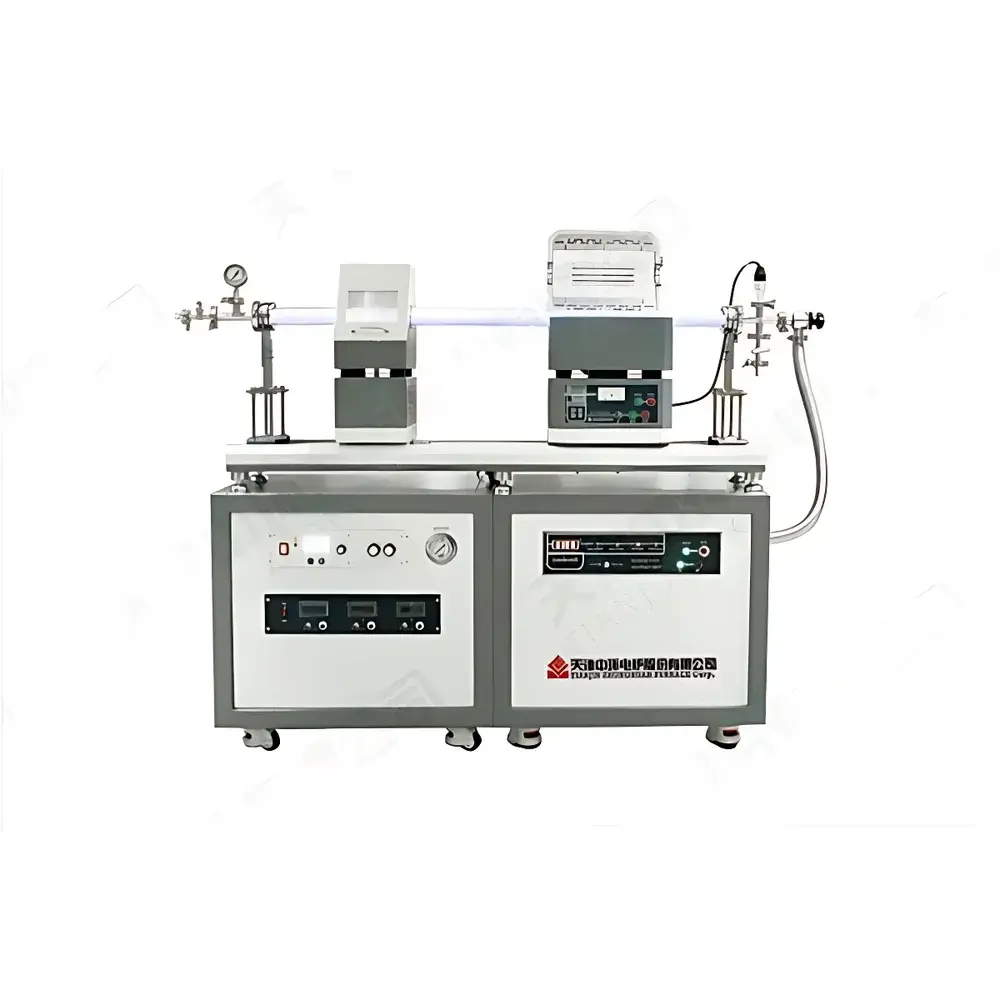
Zhonghuan Furnace PECVD-12IH-500A Integrated Plasma-Enhanced Chemical Vapor Deposition System with 1200°C Tube Furnace
| Brand | Zhonghuan Furnace |
|---|---|
| Origin | Tianjin, China |
| Instrument Type | Horizontal Single-Zone Vacuum Tube Furnace with RF Plasma Module |
| Max Temperature | 1200 °C |
| Temperature Control Accuracy | ±1 °C |
| Heating Zone Length | 200 mm |
| Uniform Temperature Zone Length | 100 mm |
| Tube Diameter | Φ60 mm (quartz) |
| Internal Chamber Dimensions | 290 × 350 × 495 mm |
| Rated Power | 2 kW |
| Programmable Ramp/Soak | 50-step PID control |
| RF Frequency | 13.56 MHz ±0.005% |
| RF Power Output Range | 0–500 W |
| Forward Power Stability | ±0.1% |
| Matching Network | Automatic capacitive tuner |
| Gas Channels | 4 (expandable to 6) |
| Mass Flow Range | 0–500 sccm per channel (N₂-calibrated, ±1% F.S.) |
| Operating Pressure Range | 10–100 Pa |
| Base Vacuum (with optional dual-stage pump) | ≤3×10⁻¹ Pa |
| Cooling | Intelligent air-cooling fan activation at surface temperature ≥50 °C |
| Control Interface | LCD touchscreen with micro-PLC architecture |
Overview
The Zhonghuan Furnace PECVD-12IH-500A is an integrated laboratory-scale plasma-enhanced chemical vapor deposition system engineered for reproducible thin-film synthesis under controlled thermal and reactive plasma environments. It combines a precision 1200 °C horizontal single-zone vacuum tube furnace with a fully matched 13.56 MHz radiofrequency (RF) plasma source, enabling low-temperature, high-quality film growth on substrates such as silicon wafers, quartz slides, metal foils, and flexible polymers. Unlike conventional thermal CVD, PECVD utilizes non-equilibrium plasma to dissociate precursor gases (e.g., SiH₄/NH₃ for SiNₓ, CH₄/H₂ for graphene, TiCl₄/Ar for TiN), significantly lowering required substrate temperatures while maintaining stoichiometric control and film density. The system operates within a defined pressure window (10–100 Pa), where electron-impact reactions dominate over thermal decomposition—critical for preserving temperature-sensitive substrates and achieving conformal step coverage in nanostructured templates.
Key Features
- High-stability 13.56 MHz RF generator with 0–500 W continuous output, <±0.1% power stability, and real-time forward/reflected power monitoring via N-type 50 Ω interface
- 50-segment programmable temperature profile with ±1 °C accuracy across a 1200 °C maximum operating range; uniform zone length of 100 mm ensures consistent thermal exposure
- Quartz tube configuration (Φ60 mm ID) rated for sustained operation up to 1150 °C under vacuum or inert/reducing atmospheres
- Four-channel mass flow controller (MFC) system with digital keypad interface, calibrated for N₂ and compatible with common precursors (NH₃, SiH₄, O₂, Ar, H₂); optional expansion to six channels
- Intelligent thermal management: air-cooling fans activate automatically when external furnace surface exceeds 50 °C, ensuring operator safety and structural integrity during rapid thermal cycling
- Modular vacuum architecture: designed for integration with externally sourced dual-stage rotary vane pumps (4 L/s nominal pumping speed, base pressure ≤3×10⁻¹ Pa)
- LCD touchscreen interface with embedded micro-PLC logic supports local operation, parameter logging, and alarm-triggered shutdown protocols
Sample Compatibility & Compliance
The PECVD-12IH-500A accommodates standard 2″–4″ wafers, microscope slides (up to 75 × 25 mm), and custom substrates mounted on graphite or ceramic holders. Its low-pressure plasma environment enables deposition of amorphous silicon (a-Si:H), silicon nitride (SiNₓ), silicon dioxide (SiO₂), titanium nitride (TiN), aluminum oxide (Al₂O₃), and carbon-based films—including monolayer graphene nucleation on Cu foil. All gas handling components comply with ISO 8573-1 Class 4 purity standards for compressed air and process gases. While not certified to IEC 61000-6-3 or UL 61010-1 out-of-the-box, the system meets fundamental electrical safety and electromagnetic compatibility requirements for research-grade laboratory use. Vacuum flanges utilize multi-ring elastomeric sealing and quick-clamp coupling per ISO-KF 25/40 standards.
Software & Data Management
Local operation is managed through the integrated LCD interface, which records time-temperature-RF-power-gas flow logs at user-defined intervals (1–60 s resolution). Data export is supported via USB flash drive in CSV format for post-processing in MATLAB, Python (Pandas), or OriginLab. Optional RS-485 or Ethernet communication modules enable remote supervision and integration into centralized lab automation platforms compliant with IEEE 1851-2012. For GLP/GMP-aligned workflows, audit trail functionality—including operator ID tagging, parameter change history, and timestamped event logs—can be enabled via firmware update. No cloud connectivity or proprietary software installation is required for basic operation.
Applications
- Growth of passivation layers (SiNₓ, Al₂O₃) for photovoltaic cell fabrication and perovskite solar module encapsulation
- Synthesis of conductive transparent oxides (ITO, AZO) and transition-metal dichalcogenides (MoS₂, WS₂) on flexible polyimide substrates
- Plasma-assisted nitridation and oxidation of III-V semiconductors (GaAs, InP) for gate dielectric formation
- In-situ plasma cleaning and surface activation prior to ALD or sputtering steps
- Deposition of biocompatible coatings (e.g., diamond-like carbon, SiO₂) on medical device substrates under ISO 13485-aligned protocols
- Fundamental studies of plasma-surface interaction kinetics using Langmuir probe-compatible configurations (optional add-on)
FAQ
What vacuum level is required for stable plasma ignition?
Stable capacitive-coupled plasma discharge is achievable between 10–100 Pa; optimal film uniformity is typically observed at 20–40 Pa with appropriate RF matching.
Can the system operate with corrosive precursors such as NF₃ or BCl₃?
Yes—provided stainless-steel gas lines, VCR fittings, and chemically resistant MFC seals (e.g., Kalrez®) are specified at order; standard configuration uses EPDM-compatible components.
Is quartz tube replacement included in routine maintenance?
Quartz tubes are consumables with finite thermal cycling life; typical service interval is 200–300 cycles depending on ramp rate and atmosphere; spare tubes (Φ60 mm × 600 mm) are available as OEM parts.
Does the RF generator support pulsed mode operation?
No—the standard 500 W RF source operates in continuous-wave (CW) mode only; pulsed RF capability requires optional external pulse modulator (not included).
What electrical infrastructure is required for installation?
Single-phase 220 V AC ±10%, 50/60 Hz, dedicated 16 A circuit with earth-ground continuity verified to IEC 60364-5-54 standards.



