
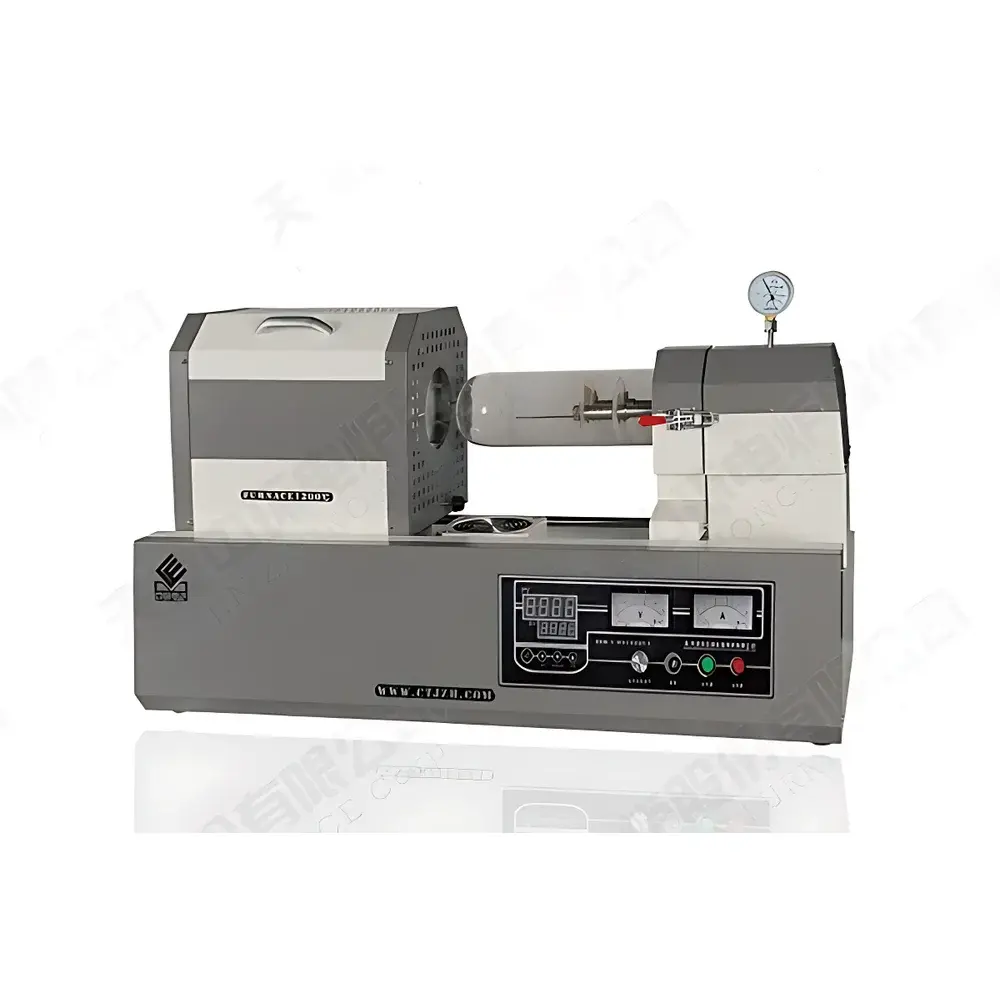
ZHONGHUAN FURNACE RTP-G11103-K Compact Rapid Thermal Processing Furnace
| Brand | ZHONGHUAN FURNACE |
|---|---|
| Origin | Tianjin, China |
| Instrument Type | Tube Furnace |
| Max Temperature | 1000 °C |
| Temperature Control Accuracy | ±1 °C |
| Max Power | 9 kW |
| Heating Rate (RT→900 °C) | 30 °C/s |
| Heating Rate (900→1000 °C) | 10 °C/s |
| Heating Method | Infrared Lamp Array |
| Internal Chamber Dimensions | 950 × 350 × 530 mm |
| Heating Zone Length | 300 mm |
| Uniform Temperature Zone Length | 100 mm |
| Quartz Tube Dimensions | Φ110 × 380 mm |
| Tube Material | High-Purity Fused Quartz |
| Sliding Stroke | 355 mm |
| Sliding Mechanism | Manual Linear Translation |
| Weight | 45 kg |
| Voltage/Frequency | 220 V AC, 50/60 Hz |
| Programmable Controller | 50-Step Ramp-Soak Profile |
| Standard Accessories | Vacuum/Atmosphere Gas Train (with Dual-Range Pressure Gauge), One Quartz Tube, One Quartz Sample Holder (76 mm), Pair of High-Temperature Gloves |
Overview
The ZHONGHUAN FURNACE RTP-G11103-K is a compact, benchtop rapid thermal processing (RTP) furnace engineered for high-precision, transient thermal treatments in semiconductor process development, photovoltaic R&D, and advanced materials synthesis. Unlike conventional resistance-heated tube furnaces, this system employs an array of high-intensity infrared lamps to deliver localized, controllable radiant heating—enabling ultra-fast thermal ramping without significant thermal mass lag. The core operational principle relies on selective absorption of near-infrared radiation by substrates (e.g., Si wafers, thin-film stacks, or metal-coated glasses), allowing direct, non-contact energy transfer with minimal heat loss to the ambient environment. Its integrated sliding tube mechanism enables rapid physical displacement of the quartz reaction chamber from the hot zone, while a forced-air cooling system accelerates quenching—achieving effective thermal cycles with sub-second exposure control at peak temperatures up to 1000 °C. Designed for laboratory-scale process optimization—not production throughput—the RTP-G11103-K supports repeatable, traceable thermal protocols essential for evaluating annealing kinetics, oxide growth kinetics, dopant activation, and interfacial reaction thermodynamics.
Key Features
- Infrared lamp-based heating system delivering rapid, uniform radiant flux across a 300 mm active heating zone, with a 100 mm isothermal region (±1 °C) verified by in-tube thermocouple monitoring
- Manually actuated linear translation stage enabling precise, repeatable retraction of the quartz tube (355 mm stroke) to terminate thermal exposure and initiate convective cooling
- 50-segment programmable temperature controller supporting complex ramp-soak-cool profiles, compliant with GLP documentation requirements for audit-ready experimental records
- Benchtop footprint (950 × 350 × 530 mm) with front-access quick-flange coupling—minimizing quartz tube handling stress and reducing risk of thermal shock-induced fracture during installation
- Standard vacuum/atmosphere gas train with dual-range pressure gauge (0–760 Torr / –0.1 to 0 MPa), compatible with inert (N₂, Ar), oxidizing (O₂), or forming (N₂/H₂) ambient configurations
- High-purity fused quartz tube (Φ110 × 380 mm) rated for continuous use up to 950 °C and intermittent operation at 1000 °C for <1 hour per cycle
Sample Compatibility & Compliance
The RTP-G11103-K accommodates standard 2–6 inch semiconductor wafers, coated glass substrates, and small-area thin-film samples mounted on a 76 mm quartz sample holder. Its design supports process compatibility with ASTM F1478 (Standard Practice for Evaluating Rapid Thermal Processing Equipment), ISO 14644-1 (cleanroom-compatible operation when used with filtered purge gases), and USP <1058> (analytical instrument qualification framework). While not FDA 21 CFR Part 11–certified out-of-the-box, the programmable controller logs timestamped setpoint and actual temperature data in CSV format—enabling manual implementation of ALCOA+ data integrity principles (Attributable, Legible, Contemporaneous, Original, Accurate, Complete, Consistent, Enduring, Available) for GMP-aligned labs.
Software & Data Management
The embedded temperature controller provides local interface via tactile keypad and LCD display, with full profile editing, real-time curve visualization, and event-triggered alarm outputs (over-temperature, power failure, door open). Data export is supported via USB port to external storage; no proprietary software or cloud dependency is required. All 50-step programs—including ramp rates, soak durations, and cooling logic—are stored in non-volatile memory with battery-backed retention. Optional RS485 Modbus RTU output allows integration into centralized lab automation systems for remote monitoring and synchronized multi-instrument sequencing.
Applications
- Post-ion-implantation annealing of Si, Ge, and III–V substrates
- Growth of ultrathin silicon dioxide (SiO₂) and hafnium oxide (HfO₂) gate dielectrics via rapid thermal oxidation (RTO) and rapid thermal chemical vapor deposition (RTCVD)
- Metal silicide formation (e.g., NiSi, CoSi₂) and contact alloying for CMOS and MEMS fabrication
- Crystallization and phase transformation studies in chalcogenide thin films (e.g., Ge₂Sb₂Te₅, MoS₂)
- Thermal stability assessment of perovskite photovoltaic layers under controlled N₂/O₂ partial pressures
- Activation of rare-earth dopants in phosphor precursors and solid-state laser host materials
FAQ
What atmosphere options are supported?
Standard configuration includes vacuum capability down to 10⁻² mbar and compatibility with N₂, Ar, O₂, and 5% H₂/N₂ forming gas via the integrated gas train with stainless-steel fittings and needle valves.
Is the quartz tube included with the system?
Yes—one high-purity fused quartz tube (Φ110 × 380 mm) is supplied as part of the standard configuration, along with a 76 mm quartz sample holder and high-temperature gloves.
Can the system be operated under vacuum during heating?
Yes, but vacuum operation above 800 °C requires careful outgassing of the quartz tube prior to ramping; prolonged high-temperature vacuum exposure may accelerate quartz devitrification and should be limited to <15 minutes per cycle.
How is temperature uniformity validated?
Uniformity is characterized using a calibrated multi-point thermocouple probe inserted axially within the quartz tube at the center of the heating zone, following ISO/IEC 17025–aligned calibration procedures traceable to NIST standards.
What maintenance is required for the infrared lamp array?
Lamp lifetime exceeds 2000 hours under nominal operating conditions. Periodic visual inspection for filament discoloration or envelope clouding is recommended; replacement lamps are field-swappable without recalibration.
Related Products



