
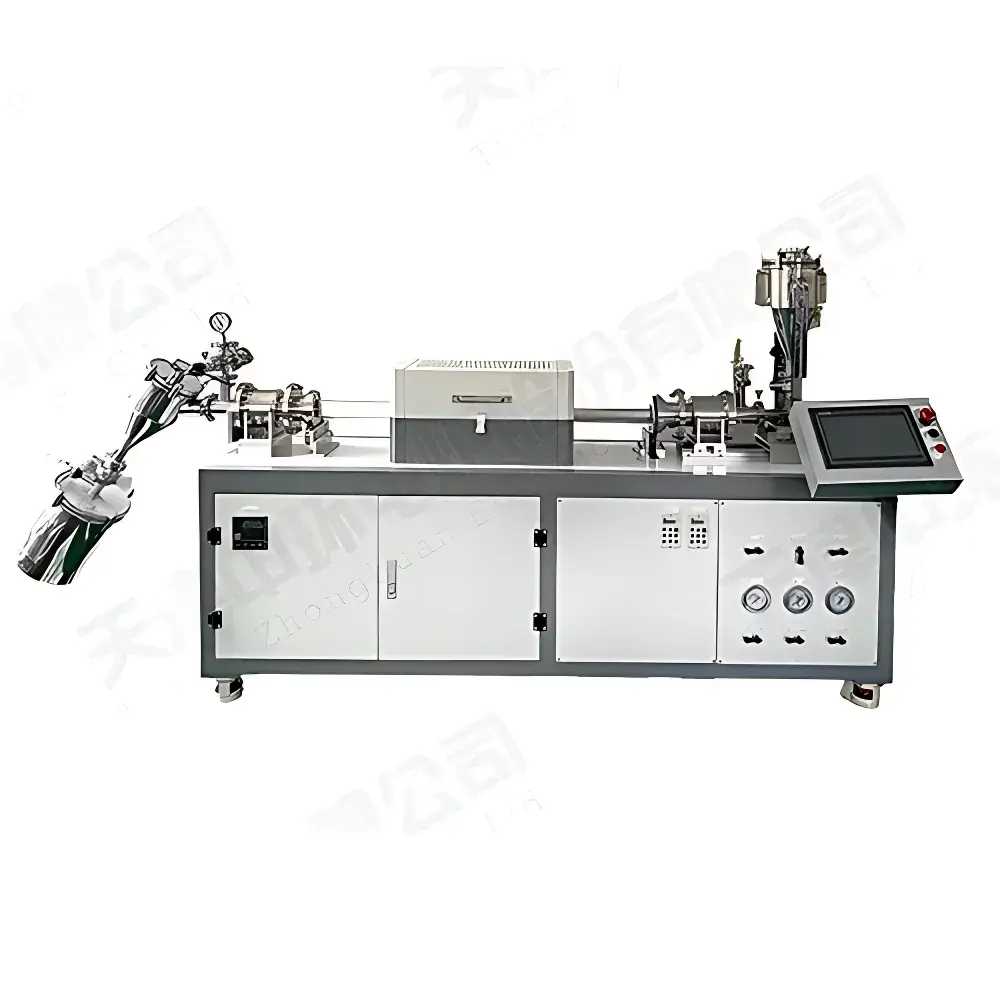
ZHONGHUAN FURNACE SK-G10123K-ZR-1 Automated Feed Rotating Tube Furnace
| Brand | ZHONGHUAN FURNACE |
|---|---|
| Origin | Tianjin, China |
| Model | SK-G10123K-ZR-1 |
| Max Temperature | 1200 °C |
| Operating Temperature Range | ≤1100 °C |
| Heating Zone Length | 420 mm |
| Temperature Control Accuracy | ±1 °C |
| Ramp Rate | 0–15 °C/min |
| Rated Power | 3.8 kW |
| Heating Element | High-Grade Resistance Alloy Wire |
| Tube Dimensions | φ60×420 mm (ends), φ100×360 mm (center), L=1200 mm |
| Rotation Speed | 0–25 r/min |
| Feed Mechanism | Motor-Driven Auger with Adjustable Speed |
| Gas Flow Control | Mass Flow Controller (0–500 sccm, single channel standard) |
| Base Vacuum (cold, empty) | <10 Pa (with optional pump & gauge) |
| Tilt Angle Range | 0–45° |
Overview
The ZHONGHUAN FURNACE SK-G10123K-ZR-1 Automated Feed Rotating Tube Furnace is an engineered thermal processing system designed for controlled atmosphere heat treatment of fine particulate and powder materials. It integrates programmable temperature control, continuous rotational motion, automated axial feed, and adjustable furnace tilt to ensure uniform thermal exposure and reproducible solid-state reaction kinetics. The furnace operates on the principle of conductive and radiant heating via high-stability resistance alloy wire elements embedded in a multi-crystalline mullite fiber insulation chamber. Its rotating quartz tube—equipped with internal quartz baffles—induces continuous tumbling of feedstock, mitigating particle agglomeration and promoting homogenous heat transfer across the entire sample bed. This architecture is particularly suited for solid-phase synthesis, carbothermal reduction, coating pyrolysis, and annealing processes where batch consistency, interfacial contact uniformity, and gas–solid interaction efficiency are critical.
Key Features
- 360° continuous rotation system with dual-side magnetic fluid seals, enabling stable, leak-tight operation under inert or reducing atmospheres at speeds adjustable from 0 to 25 rpm;
- Motor-driven auger feed mechanism with variable-speed control for precise, repeatable dosing of powders into the hot zone—minimizing thermal shock and ensuring consistent residence time distribution;
- 0–45° programmable tilting capability for gravity-assisted loading and unloading, significantly improving operational safety and throughput in routine lab workflows;
- 10-inch industrial-grade LCD HMI with PLC-based control architecture, supporting up to 16-segment temperature ramp/soak programs and synchronized actuation of rotation, tilt, feeding, and gas flow subsystems;
- Fuzzy PID temperature regulation ensures ±1 °C stability across the full operating range (room temperature to 1200 °C), with recommended continuous use limited to ≤1100 °C for extended heater longevity;
- Integrated mass flow controller (standard 1-channel, 0–500 sccm) with user-configurable gas selection and calibration tables—compatible with N₂, Ar, H₂, NH₃, and forming gas mixtures;
- Optional vacuum package—including two-stage rotary vane pump and resistive vacuum gauge—enables base pressures <10 Pa (cold, empty), suitable for low-oxygen sintering and volatile byproduct removal.
Sample Compatibility & Compliance
The SK-G10123K-ZR-1 accommodates free-flowing powders, granules, and coated precursor particles with median diameters ranging from 100 nm to 500 µm. It is routinely deployed for thermal processing of lithium-ion battery cathode/anode precursors (e.g., NMC, LFP, SiOx, hard carbon), ceramic oxides (Al₂O₃, Y₂O₃, ZrO₂), metal-organic frameworks (MOFs), and catalytic supports. Quartz tube geometry (φ60/φ100 mm stepped bore, 1200 mm total length) allows simultaneous optimization of feedstock volume, gas residence time, and thermal gradient profile. The system complies with general laboratory safety standards for Class II electrical equipment (IEC 61010-1) and supports GLP-aligned documentation when paired with optional audit-trail-capable data logging software. While not certified to FDA 21 CFR Part 11 out-of-the-box, its programmable logic controller architecture permits integration with validated electronic record systems under site-specific qualification protocols.
Software & Data Management
Temperature, rotation speed, tilt angle, auger feed rate, and gas flow are logged in real time to internal non-volatile memory (10,000+ data points) and exportable CSV files via USB interface. The HMI firmware supports manual override, emergency stop sequencing, and fault-code diagnostics (e.g., overtemperature, seal leakage detection, motor stall). Optional PC-based software provides trend visualization, comparative run analysis, and PDF report generation—including timestamped parameter traces, setpoint deviations, and event markers for process deviations. All control logic adheres to IEC 61131-3 structured text conventions, facilitating third-party SCADA integration in pilot-scale manufacturing environments.
Applications
- Lithium battery material synthesis: solid-state reaction of layered oxide cathodes, carbon-coating pyrolysis of silicon anodes, and oxygen-deficient annealing of Li-rich manganese oxides;
- Ceramic powder densification: low-temperature sintering of nanostructured alumina and zirconia with minimized grain growth;
- Functional coating development: ALD/CVD precursor decomposition on nanoparticle substrates under controlled partial pressure;
- Thermal stabilization of MOFs and covalent organic frameworks (COFs) for gas storage applications;
- Reductive roasting of transition metal sulfides and phosphates for catalyst pre-activation;
- Atmosphere-sensitive calcination of phosphors and upconversion nanocrystals where stoichiometric fidelity depends on precise O₂ partial pressure control.
FAQ
What types of atmospheres can be used with this furnace?
Nitrogen, argon, hydrogen, ammonia, and custom gas mixtures are supported via the mass flow controller; vacuum operation is enabled with optional pumping hardware.
Is the quartz tube replaceable, and what is its expected service life?
Yes—the stepped-diameter quartz tube is a consumable component; typical lifetime exceeds 200 cycles at ≤1100 °C in inert atmosphere, depending on thermal cycling frequency and particulate abrasion.
Can the feed rate be synchronized with temperature ramping?
Yes—PLC logic allows conditional triggering of auger activation based on temperature thresholds or time elapsed within a program segment.
Does the system support remote monitoring or Ethernet connectivity?
Standard configuration includes USB data export only; RS-485 Modbus RTU communication is available as a factory option for integration into centralized lab networks.
What safety interlocks are built into the system?
Hardware-level cut-offs include overtemperature shutdown, rotation motor thermal protection, tilt-angle limit switches, and door-open inhibition of heating and rotation functions.



