
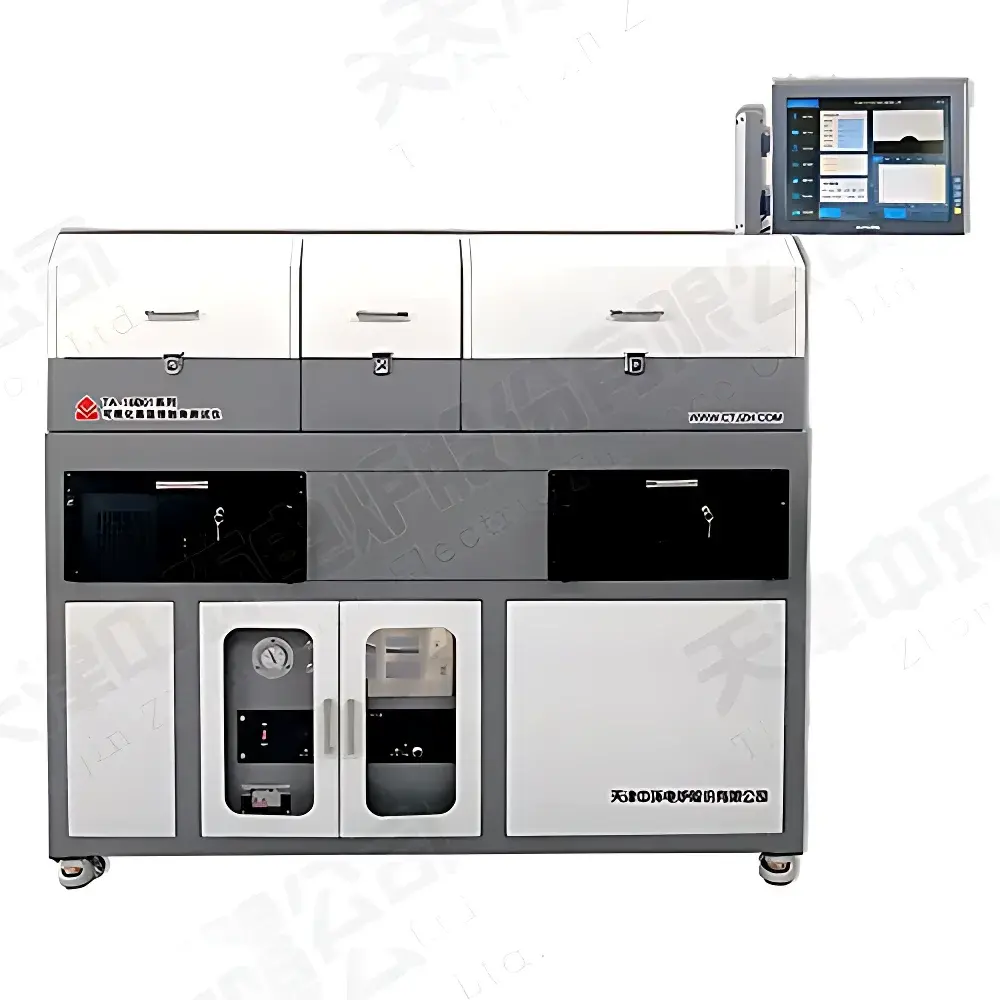
ZHONGHUAN FURNACE TA-16B01 High-Temperature Visual Contact Angle Analyzer (Air Atmosphere)
| Brand | ZHONGHUAN FURNACE |
|---|---|
| Origin | Tianjin, China |
| Manufacturer Type | Authorized Distributor |
| Product Origin | Domestic (China) |
| Model | TA-16B01, TA-Z16B01 |
| Instrument Category | High-Temperature Vacuum Contact Angle Measurement System |
| Instrument Form Factor | Benchtop Laboratory System |
| Contact Angle Measurement Accuracy | ±1° |
Overview
The ZHONGHUAN FURNACE TA-16B01 High-Temperature Visual Contact Angle Analyzer is an engineered research platform designed for quantitative, in situ characterization of solid–liquid interfacial behavior under elevated temperature conditions—up to 1600 °C—in controlled atmospheric environments. Unlike conventional room-temperature goniometers, this system integrates a high-precision optical imaging module with a modular ultra-high-temperature furnace chamber and programmable thermal control architecture. It operates on the principle of sessile drop analysis using real-time video capture and geometric contour fitting algorithms to determine contact angle (θ), droplet diameter (d), height (h), and volume (v) as functions of temperature or time. The instrument supports both static measurements at fixed temperatures and dynamic profiling across thermal cycles—including heating, soaking, and cooling ramps—enabling rigorous thermodynamic and kinetic analysis of wetting, spreading, and interfacial reactivity in ceramic, metallic, glassy, and composite systems.
Key Features
- Maximum operating temperature of 1600 °C with thermal stability better than ±2 °C over extended dwell periods
- Benchtop modular design featuring interchangeable furnace inserts, precision XYZ sample stage with micrometer-driven alignment, and coaxial optical path configuration
- High-speed CCD imaging system capable of ≥30 frames per second, enabling continuous acquisition throughout thermal transients
- Integrated atmosphere control options: ambient air (standard), vacuum down to 1×10⁻³ Pa, and reactive/inert gas environments with oxygen partial pressure controllable to <10−2 ppm
- Automated image processing software that computes contact angle, base diameter, apex height, and droplet volume frame-by-frame; outputs time- and temperature-resolved datasets in CSV and HDF5 formats
- Fully programmable 50-segment thermal profile capability for simulating complex sintering, brazing, or thermal cycling protocols
Sample Compatibility & Compliance
The TA-16B01 accommodates diverse specimen geometries—including powders, green compacts, sintered pellets, machined substrates, and thin-film-coated wafers—without requiring specialized mounting fixtures. Sample holders are fabricated from high-purity graphite or molybdenum to ensure dimensional stability and minimal chemical interaction up to 1600 °C. All hardware and software modules comply with general laboratory safety standards for high-temperature equipment (IEC 61010-1). While not certified to ISO/IEC 17025, the system supports GLP-compliant workflows through audit-trail-enabled software logging, user-access controls, and exportable raw image sequences—facilitating traceability required for materials qualification under ASTM C1428 (Standard Test Method for Contact Angle of Molten Metals), ISO 20520 (High-temperature surface tension and wettability), and internal R&D documentation protocols.
Software & Data Management
The proprietary analysis suite provides calibrated pixel-to-micron scaling, edge-detection optimization for low-contrast molten droplets, and batch-processing pipelines for multi-sample thermal series. Raw video files are stored losslessly in AVI or MP4 format; processed parameters are exported with timestamps, temperature readings from dual thermocouples (Type S), and metadata tags (e.g., atmosphere mode, heating rate, sample ID). Software supports data overlay of θ vs. T curves across multiple runs, statistical reporting of hysteresis loops, and export to MATLAB, Python (via Pandas), or Excel for further modeling—such as Young–Dupré equation fitting or surface energy component derivation using Owens–Wendt methodology. Audit logs record operator login, parameter changes, and analysis events in accordance with FDA 21 CFR Part 11 principles (electronic signature readiness available upon request).
Applications
- Development and screening of sintering aids for advanced ceramics (e.g., Si₃N₄, Al₂O₃, ZrO₂), correlating contact angle evolution with densification onset and grain boundary mobility
- Wettability assessment of braze alloys (Ag–Cu, Ni-based, Ti–Al) on refractory metal or ceramic substrates for hermetic packaging and power electronics
- Determination of characteristic thermal transition points—including softening, sintering, and melting—of powder metallurgy preforms and recycled slag-derived materials
- In situ evaluation of CMAS (calcium–magnesium–aluminosilicate) infiltration resistance in environmental barrier coatings (EBCs) for turbine components
- Quantitative analysis of slag–metal interfacial reactions in metallurgical slags (e.g., copper converter slag, steelmaking pre-melted fluxes) under simulated industrial conditions
FAQ
What is the maximum recommended heating rate for stable contact angle measurement?
For optimal droplet shape fidelity and thermal equilibrium, a ramp rate of ≤10 °C/min is advised above 1000 °C; slower rates (≤5 °C/min) are recommended during critical transitions (e.g., near melting point).
Can the system measure advancing and receding contact angles at high temperature?
Yes—by sequential dispensing and retraction of molten phase via micro-syringe (optional accessory), dynamic hysteresis loops can be constructed across temperature ranges.
Is vacuum-compatible optical viewport included as standard?
Yes—the furnace is equipped with a fused silica viewport rated for UHV compatibility and broadband transmission (200–2500 nm), suitable for both visible-light imaging and optional IR pyrometry integration.
Does the software support ASTM D7334 or ISO 19403-compliant contact angle calculation methods?
The core algorithm implements tangent and circle-fitting methods aligned with ISO 19403-2; full compliance with ASTM D7334 requires external calibration verification using NIST-traceable reference surfaces, which is supported via user-defined reference libraries.
Are there service and calibration options available outside China?
ZHONGHUAN FURNACE partners with regional technical service providers in Europe and North America for remote diagnostics, on-site preventive maintenance, and NIST-traceable temperature calibration—subject to local regulatory approvals and shipping logistics.



