
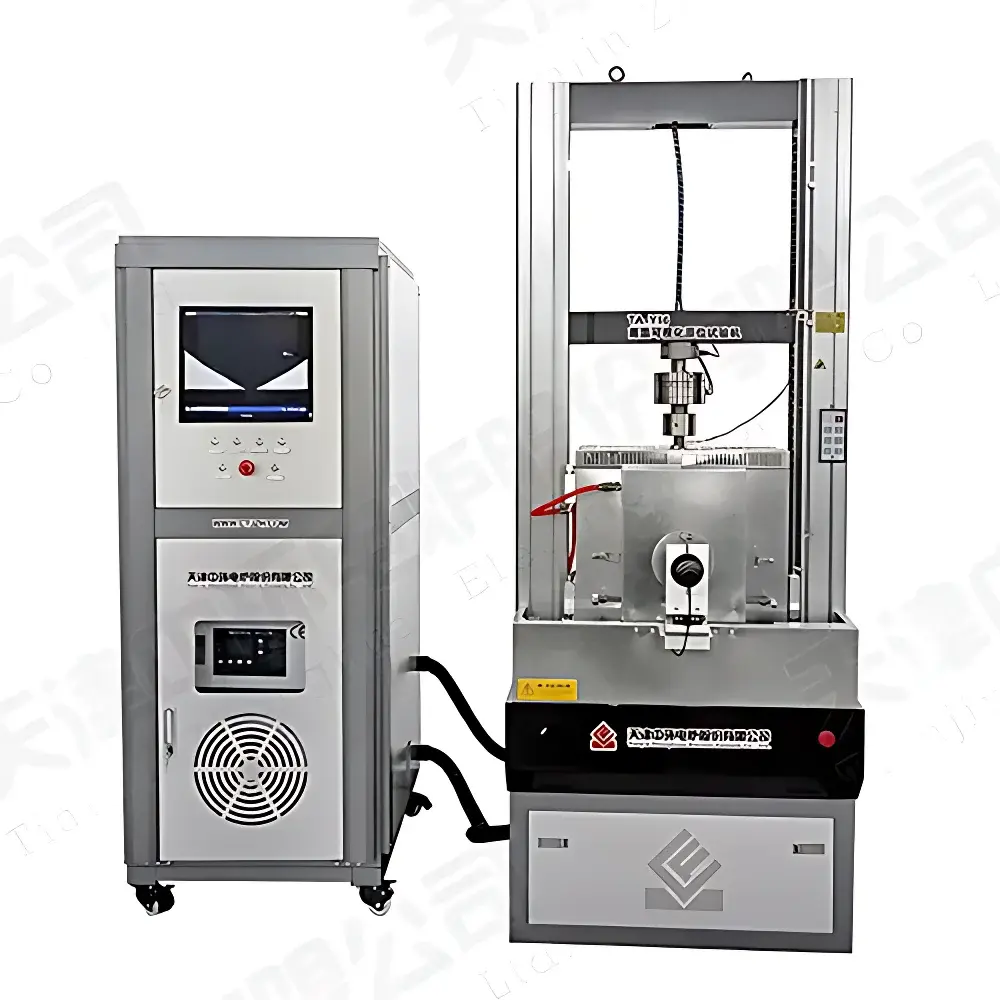
Zhonghuan Furnace YA-Y16 High-Temperature In Situ Visualization Testing System
| Brand | Zhonghuan Furnace |
|---|---|
| Origin | Tianjin, China |
| Model | YA-Y16 |
| Temperature Range | RT–1600 °C (≤1400 °C under load) |
| Heating Rate | 0–20 °C/min adjustable |
| Heating Element | MoSi₂ rods |
| Thermocouple Type | Type B |
| Temperature Control Accuracy | ±1 °C |
| Temperature Measurement Accuracy | Class 0.2 |
| Sample Chamber Dimensions | 80 × 100 × 140 mm |
| Standard Sample Size | 3 × 8 × 60 mm |
| Fixture Material | Alumina |
| Indenter Material | Silicon Carbide |
| Maximum Load Capacity | 5 kN |
| Dimensional Shrinkage Resolution | 1 µm (dual-lens mode) / 10 µm (single-lens mode) |
| Image Acquisition Frequency | User-configurable |
| Power Supply | 220 V, 50 Hz, 5 kW |
Overview
The Zhonghuan Furnace YA-Y16 High-Temperature In Situ Visualization Testing System is an integrated thermo-mechanical characterization platform engineered for real-time, optically guided evaluation of structural materials under elevated temperatures. It combines a precision-controlled high-temperature furnace (up to 1600 °C), a synchronized uniaxial mechanical testing module (5 kN capacity), and a dual-lens optical imaging system featuring custom LED blue-light telecentric illumination. This architecture enables quantitative in situ observation of deformation, cracking, phase evolution, dimensional change, and microstructural response during thermal and mechanical loading—without interrupting the test or removing the specimen. The system operates on the principle of coupled thermomechanical imaging: thermal energy induces material response (e.g., elastic modulus shift, plastic flow, interfacial delamination), while high-resolution optical metrology captures sub-micron-scale displacement fields and surface morphology changes frame-by-frame. Designed specifically for R&D laboratories and quality assurance units working with refractory metals, superalloys, advanced ceramics, ceramic matrix composites (CMCs), and thermal/environmental barrier coatings (TBCs/EBCs), the YA-Y16 supports fundamental property mapping across temperature gradients under controlled atmospheres (ambient air).
Key Features
- Real-time, non-contact measurement of elastic modulus evolution from room temperature to 1400 °C under load—enabling identification of ductile-to-brittle transition temperatures (DBTT) and modulus-temperature coefficients.
- In situ quantification of high-temperature energy dissipation and elastic recovery ratios—critical for evaluating cyclic fatigue resistance and viscoelastic relaxation behavior in ceramics and intermetallics.
- Dynamic hardness profiling via high-temperature spherical indentation, supporting ISO 14577-compliant hardness-temperature correlations.
- Thermal stress mapping of ceramic coatings through curvature-based strain analysis during ramped heating/cooling cycles—validated against ASTM C1358 for TBC adhesion assessment.
- High-fidelity tracking of notch sensitivity, crack initiation, and propagation kinetics in complex geometries (e.g., notched rings, miniature turbine blade sections) under combined thermal–mechanical–oxidative loading.
- Simultaneous acquisition of mechanical load–displacement data and synchronized optical video streams (up to 60 fps at 1080p resolution), enabling pixel-level digital image correlation (DIC) post-processing.
- Dual-lens optical configuration provides both macro-scale deformation monitoring (10 µm resolution) and localized micro-feature analysis (1 µm resolution) within the same experimental run.
Sample Compatibility & Compliance
The YA-Y16 accommodates standard flexural bars (3 × 8 × 60 mm), compression cylinders, and custom-shaped specimens up to 80 × 100 × 140 mm in chamber volume. Compatible material classes include Ni-based superalloys (e.g., Inconel 718, Haynes 230), SiC/SiC CMCs, Al₂O₃ and ZrO₂-based ceramics, mullite refractories, and plasma-sprayed YSZ or La₂Zr₂O₇ thermal barrier coatings. All mechanical fixtures are fabricated from high-purity alumina (≥99.8% Al₂O₃), and indenter tips use reaction-bonded silicon carbide (SiC) for oxidation resistance above 1200 °C. The system meets structural safety requirements per ISO 12100 and incorporates redundant over-temperature cutoffs aligned with IEC 61508 SIL-2 functional safety principles. While not certified for GMP production environments, its data logging architecture supports GLP-compliant audit trails when paired with validated third-party software.
Software & Data Management
The embedded control suite provides synchronized orchestration of furnace ramping, load application, and image capture via time-stamped event triggers. Raw video sequences (AVI/H.264) and force–displacement datasets (CSV/ASCII) are stored with metadata including thermocouple readings, stage position, and user-defined annotations. Exported frames support DIC analysis using open-source tools (e.g., Ncorr, PyDIC) or commercial packages (VIC-2D, ARAMIS). The system does not enforce proprietary file locking; all outputs are interoperable with MATLAB, Python (OpenCV, scikit-image), and OriginLab for statistical modeling of temperature-dependent property trends. Audit-ready reports—including calibration logs, environmental deviation flags, and operator sign-off fields—can be generated manually or scheduled automatically. While native software does not implement FDA 21 CFR Part 11 electronic signature controls, it exports timestamped, hash-verified datasets compatible with LIMS integration and external e-signature workflows.
Applications
- Mapping elastic modulus vs. temperature for next-generation turbine disk alloys under simulated service conditions.
- Evaluating interfacial debonding onset and crack bridging efficiency in SiC fiber-reinforced SiC composites during thermal cycling.
- Quantifying sintering shrinkage kinetics and pore closure dynamics in green ceramic bodies—supporting DOE-driven optimization of firing schedules.
- Assessing residual stress relaxation and creep compliance in electron-beam-physical-vapor-deposited (EB-PVD) TBCs under isothermal holds at 1100 °C.
- Correlating high-temperature ball indentation depth recovery with nanoindentation-derived activation energies for dislocation climb in single-crystal superalloys.
- Monitoring oxygen-induced embrittlement in TiAl intermetallics via real-time crack growth tracking in ambient air at 800 °C.
FAQ
What atmosphere options are supported beyond ambient air?
The YA-Y16 operates natively in air; inert or reducing atmospheres require optional quartz tube integration with gas inlet/outlet ports and flow controllers (not included). Custom vacuum configurations down to 10⁻² Pa are available upon request.
Is the system compatible with third-party mechanical testers?
No—the YA-Y16 integrates a purpose-built 5 kN electromechanical actuator with coaxial alignment to the optical axis. Retrofitting external load frames is not supported due to spatial and synchronization constraints.
Can thermal expansion coefficients be extracted directly from image data?
Yes. Using fiducial markers or edge-detection algorithms on reference features, linear thermal expansion coefficients (CTE) can be calculated across temperature intervals with repeatability better than ±0.1 × 10⁻⁶/K (for samples ≥10 mm gauge length).
Does the system support automated test sequencing?
It supports multi-step temperature–load profiles (e.g., hold at 1000 °C → apply 2 kN → ramp to 1200 °C → hold → unload), but fully autonomous “batch mode” execution requires external PLC coordination via analog/digital I/O interfaces.
What maintenance intervals are recommended for optical and thermal subsystems?
LED light sources: rated for 20,000 hours; inspect annually for intensity drift. MoSi₂ heating elements: replace after ~500 cycles above 1400 °C. B-type thermocouples: recalibrate every 6 months or after 100 high-temperature cycles (>1200 °C).



