
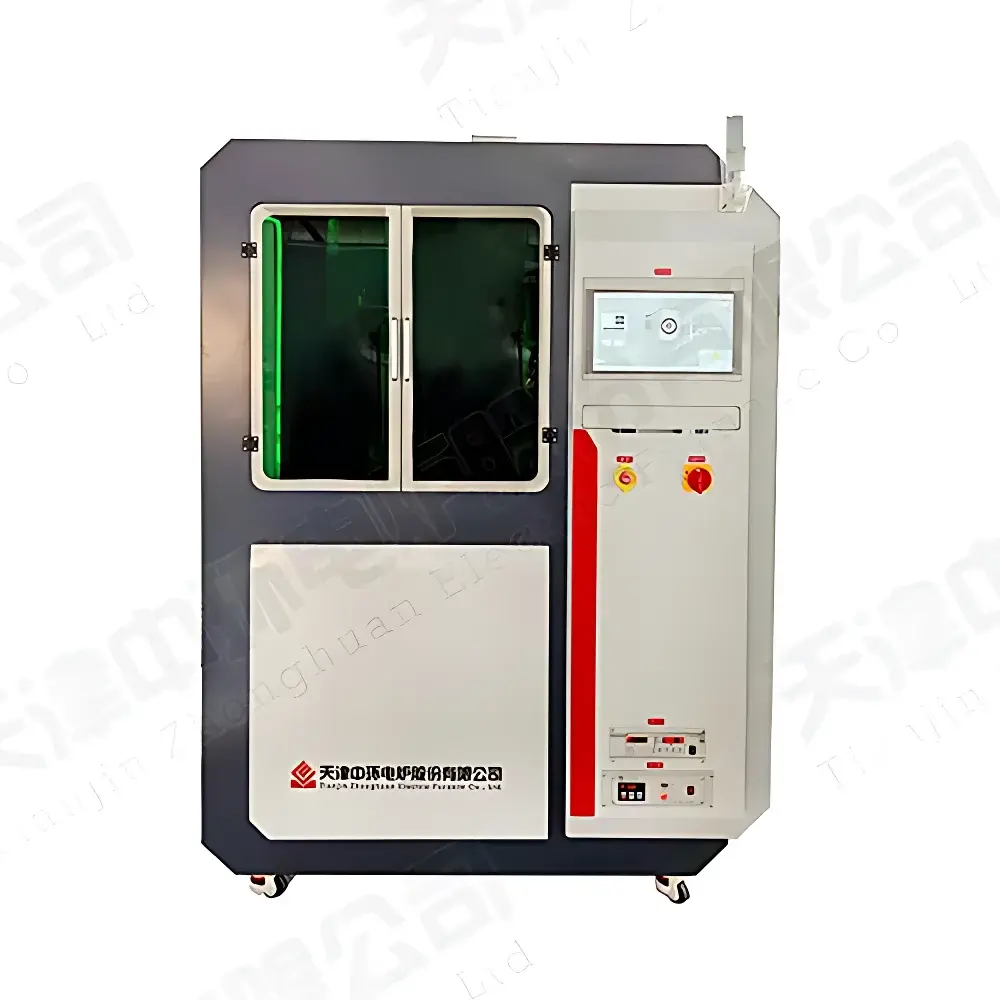
ZHONGHUAN FURNACE ZHD-1812X Vertical Bell-Jar Vacuum Brazing Furnace
| Brand | ZHONGHUAN FURNACE |
|---|---|
| Origin | Tianjin, China |
| Model | ZHD-1812X |
| Max Temperature | 1200 °C |
| Control Accuracy | ±1.0 °C |
| Heating Zone Length | 540 mm |
| Effective Chamber Dimensions | Ø280 × 300 mm (inside quartz bell jar) |
| Ultimate Vacuum | 5.67 × 10⁻⁵ Pa (cold, empty chamber) |
| Rated Power | 16 kW |
| Voltage | 380 V |
| Heating Element | OCr27Al7Mo2 high-resistance alloy wire |
| Insulation | Vacuum-formed alumina fiber |
| Cooling | Forced-air with motorized bell-jar displacement |
| Control System | Touchscreen PLC with K-type thermocouple feedback |
Overview
The ZHONGHUAN FURNACE ZHD-1812X is a vertically configured bell-jar vacuum brazing furnace engineered for high-precision joining of dissimilar and refractory materials under controlled low-pressure environments. Unlike conventional muffle furnaces, this system employs a movable heating zone that envelops a stationary quartz bell jar during thermal ramping—enabling uniform radial heat distribution and minimizing thermal gradients across the load. During cooling, the entire heating assembly retracts vertically, exposing the quartz enclosure to ambient air while maintaining vacuum integrity; forced convection via integrated axial fans accelerates cooldown without compromising vacuum seal integrity or sample atmosphere purity. The furnace operates within a working temperature range up to 1100 °C (rated maximum 1200 °C), with a cold-state ultimate vacuum of 5.67 × 10⁻⁵ Pa—sufficient for oxygen-sensitive braze cycles involving reactive metals (e.g., titanium, zirconium), oxide-free copper joints, and ultra-clean ceramic-metal bonding.
Key Features
- Movable heating zone architecture: Enables dynamic thermal envelope adjustment—fully encircling the quartz bell jar at elevated temperatures for optimal heat transfer, then retracting to permit rapid convective cooling while preserving vacuum
- High-integrity vacuum system: Water-cooled flange interface and OCr27Al7Mo2 resistance heating elements ensure long-term thermal stability and minimal outgassing under sustained vacuum
- Advanced thermal insulation: Vacuum-formed alumina fiber lining provides low thermal conductivity (<0.15 W/m·K at 1000 °C) and structural rigidity at operating temperatures
- Integrated touchscreen PLC control: Real-time monitoring of vacuum pressure, thermocouple readings, power input, and motion status with programmable multi-step ramps and soak profiles
- Optimized chamber geometry: Ø280 × 300 mm effective volume accommodates stacked or nested components—including large-diameter tooling inserts, PCD/PCBN blanks, and sapphire wafers—without sacrificing uniformity
Sample Compatibility & Compliance
The ZHD-1812X supports vacuum brazing of both metallic and nonmetallic substrates requiring minimal interfacial oxidation. Compatible material systems include Cu–Ag–P, Ni-based, and Au-based filler alloys applied to stainless steel, Kovar®, titanium alloys, tungsten carbide, and hardmetals. For ceramics and superabrasives, it enables direct brazing of Al₂O₃, Si₃N₄, PCD, CBN, and single-crystal diamond tools using active metal brazes (e.g., Ti-containing Ag–Cu–Ti). The furnace meets baseline mechanical and electrical safety requirements per IEC 61000-6-2 (EMC immunity) and GB/T 10066.1–2004 (industrial electric heating equipment). While not certified to ASTM F2881 or ISO 13579 for medical device brazing, its documented vacuum stability, repeatability of thermal profiles, and audit-ready data logging support GLP-compliant process validation in R&D and pilot-scale manufacturing.
Software & Data Management
Control firmware supports full-cycle data capture—including time-stamped vacuum pressure, dual-zone thermocouple signals (chamber wall and load center), heater current, and vertical position feedback—with export capability to CSV and XML formats. All setpoints, alarms, and operator actions are logged with timestamps and user IDs, satisfying basic traceability requirements aligned with FDA 21 CFR Part 11 Annex 11 principles. Optional Ethernet/IP or Modbus TCP integration allows centralized monitoring via SCADA or MES platforms. No cloud connectivity is embedded; local storage resides on industrial-grade SD card with write-protection switch.
Applications
- Joining of hermetic sensor housings (e.g., pressure transducers with ceramic diaphragms bonded to Kovar® bases)
- Brazing of polycrystalline diamond (PCD) cutting inserts onto tungsten carbide substrates for machining aerospace alloys
- Vacuum diffusion bonding of Ti–6Al–4V biomedical implants with porous surface structures
- Active brazing of sapphire optical windows to stainless steel flanges for high-vacuum viewports
- Research-scale development of graded brazes for thermal barrier coating (TBC) repair in turbine blades
FAQ
Can the furnace maintain vacuum during rapid air-cooling?
Yes—the quartz bell jar remains sealed throughout the cooling phase; only the external heating zone retracts. Vacuum integrity is preserved by the water-cooled flange and elastomer-free metal gasket system.
Is quartz bell jar replacement supported in-field?
Yes—quartz components are modular and replaceable using standard ISO-KF vacuum fittings; no furnace disassembly is required.
What is the typical cooldown time from 1000 °C to 150 °C?
Approximately 25–35 minutes under forced-air mode, depending on load mass and emissivity; no active quenching gas is introduced.
Does the system comply with UL or CE safety standards?
It conforms to GB standards for industrial electric heating equipment; CE marking requires end-user responsibility for final integration and risk assessment per Machinery Directive 2006/42/EC.
Can custom thermocouple placement be accommodated?
Yes—two auxiliary thermocouple ports are provided on the flange for load-surface or fixture-integrated sensing, configurable via PLC input mapping.



