
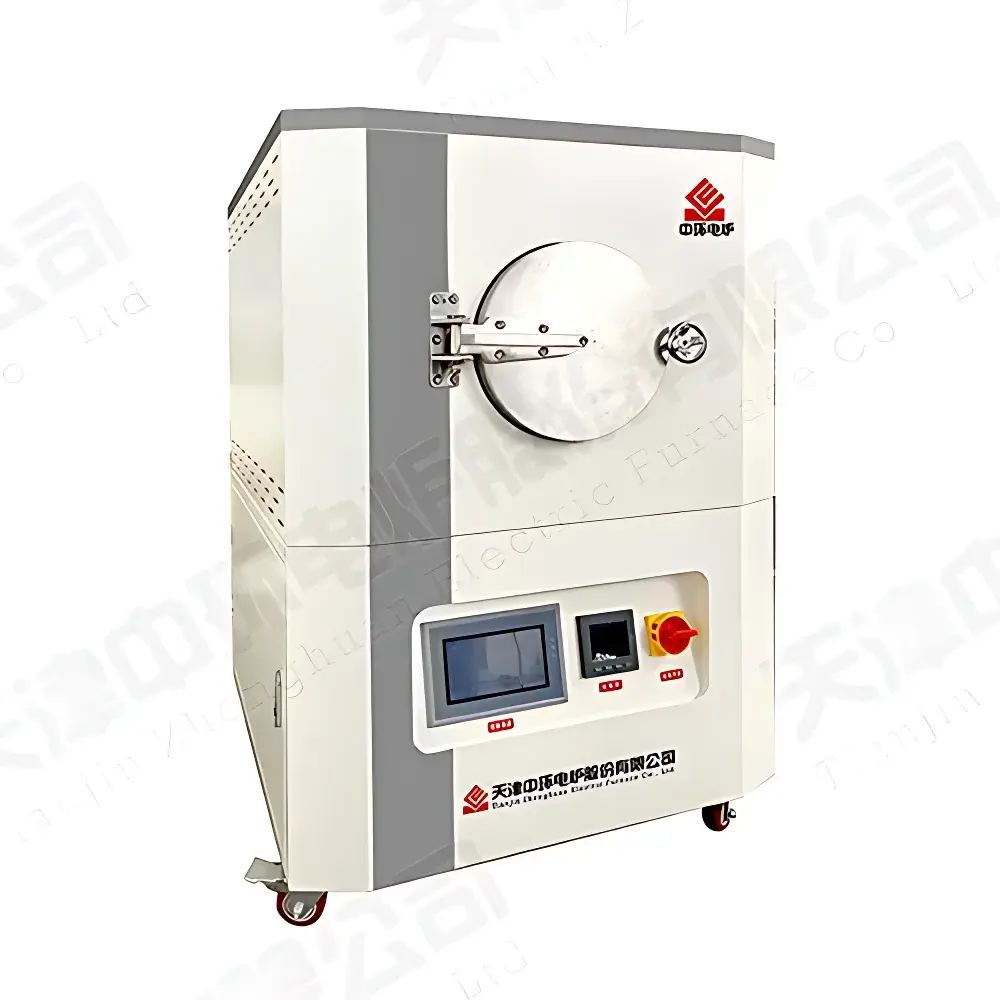
Zhonghuan Furnace ZHG-P30126 Vacuum Debinding and Sintering Furnace
| Brand | Zhonghuan Furnace |
|---|---|
| Origin | Tianjin, China |
| Model | ZHG-P30126 |
| Max Temperature | 1200 °C |
| Operating Temperature Range | ≤1100 °C |
| Rated Power | 20 kW |
| Supply Voltage | 380 V |
| Heating Zone | Single-zone |
| Temperature Control Accuracy | ±1 °C |
| Cold-Start Ramp Rate | ≤15 °C/min |
| Alloy Crucible Dimensions | Ø300 × 300 mm (D × H) |
| Ultimate Vacuum (Cold) | 10 Pa |
| Outer Shell Surface Temperature | ≤50 °C |
| Atmosphere Options | Ar, N₂ |
| Door Type | Side-opening |
| Heating Element | Silicon Carbide Rods |
| Thermocouple Type | Type S |
| Standard Configuration | Vacuum Pump, Debinding Canister, Gas Flow Meter |
| Optional Accessories | High-Temperature Off-Gas Cracking Unit, Chilled Water Circulator, High-Vacuum Diffusion Pump System |
Overview
The Zhonghuan Furnace ZHG-P30126 is a dedicated vacuum debinding and sintering furnace engineered for high-reproducibility thermal processing of advanced powder metallurgy components, ceramic-metal composites, translucent ceramics (e.g., YAG, ALON), and silicon nitride-based semiconductor substrates. It operates on a dual-stage thermal protocol: first enabling controlled catalytic or thermal debinding under inert or reducing atmospheres (Ar/N₂), followed by high-purity vacuum sintering at temperatures up to 1200 °C. The furnace employs a robust single-zone resistive heating architecture with silicon carbide (SiC) rod elements and Type S platinum-rhodium thermocouples, delivering stable thermal uniformity across the crucible volume. Its design adheres to fundamental principles of vacuum thermodynamics—minimizing residual gas partial pressures (<10 Pa cold base pressure) to suppress oxide formation and promote densification kinetics in reactive alloys such as Ti–6Al–4V, W–Cu pseudoalloys, and Mo–Re systems.
Key Features
- Integrated industrial-grade touchscreen HMI with proprietary process control firmware, supporting multi-step ramp-soak-cool profiles with real-time deviation logging and user-defined alarm thresholds.
- Seamless high-temperature alloy inner chamber fabricated via full-penetration welding and electropolished to surface roughness < Ra 0.2 µm (equivalent to ISO 1302 △6 finish), ensuring low outgassing rates and minimizing particle shedding during repeated thermal cycling.
- Compact side-opening configuration with water-cooled flange-mounted door, achieving helium leak rates <1×10⁻⁸ mbar·L/s per ASTM E493, while enabling rapid access without compromising vacuum integrity or operator safety.
- Top-access lift-and-tilt furnace chamber design facilitates forced convective cooling of the alloy crucible post-sintering, reducing cycle time by up to 40% compared to passive air-cooled alternatives.
- Modular crucible interface allows customization of internal dimensions (standard: Ø300 × 300 mm); optional liners include molybdenum, graphite, and alumina-coated stainless steel for application-specific chemical compatibility.
Sample Compatibility & Compliance
The ZHG-P30126 accommodates a broad spectrum of feedstock geometries—from green compacts in metal injection molding (MIM) and ceramic injection molding (CIM) to pre-sintered billets and porous preforms. It supports ISO/ASTM-compliant debinding protocols for polymeric binders (e.g., PEG, PMMA, PVDF) and waxy systems, with integrated gas flow metering enabling precise stoichiometric control during catalytic H₂-assisted removal. The furnace meets mechanical and electrical safety requirements per IEC 61000-6-2 (EMC immunity) and GB/T 10066.1–2004 (industrial electric furnaces). While not certified to ASME Section VIII Div. 1, its pressure boundary design incorporates redundant interlocks compliant with EN 60204-1 for vacuum vessel operation.
Software & Data Management
The embedded controller records timestamped temperature, pressure, and atmosphere composition data at configurable intervals (1–60 s), exporting CSV-formatted logs compatible with LIMS integration. Audit trails are retained for ≥180 days with write-protection enabled; all parameter modifications require dual-user authentication. Optional software packages support FDA 21 CFR Part 11 compliance—including electronic signatures, role-based access control, and immutable record archiving—making the system suitable for GLP/GMP-regulated R&D environments in medical device and aerospace component development.
Applications
- Vacuum sintering of tungsten heavy alloys (W–Ni–Fe) for radiation shielding components.
- Debinding and co-sintering of alumina–zirconia laminates used in microelectromechanical systems (MEMS) packaging.
- Controlled-atmosphere annealing of silicon carbide (SiC) power module substrates prior to metallization.
- Thermal treatment of titanium alloy orthopedic implants produced via additive manufacturing, including stress relief and beta-annealing cycles.
- High-vacuum densification of transparent spinel (MgAl₂O₄) for infrared window applications requiring <0.1% bulk scattering loss.
FAQ
What vacuum level is achievable during active sintering at 1100 °C?
Ultimate pressure remains ≤5×10⁻² Pa under hot conditions when equipped with the optional diffusion pump upgrade; standard configuration maintains ≤1 Pa at peak temperature.
Can the furnace be integrated into an automated production line?
Yes—RS485 Modbus RTU and Ethernet/IP interfaces are available for PLC-level coordination with conveyor loading/unloading stations and upstream binder removal units.
Is nitrogen purge capability included as standard?
A dual-gas manifold (Ar/N₂) with mass flow controllers and back-pressure regulation is supplied; additional gases (H₂, forming gas) require custom inlet fittings and safety interlocks.
What maintenance intervals are recommended for the SiC heating elements?
Inspection every 200 operational hours; typical service life exceeds 1,500 h at ≤1100 °C with periodic resistance monitoring and alignment verification.
Does the system support remote diagnostics?
Firmware v2.3+ enables secure SSH-based log retrieval and parameter diagnostics via authenticated VPN tunnel, subject to local IT security policy approval.






