
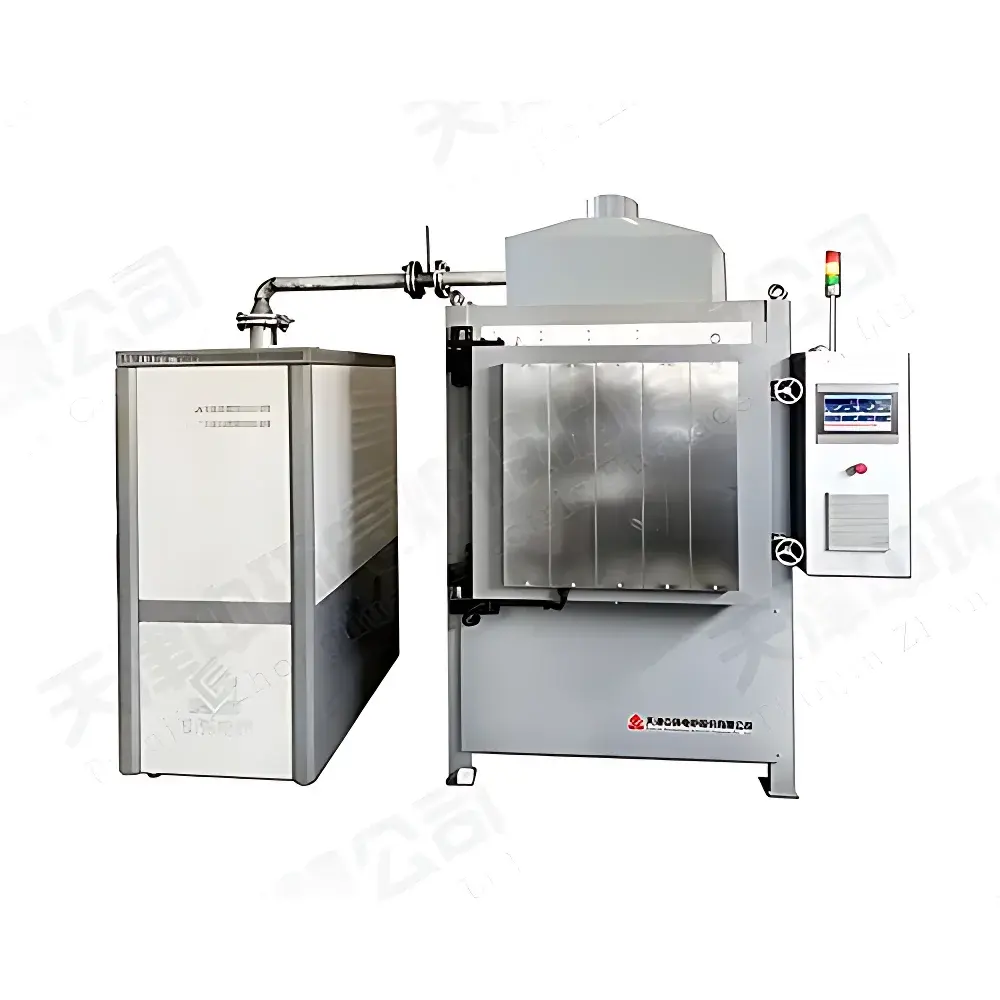
ZHONGHUAN FURNACE ZHX-P95116 & ZHX-P630116 Integrated Debinding and Pre-Sintering Furnace
| Brand | ZHONGHUAN FURNACE |
|---|---|
| Origin | Tianjin, China |
| Model | ZHX-P95116 / ZHX-P630116 |
| Effective Chamber Dimensions (D×W×H) | 420×530×430 mm / 820×700×1100 mm |
| Chamber Volume | 95 L / 630 L |
| Rated Temperature | 1200 °C |
| Operating Temperature | 1100 °C |
| Temperature Uniformity | ±1 °C |
| Heating Element | HRE Alloy Wire |
| Refractory Lining | Morgan TJM Firebrick |
| Power Consumption | 30 kW (Heating: 18 kW) / 68 kW (Heating: 56 kW) |
| Voltage | 380 V, 3-Phase |
| Control System | Manual Programmable Controller (Optional: Touchscreen PID Integration) |
| Safety Features | Pressure-Activated Debonding Vent, Door-Interlocked Power Cut-off, Over-Temperature Protection |
| Optional Auxiliary Unit | ZHK-W065103 Tail-Gas Thermal Cracking and Purification Furnace (Rated Temp: 900 °C, Working Temp: 800 °C, 15 kW, K-Type Thermocouple, ±1 °C Accuracy) |
Overview
The ZHONGHUAN FURNACE ZHX-P95116 and ZHX-P630116 Integrated Debinding and Pre-Sintering Furnace is an engineered thermal processing system designed for sequential, atmospherically controlled heat treatment of advanced ceramic components. It integrates three critical stages—organic binder removal (debinding), intermediate pre-sintering, and final sintering—within a single furnace architecture, eliminating cross-contamination risks and process transfer losses common in multi-furnace workflows. The system operates under inert or reducing atmospheres (e.g., N₂, forming gas) and is thermally optimized for low-thermal-mass ramp profiles during debinding (typically 1–5 °C/min below 600 °C) and high-stability dwell control during pre-sintering (800–1100 °C). Its triple-zone heating configuration with dual preheat zones enables precise thermal gradient management across the chamber, ensuring uniform volatilization kinetics and minimizing warpage in thin-film LTCC substrates, multilayer MLCC stacks, and AlN/Al₂O₃ circuit carriers.
Key Features
- Triple-zone thermal field architecture with independent power modulation and dual preheat zones for decoupled low-temperature debinding and high-temperature sintering control.
- Morgan TJM high-purity refractory brick lining—engineered for low particulate shedding, minimal alkali metal leaching, and extended service life (>8,000 h at 1100 °C).
- Pressure-responsive debinding vent mechanism: integrated pressure sensor triggers automatic vent opening when internal pressure exceeds user-defined thresholds (adjustable from 0.5 to 5 kPa), preventing blistering and delamination in green bodies.
- Surface temperature reduction via optimized multi-layer insulation design—external casing surface rise limited to <45 °C above ambient, meeting ISO 13732-1 ergonomic safety requirements.
- Standard manual programmable controller with 30-segment ramp-soak capability; optional touchscreen HMI with Ethernet connectivity supports recipe storage, audit trail logging, and remote monitoring.
- Integrated door interlock and over-temperature cut-off (dual independent thermocouples) compliant with IEC 61000-6-2 EMC and EN 60519-2 industrial furnace safety directives.
Sample Compatibility & Compliance
The furnace accommodates a broad spectrum of structural and functional ceramics requiring controlled organic removal and densification: LTCC modules, MLCC laminates, AlN and Si₃N₄ substrates, ZrO₂ smartphone backplates, piezoelectric PZT elements, oxygen sensor zirconia tubes, and additive-manufactured (3D-printed) ceramic green parts. All models support ISO 17873-compliant thermal profiling and are compatible with ASTM C1161 (flexural strength) and ASTM C1338 (thermal shock resistance) sample conditioning protocols. When equipped with the optional ZHK-W065103 tail-gas cracking furnace, volatile organics (e.g., PVB, PMMA, paraffin) are fully oxidized to CO₂ and H₂O prior to exhaust—enabling compliance with local VOC emission limits (e.g., EPA Method 25A, EU Directive 2010/75/EU). Data integrity meets GLP/GMP documentation standards with optional 21 CFR Part 11–compliant electronic signature and audit trail modules.
Software & Data Management
The standard control system provides deterministic time-temperature program execution with real-time deviation alerts. Optional firmware upgrade includes a web-enabled SCADA interface supporting Modbus TCP and OPC UA protocols for integration into MES platforms (e.g., Siemens Opcenter, Rockwell FactoryTalk). All temperature logs, pressure events, and vent actuation timestamps are stored with microsecond resolution and exportable in CSV or .tdms format. Calibration history, operator ID, and environmental condition metadata (ambient T/RH) are embedded in each dataset. Firmware supports automated calibration verification via built-in reference junction compensation and thermocouple drift diagnostics per IEC 60584-2.
Applications
- Debinding and pre-sintering of LTCC multilayer substrates for 5G RF filters and millimeter-wave antennas.
- Controlled thermal processing of MLCC tapes with nickel electrode systems to prevent Ni oxidation and interlayer diffusion.
- Low-oxygen sintering of AlN substrates for high-power LED packaging and RF modules.
- Thermal debinding of ZrO₂ dental crowns and watch cases prior to HIP-assisted final sintering.
- Atmosphere-controlled pyrolysis of binder-jetted and stereolithographic (SLA) ceramic green parts.
- Pre-sintering of ferrite cores and soft magnetic Mn-Zn composites for EMI suppression components.
FAQ
What atmosphere options are supported for debinding and sintering?
Nitrogen, argon, forming gas (N₂/H₂), and vacuum (down to 10⁻² mbar with optional pump package) are fully supported. Atmosphere purity is maintained via continuous flow purge and inline dew point monitoring (optional).
Can the furnace be validated for GMP production environments?
Yes—IQ/OQ documentation packages are available. With optional software modules, the system supports 21 CFR Part 11 compliance, including electronic signatures, role-based access control, and immutable audit trails.
Is furnace calibration traceable to national standards?
All thermocouples are certified to GB/T 16839.2 (equivalent to IEC 60584-2 Class I), and on-site calibration services include NIST-traceable reference thermometry per ISO/IEC 17025.
What maintenance intervals are recommended for the refractory lining?
Morgan TJM bricks require visual inspection every 500 operational hours; full replacement is typically required after ≥6,000 h at 1100 °C or upon detection of >2 mm surface erosion.
How is thermal uniformity verified across the working zone?
Uniformity is characterized per ASTM E2203 using a 9-point thermocouple mapping fixture. Certified uniformity data (±3 °C at 1100 °C) is provided with each unit shipment.



