
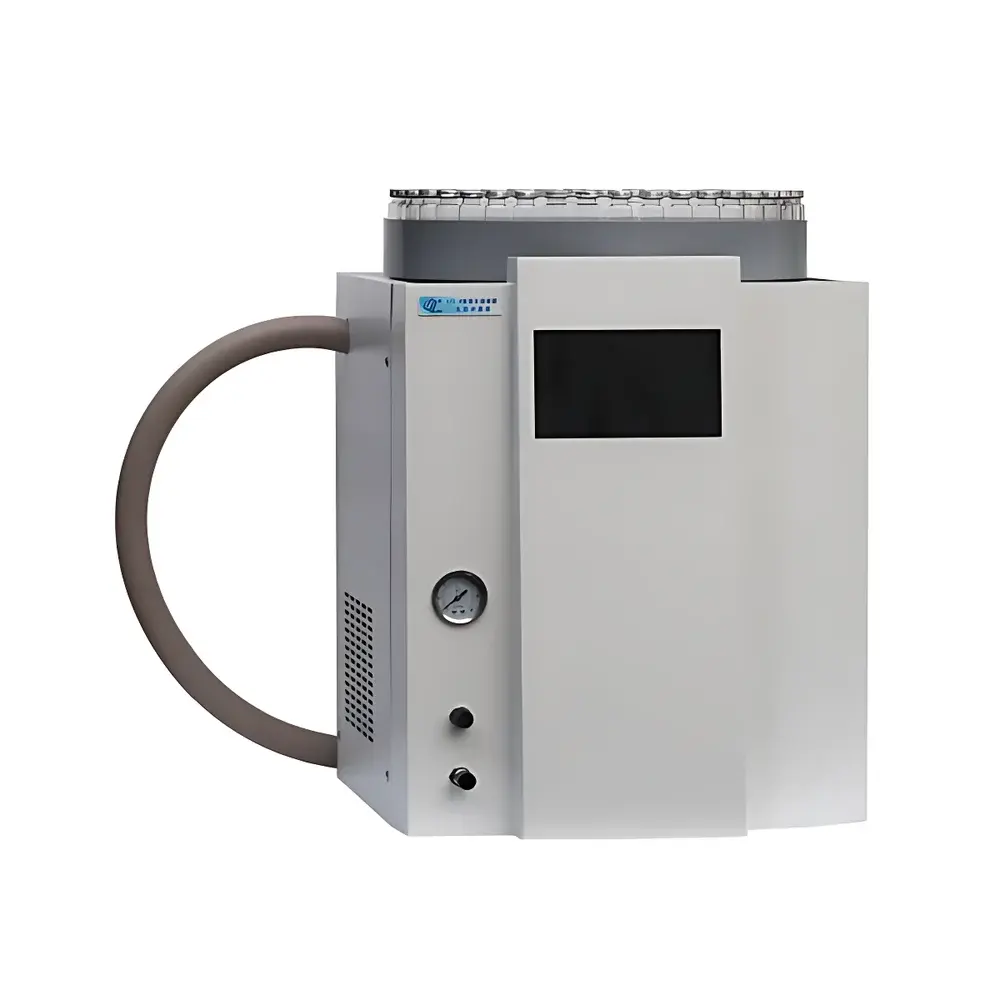
Zhonghui Pu HS-4 Automated Static Headspace Sampler
| Brand | Zhonghui Pu |
|---|---|
| Origin | Beijing, China |
| Manufacturer Type | Direct Manufacturer |
| Instrument Type | Static Headspace Sampler |
| Automation Level | Fully Automated |
| Sample Vial Heating Range | 40–200 °C (customizable up to 300 °C) |
| Valve & Transfer Line Heating Range | 40–200 °C (customizable up to 330 °C) |
| Quantitative Loop Volume | 1 mL (customizable up to 3 mL) |
| Temperature Control Accuracy | ±1 °C |
| Sample Capacity | 40 positions |
| Vial Format | 20 mL |
| Simultaneous Heating Positions | 8 (with vibration) |
| Multiple Headspace Extraction (MHE) | up to 10 cycles per vial |
| RSD | <1.2% (for 100 ppm ethanol in water) |
| Power Consumption | peak 450 W |
| Dimensions (L×W×H) | 460 × 400 × 550 mm |
| Net Weight | ~30 kg |
Overview
The Zhonghui Pu HS-4 Automated Static Headspace Sampler is an engineered solution for precise, reproducible volatile compound analysis in compliance with modern chromatographic workflows. It operates on the principle of static headspace equilibrium—where a sealed sample vial is heated to partition analytes between the solid/liquid matrix and the gas phase above it. Following thermal equilibration, a defined volume of headspace vapor is transferred via pressurized sampling into the GC inlet using a high-precision six-port valve and inert quantitative loop. Designed for integration with all major gas chromatography (GC) and GC-MS systems, the HS-4 supports regulatory-compliant method execution under GLP/GMP environments, including audit-trail-capable PC control and synchronized instrument triggering.
Key Features
- Fully automated 40-position carousel with independent microprocessor-controlled heating zones; supports simultaneous heating of up to 8 vials with programmable orbital vibration to enhance mass transfer from complex or viscous matrices.
- Triple-zone independent temperature control: sample vial oven (40–200 °C, optional 300 °C), six-port valve manifold (40–200 °C, optional 330 °C), and transfer line (40–200 °C, optional 330 °C), all maintained within ±1 °C accuracy.
- Inert fluid path constructed entirely from RESTEK Siltek®/Sulfinert®-treated 316L stainless steel tubing and quantitative loops—ensuring minimal adsorption, zero carryover, and reliable quantitation of polar, acidic, sulfur-containing, and reactive analytes.
- Positive-pressure sampling architecture eliminates baseline drift and enables detection limits as low as 1 ppb for benzene in aqueous matrices—without requiring vacuum or cryogenic trapping.
- Multiple Headspace Extraction (MHE) capability: up to 10 sequential extractions per vial to assess extraction efficiency or residual volatility profiles—critical for pharmaceutical residual solvent validation (ICH Q3C) and forensic toxicology.
- Integrated maintenance and diagnostics mode with real-time mechanical motion monitoring; automatic emergency stop and error logging upon positional deviation or actuator stall—preventing vial breakage and ensuring long-term positional repeatability.
- 7-inch capacitive touchscreen interface with preloaded method templates, real-time status visualization, and local storage for ≥100 user-defined methods—including balance time (0–99.9 min), pressurization (0–9.99 min), loop equilibration (0–9.99 min), and injection timing parameters.
Sample Compatibility & Compliance
The HS-4 accommodates standard 20 mL crimp-top headspace vials and is compatible with both liquid and solid samples—including polymers, soils, pharmaceutical tablets, food matrices, and biological tissues. Its air-bath heating design ensures uniform thermal distribution across all vial positions—superior to metal-block alternatives in minimizing edge effects and inter-vial variability. The system meets essential requirements for ISO 17025-accredited laboratories and supports method validation per USP Chapter 467 (Residual Solvents) and ASTM D7217 (Determination of Volatile Organic Compounds in Water by Static Headspace GC). All firmware and PC software support timestamped audit trails, electronic signatures, and 21 CFR Part 11–compliant data integrity protocols when operated via the optional workstation interface.
Software & Data Management
The HS-4 features native RS-232 and USB interfaces for bidirectional communication with third-party GC data systems (e.g., Agilent OpenLab, Thermo Chromeleon, Shimadzu GCsolution). A dedicated Windows-based control application provides full remote operation—including real-time run monitoring, method scheduling, event-triggered GC start/stop commands, and status polling (e.g., “ready,” “injecting,” “error”). All method parameters, run logs, and system diagnostic records are stored in encrypted SQLite databases with configurable auto-backup intervals. Raw log files adhere to ASTM E1394-97 structure for seamless import into LIMS platforms. No proprietary drivers or dongles are required—plug-and-play compatibility with standard COM port enumeration.
Applications
- Pharmaceutical quality control: residual solvent testing (acetone, dichloromethane, toluene) per ICH Q3C guidelines.
- Environmental analysis: VOCs (BTEX, chlorinated ethenes) in groundwater and soil extracts.
- Food & beverage safety: ethanol quantification, flavor compound profiling, and packaging migration studies.
- Forensic toxicology: blood alcohol concentration (BAC) determination and drug metabolite screening.
- Materials science: monomer release from cured resins, plasticizer volatilization kinetics, and polymer degradation product identification.
FAQ
Is the HS-4 compatible with my existing GC or GC-MS system?
Yes—the HS-4 uses universal pneumatic and electrical interfaces. Connection requires only carrier gas supply and insertion of the transfer line into the GC inlet; no hardware modification is needed.
Can I perform multiple extractions from the same vial?
Yes—up to 10 sequential headspace extractions (MHE) are programmable per vial, enabling kinetic modeling and recovery assessment.
What level of inertness does the sample pathway provide?
All wetted surfaces—including the six-port valve, quantitative loop, and transfer lines—are passivated with Siltek®/Sulfinert® coatings on 316L stainless steel, validated for trace-level analysis of hydrogen sulfide, formaldehyde, and organic acids.
Does the system support 21 CFR Part 11 compliance?
When used with the optional PC control software, the HS-4 provides full audit trail generation, role-based access control, electronic signatures, and data immutability—meeting FDA requirements for regulated laboratories.
What maintenance is required for long-term reliability?
Routine tasks include vial carousel calibration verification, valve seal inspection every 6 months, and quarterly leak testing using built-in diagnostics mode—no specialized tools required.





