
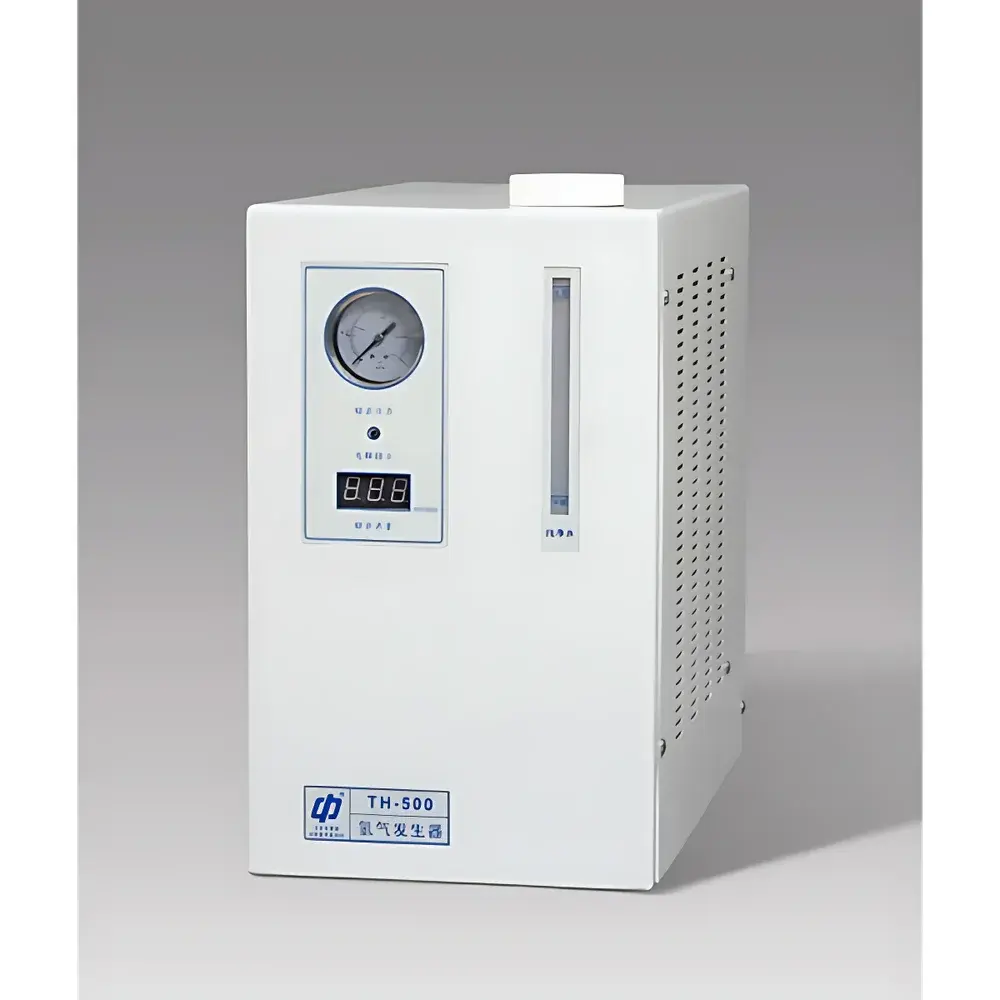
Zhonghuipu TH-500H3 High-Pressure Hydrogen Generator
| Brand | Zhonghuipu |
|---|---|
| Origin | Beijing, China |
| Manufacturer Type | Direct Manufacturer |
| Model | TH-500H3 |
| Hydrogen Generation Principle | Pure Water Electrolysis via SPE Membrane |
| Output Flow Rate | 0–500 mL/min |
| Output Pressure | 0–3 MPa (30 kg/cm²) |
| Hydrogen Purity | 99.999% |
| Power Consumption | 250 W |
| Dimensions (W×D×H) | 400 × 360 × 220 mm |
| Net Weight | 22 kg |
| Pressure Stability | < 0.001 MPa |
| Input Power | 220 V ±10%, 50 Hz |
| Certification | CE |
Overview
The Zhonghuipu TH-500H3 High-Pressure Hydrogen Generator is an engineered solution for laboratories requiring on-demand, high-purity hydrogen gas at elevated pressures—up to 3 MPa (30 bar)—without reliance on compressed gas cylinders. It employs solid polymer electrolyte (SPE) membrane technology to perform pure water electrolysis, eliminating the need for caustic alkaline electrolytes and associated maintenance hazards. This electrochemical process separates deionized water into high-purity H₂ and O₂ at the anode and cathode, with the hydrogen stream directed through integrated gas purification stages—including stainless-steel gas–liquid separation, low-sulfur silicone sealing rings, and multi-stage filtration—to achieve ≥99.999% purity (residual O₂ & moisture < 1 ppm). Designed for continuous operation in analytical, catalytic, and materials synthesis applications, the TH-500H3 delivers stable flow (0–500 mL/min) and pressure control with <0.001 MPa fluctuation, ensuring reproducible experimental conditions under dynamic load.
Key Features
- SPE-based proton exchange membrane electrolysis using only deionized water—no KOH or NaOH required
- Integrated pressure regulation system enabling precise, stepless control from ambient to 3 MPa (30 kg/cm²)
- Stainless-steel wetted components throughout the gas path—including separator, filters, and fittings—for corrosion resistance and high-pressure integrity
- Low-sulfur silicone O-rings minimize sulfur contamination, critical for sensitive applications such as GC carrier gas and hydrogenation catalysis
- Intelligent water-level monitoring with automatic shutdown upon low-water detection to protect the electrolytic cell and extend service life
- Compact footprint (400 × 360 × 220 mm) and lightweight design (22 kg) facilitate benchtop integration in fume hoods or instrument cabinets
- CE-certified electrical architecture compliant with IEC 61010-1 for laboratory safety and electromagnetic compatibility
Sample Compatibility & Compliance
The TH-500H3 is compatible with a wide range of laboratory workflows requiring ultra-high-purity hydrogen, including gas chromatography (GC) carrier gas, fuel cell testing, catalytic hydrogenation reactors, and in-situ spectroscopic studies. Its output meets ISO 8573-1 Class 1 (solid particles), Class 2 (water), and Class 2 (oil) specifications for compressed gases. The absence of alkali carryover and minimal metallic leaching ensures compatibility with palladium- or platinum-based catalysts and sensitive detectors such as thermal conductivity (TCD) and flame ionization (FID). While not inherently GLP/GMP validated, the unit supports audit-ready operation when paired with external logging systems; its digital pressure/flow feedback loop enables traceable parameter recording per FDA 21 CFR Part 11 requirements if interfaced via analog output or optional RS-232/USB.
Software & Data Management
The TH-500H3 operates as a standalone unit with front-panel LED indicators for pressure, flow, water level, and system status. Analog 0–10 V outputs are provided for real-time remote monitoring of pressure and flow rate, allowing integration into SCADA or LIMS environments. Optional firmware upgrades support Modbus RTU protocol over RS-485 for centralized fleet management in multi-instrument labs. All operational events—including auto-shutdown triggers, power cycle logs, and pressure deviation alerts—are timestamped and stored in non-volatile memory for post-hoc diagnostics. No proprietary software installation is required; configuration remains hardware-based to ensure long-term stability and reduce cybersecurity exposure surfaces.
Applications
- GC carrier and detector fuel gas supply (replacing cylinder-based systems with improved safety and consistency)
- High-pressure hydrogenation reactions in sealed autoclaves or flow reactors (e.g., pharmaceutical intermediate synthesis)
- Fuel cell performance evaluation under variable pressure and flow conditions
- In-situ XRD, XAS, or Raman studies requiring controlled H₂ atmospheres up to 3 MPa
- Calibration gas generation for hydrogen sensors and leak detectors
- Research-scale metal hydride formation and hydrogen storage material testing
FAQ
What type of water is required for optimal operation?
Deionized water with resistivity ≥15 MΩ·cm and total organic carbon (TOC) < 50 ppb is mandatory. Tap or distilled water will cause rapid membrane fouling and irreversible performance loss.
Can the TH-500H3 be used with GC systems requiring ultra-high purity (99.9999%)?
While the generator delivers 99.999% H₂, achieving six-nines purity typically requires downstream purification (e.g., heated getter or palladium diffuser); consult your GC manufacturer for compatibility validation.
Is the oxygen byproduct vented safely?
Yes—the O₂ stream is routed through a dedicated exhaust port equipped with a flame arrestor and must be vented to atmosphere via rigid tubing outside the lab space per local fire codes.
Does the unit support continuous 24/7 operation?
It is rated for unattended operation up to 72 hours; however, periodic visual inspection of water reservoir level and condensate trap is recommended for long-term reliability.
What maintenance intervals are advised?
Water reservoir cleaning every 2 weeks, filter replacement every 6 months (or after 1,000 operating hours), and annual membrane performance verification using calibrated gas analyzers.



