
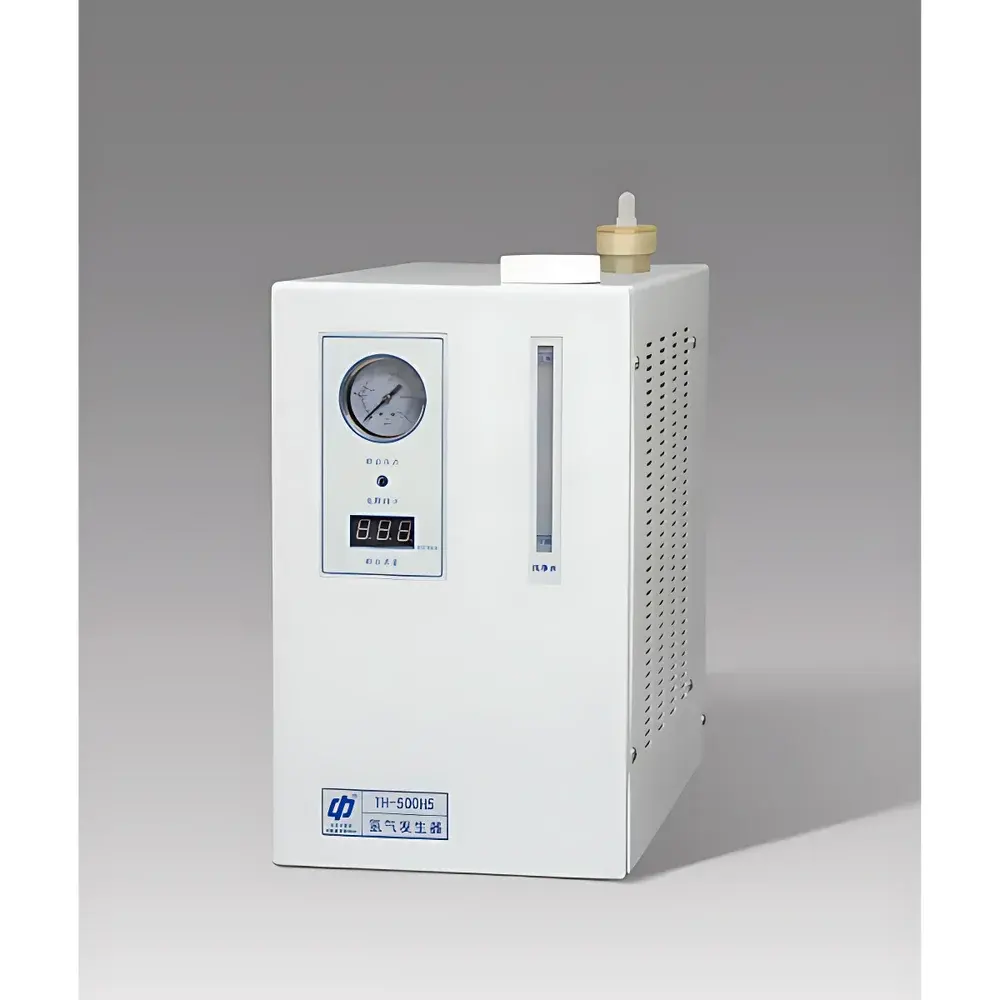
Zhonghuipu TH-500H5 High-Pressure Hydrogen Generator
| Brand | Zhonghuipu |
|---|---|
| Origin | Beijing, China |
| Manufacturer Type | Direct Manufacturer |
| Model | TH-500H5 |
| Hydrogen Generation Principle | Pure Water Electrolysis via SPE Membrane |
| Output Flow Rate | 0–500 mL/min |
| Output Pressure | 0–5 MPa (50 kg/cm²) |
| Hydrogen Purity | 99.999% |
| Power Consumption | 250 W |
| Dimensions (W×D×H) | 400 × 360 × 220 mm |
| Net Weight | 22 kg |
| Pressure Stability | < 0.001 MPa |
| Input Power | 220 V ±10%, 50 Hz |
| Certification | CE |
Overview
The Zhonghuipu TH-500H5 High-Pressure Hydrogen Generator is an engineered solution for laboratories requiring on-demand, high-purity hydrogen gas at elevated pressures—up to 5 MPa (50 bar)—without reliance on compressed gas cylinders. It employs solid polymer electrolyte (SPE) membrane technology to perform pure water electrolysis, eliminating the need for caustic potassium hydroxide (KOH) or sodium hydroxide (NaOH) solutions commonly associated with traditional alkaline electrolyzers. This design ensures intrinsic safety, reduced maintenance, and consistent gas quality. The system integrates a corrosion-resistant stainless-steel gas path, low-sulfur silicone seals, and a multi-stage gas-drying and filtration architecture—including integrated gas–liquid separation—to deliver ultra-high-purity hydrogen (≥99.999%) suitable for demanding analytical, catalytic, and synthetic applications. Its compact footprint (400 × 360 × 220 mm) and 22 kg net weight support benchtop deployment in regulated environments such as QC labs, R&D facilities, and university chemistry departments.
Key Features
- SPE-based proton exchange membrane electrolysis using deionized water only—no liquid electrolytes, no hazardous chemical handling
- Stainless-steel construction throughout critical gas pathways, including pressure vessels, manifolds, and filters, ensuring long-term compatibility with high-pressure H₂ and resistance to embrittlement
- Low-sulfur silicone sealing components minimize sulfur contamination, preserving catalyst integrity in hydrogenation reactions and GC carrier-gas applications
- Integrated digital pressure and flow control with real-time feedback loop, enabling stable output across the full 0–500 mL/min range and maintaining pressure stability within ±0.001 MPa
- Intelligent water-level monitoring with automatic shutdown upon low-water detection, protecting the electrolytic cell from thermal overload and dry-run damage
- CE-certified electrical architecture compliant with IEC 61010-1 for laboratory equipment safety; designed for continuous unattended operation under GLP-aligned protocols
Sample Compatibility & Compliance
The TH-500H5 is compatible with all standard laboratory gas interfaces, including 1/8″ and 1/4″ VCR and Swagelok fittings, and supports direct integration into hydrogen-consuming instruments such as gas chromatographs (GC), fuel cell test stations, catalytic reactors, and hydrotreating setups. Its 99.999% hydrogen purity meets ASTM D7165 (for GC carrier gas), ISO 8573-1 Class 1 compressed air/gas purity requirements (adapted for H₂), and USP specifications for pharmaceutical-grade process gases. The absence of alkali carryover eliminates risk of column contamination in GC systems and avoids catalyst poisoning in fine chemical synthesis. As a CE-marked device, it conforms to EMC Directive 2014/30/EU and Low Voltage Directive 2014/35/EU, supporting audit readiness for ISO/IEC 17025-accredited laboratories.
Software & Data Management
The TH-500H5 operates via embedded microcontroller logic with local LED interface for pressure, flow, temperature, and status indication. While it does not include proprietary PC software or remote connectivity, its analog 0–10 V or 4–20 mA output signals (optional configuration) enable seamless integration into centralized lab monitoring systems (e.g., SCADA, LabVantage, or DeltaV) for real-time logging of operational parameters. All internal diagnostics—including cell voltage, coolant temperature, and water level—are timestamped and retained in non-volatile memory for up to 30 days, supporting root-cause analysis during routine maintenance or regulatory review. Audit trails comply with ALCOA+ principles when paired with validated data acquisition systems, satisfying traceability requirements under FDA 21 CFR Part 11 when used in GMP-compliant environments.
Applications
- Carrier gas supply for flame ionization detectors (FID) and thermal conductivity detectors (TCD) in gas chromatography
- Hydrogen source for catalytic hydrogenation, transfer hydrogenation, and asymmetric reduction reactions in synthetic organic chemistry
- Feed gas for PEM fuel cell characterization, durability testing, and electrochemical impedance spectroscopy (EIS)
- Process gas in high-pressure hydrogenation reactors, including Parr-style autoclaves operating up to 5 MPa
- Calibration and purge gas in residual gas analyzers (RGA), mass spectrometers, and leak detection systems
- On-site hydrogen generation for portable hydrogen sensors and safety training simulators
FAQ
What type of water is required for optimal operation?
Deionized water with resistivity ≥15 MΩ·cm and total organic carbon (TOC) < 50 ppb is recommended. Use of tap or distilled water may cause membrane fouling and reduce service life.
Is the TH-500H5 compatible with GC systems requiring ultra-high-purity hydrogen?
Yes—its 99.999% purity, coupled with integrated palladium-diffusion polishing (optional) and stainless-steel gas path, meets ASTM D7165 and USP criteria for GC carrier gas.
How often does the SPE membrane require replacement?
Under normal operating conditions (≤8 h/day, 25°C ambient), the membrane is rated for ≥15,000 hours of service life. Replacement intervals are tracked via cumulative runtime logging in onboard memory.
Can the unit be integrated into a building’s central gas distribution network?
Yes—when equipped with pressure-regulated outlet and optional back-pressure regulator, it can feed dedicated H₂ lines meeting ASME B31.12 standards for hydrogen piping.
Does the generator support automated start/stop via external TTL signal?
Standard configuration includes dry-contact relay outputs for interlock signaling; TTL or Modbus RTU integration is available via OEM firmware upgrade.



