
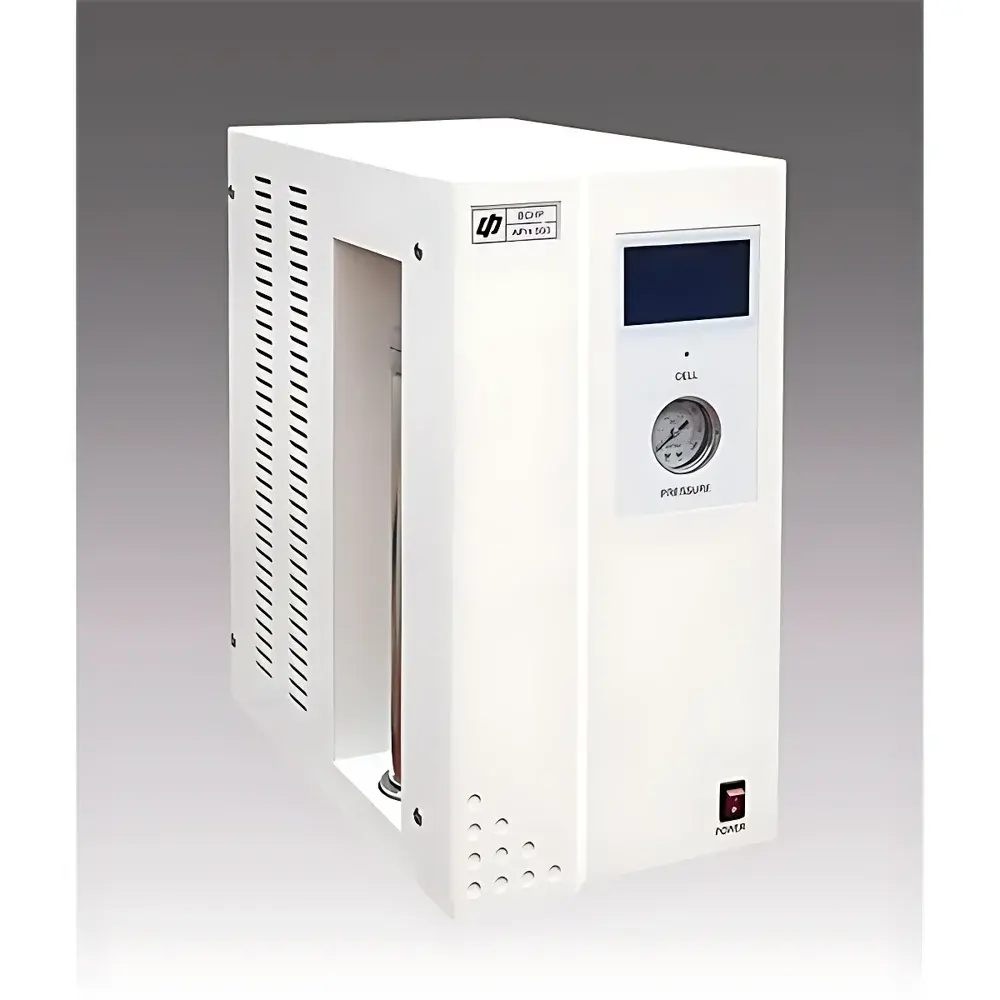
Zhonghuipu APH-500 Automatic Refill Alkaline Electrolysis Hydrogen Generator
| Brand | Zhonghuipu |
|---|---|
| Origin | Beijing, China |
| Manufacturer Type | Direct Manufacturer |
| Country of Origin | China |
| Model | APH-500 |
| Hydrogen Generation Principle | Alkaline Electrolysis |
| Output Flow Rate | 0–500 mL/min |
| Output Pressure | 0–0.4 MPa |
| Hydrogen Purity | 99.999% |
| Power Consumption | 250 W |
| Dimensions (L×W×H) | 340 × 200 × 385 mm |
| Net Weight | 15 kg |
| Operating Temperature | 1–40 °C |
| Relative Humidity | <85% |
| Power Supply | 220 V ±10%, 50 Hz |
| Pressure Stability | <0.001 MPa |
| Integrated External Water Reservoir Capacity | 15 L |
Overview
The Zhonghuipu APH-500 is a benchtop alkaline electrolysis hydrogen generator engineered for continuous, unattended operation in analytical laboratories requiring high-purity hydrogen gas. It employs a proven potassium hydroxide (KOH)-based electrolytic cell architecture to dissociate deionized water into hydrogen and oxygen gases via direct current. The generated hydrogen undergoes multi-stage purification—including membrane-based moisture separation and integrated desiccant conditioning—to achieve a certified purity of 99.999% (5.0 grade), meeting stringent requirements for carrier and fuel gas applications in gas chromatography (GC), Fourier-transform infrared (FTIR) spectroscopy, and hydrogenation reactors. Designed with industrial-grade stainless-steel electrolyte reservoirs and corrosion-resistant internal plumbing, the APH-500 delivers stable output across ambient temperatures from 1 °C to 40 °C and relative humidity up to 85%, ensuring operational robustness in diverse laboratory environments.
Key Features
- Intelligent microcontroller-based control system with backlit Chinese LCD interface for real-time monitoring of pressure, flow, electrolyte level, and system status.
- Automatic refill function: integrated precision peristaltic pump continuously monitors and replenishes the KOH electrolyte reservoir from an external 15 L water tank—enabling >72 hours of uninterrupted operation without manual intervention.
- Dynamic flow regulation: output adjusts automatically between 0 and 500 mL/min to match downstream demand, maintaining constant pressure (0–0.4 MPa) with stability better than ±0.001 MPa.
- Enhanced gas drying: dual-stage moisture removal—comprising selective polymer membrane separation followed by a passive desiccant chamber—reduces dew point to ≤−40 °C at outlet, minimizing condensation risk in sensitive instrumentation.
- Multi-layer safety architecture: includes anti-backflow alkaline barrier, over-pressure mechanical relief valve (set at 0.45 MPa), hydrogen leak detection via flow anomaly algorithm, and automatic shutdown on sustained over-flow (>520 mL/min for >3 s).
- RS-232 serial interface compliant with standard Modbus RTU protocol for integration into lab-wide monitoring systems or LIMS; supports remote start/stop, alarm logging, and parameter configuration.
Sample Compatibility & Compliance
The APH-500 is compatible with all standard GC carrier gas inlets (including split/splitless injectors and FID/TCD detectors), FTIR purge lines, and catalytic hydrogenation manifolds requiring ultra-high-purity H₂. Its design adheres to IEC 61010-1:2010 for electrical safety in laboratory equipment and incorporates fail-safe engineering aligned with ISO/IEC 17025:2017 clause 6.4.3 on equipment suitability. While not CE-marked for EU deployment, its construction meets key mechanical and material specifications referenced in ASTM D1945 (gas analysis methods) and USP (purified water for pharmaceutical gas generation). Optional calibration certificate traceable to NIM (National Institute of Metrology, China) is available upon request.
Software & Data Management
No proprietary software is required for basic operation; however, the RS-232 port enables seamless integration with third-party SCADA platforms or custom Python/LabVIEW scripts using open ASCII command sets. All operational events—including power cycles, refill triggers, pressure excursions, and safety interlock activations—are timestamped and stored in non-volatile memory (10,000-event buffer). Audit trail functionality supports GLP-compliant record retention when paired with external data acquisition systems configured for 21 CFR Part 11 electronic signature and audit trail requirements.
Applications
- Carrier gas supply for capillary GC and GC-MS systems requiring consistent 99.999% H₂ with low moisture and total hydrocarbon content.
- Fuel gas source for flame ionization detectors (FID), reducing dependency on high-pressure cylinders and associated regulatory handling burdens.
- Purge and zero-gas generation in environmental air monitoring analyzers (e.g., ozone precursors, VOCs).
- Controlled-atmosphere reactors for catalytic testing, where precise stoichiometric H₂ dosing improves reproducibility in kinetic studies.
- On-site hydrogen supply for portable FTIR spectrometers deployed in field laboratories or mobile analytical units.
FAQ
What type of water must be used with the APH-500?
Deionized water with resistivity ≥1 MΩ·cm and silica content <50 ppb is mandatory. Tap or distilled water will cause rapid electrode fouling and void the warranty.
Is KOH solution supplied with the instrument?
Yes—a pre-mixed 30% w/w potassium hydroxide electrolyte solution is included with initial commissioning. Subsequent refills require user-prepared solution per manufacturer’s technical bulletin TB-APH-02.
Can the APH-500 be mounted in a fume hood or enclosed cabinet?
Yes, provided minimum ventilation of 5 air changes per hour is maintained and hydrogen concentration remains below 1% LEL (Lower Explosive Limit) at all times—verified via fixed H₂ sensor integration.
How often does the membrane dryer require replacement?
Under typical lab use (400 mL/min average flow), the hydrophobic membrane module has a service life of ≥12 months; replacement interval is logged automatically and displayed on the LCD during routine self-diagnostic cycles.
Does the unit support external pressure regulation?
No—the APH-500 regulates output pressure internally via closed-loop PID control; downstream pressure regulators are unnecessary and discouraged to preserve flow stability and leak integrity.



