
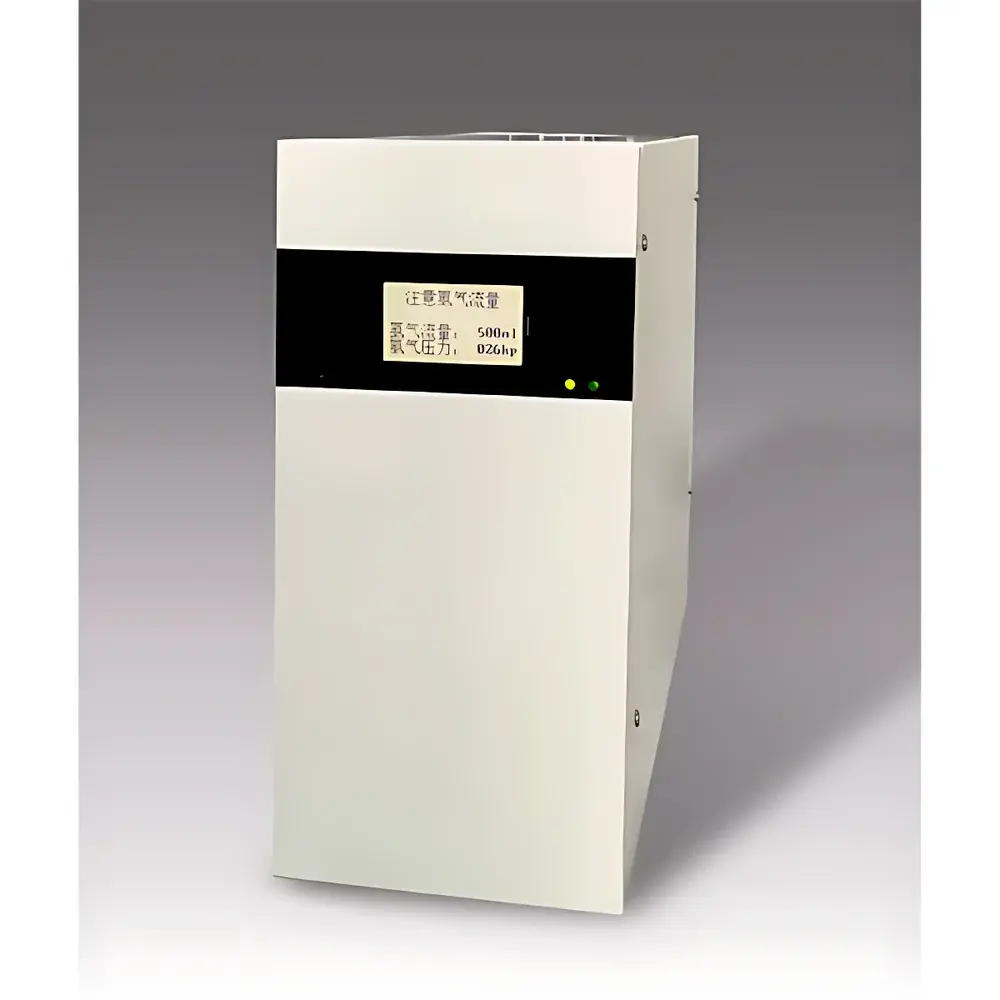
Zhonghuipu ATH-500 Automated Pure-Water Electrolysis Hydrogen Generator
| Brand | Zhonghuipu |
|---|---|
| Origin | Beijing, China |
| Manufacturer Type | Direct Manufacturer |
| Model | ATH-500 |
| Hydrogen Generation Principle | Pure-Water Electrolysis |
| Output Flow Rate | 0–500 mL/min |
| Output Pressure | 0–100 psi (≈0.7 MPa) |
| Hydrogen Purity | 99.9995% |
| Power Consumption | 300 W |
| Pressure Stability | <0.001 MPa |
| Input Voltage | 220 V ±10%, 50 Hz |
| Operating Temperature | 1–40 °C |
| Relative Humidity | <85% RH |
| Dimensions (L×W×H) | 570 × 185 × 400 mm |
| Net Weight | ~18 kg |
Overview
The Zhonghuipu ATH-500 is an automated, high-purity hydrogen generator engineered for continuous, reliable operation in analytical laboratories and gas chromatography (GC) environments. It employs proton exchange membrane (PEM) electrolysis—specifically solid polymer electrolyte (SPE) technology—to generate hydrogen exclusively from deionized water, eliminating the need for caustic potassium hydroxide (KOH) or sodium hydroxide (NaOH) electrolytes. This design ensures zero alkali carryover, minimizes corrosion risk to connected instruments, and supports compliance with stringent method requirements for carrier gas purity in GC-FID, GC-TCD, and GC-MS applications. The system operates at a maximum pressure of 100 psi (0.7 MPa) with exceptional stability (<0.001 MPa fluctuation), enabling consistent retention time reproducibility and baseline integrity across extended run sequences.
Key Features
- SPE-based pure-water electrolysis core: No liquid electrolyte handling; eliminates contamination risks and simplifies safety protocols.
- Integrated microcontroller architecture: Enables fully automated operation—including real-time water-level monitoring, auto-refill via internal reservoir, over-pressure shutdown, and hydrogen leak detection with immediate system halt.
- Dual-stage purification: Combines Nafion®-based membrane dehydration with pressure-swing adsorption (PSA), followed by integrated trace-oxygen scavenging (non-regenerable, pre-activated catalyst). No routine filter replacement required—maintenance interval exceeds 12 months under typical lab usage.
- Dynamic flow regulation: Output flow (0–500 mL/min) adjusts automatically to match instrument demand, reducing power draw during low-load conditions and improving overall energy efficiency.
- Digital interface: Built-in RS-232 serial port supports bidirectional communication with laboratory information management systems (LIMS) or GC control software for remote status monitoring, event logging, and alarm integration.
Sample Compatibility & Compliance
The ATH-500 delivers ultra-high-purity hydrogen (99.9995% v/v) suitable for all major GC detector types requiring carrier or fuel gas, including flame ionization (FID), thermal conductivity (TCD), electron capture (ECD), and pulsed discharge helium ionization (PDHID). Its output meets ASTM D7613–22 specifications for hydrogen purity in chromatographic applications and aligns with ISO 8573-1:2010 Class 1 compressed air/gas quality requirements when referenced to gaseous impurities (O₂ ≤ 0.5 ppmv, H₂O ≤ 1 ppmv dew point −70 °C). The unit complies with IEC 61010-1:2010 for electrical safety in laboratory equipment and incorporates fail-safe interlocks conforming to EN 60079-0 for use in non-hazardous areas. While not intrinsically safe, its design supports installation in ventilated lab spaces meeting local fire and gas-handling codes.
Software & Data Management
The ATH-500 does not include proprietary graphical software but provides ASCII protocol over RS-232 for seamless integration into existing lab automation frameworks. Supported commands include query of real-time pressure, flow rate, internal temperature, water level, error flags, and operational mode. All critical events—including auto-refill cycles, pressure deviations exceeding ±0.0005 MPa, and leak-triggered shutdowns—are timestamped and reportable via serial output. When deployed in GLP/GMP-regulated environments, the generator’s deterministic response behavior and deterministic log structure enable audit-ready data capture when paired with compliant data acquisition systems satisfying FDA 21 CFR Part 11 requirements for electronic records and signatures.
Applications
- Carrier gas supply for capillary GC systems requiring stable, low-part-per-trillion oxygen and moisture content.
- Fuel gas source for FID detectors—eliminating cylinder logistics, rental fees, and high-pressure storage hazards.
- Hydrogenation reaction support in small-scale catalytic screening setups where on-demand, metered flow is essential.
- Calibration gas generation in environmental monitoring labs using hydrogen-based zero-air generators.
- Backup or primary hydrogen source in research labs performing hydride generation atomic absorption spectroscopy (HG-AAS) or cold vapor atomic fluorescence (CVAFS).
FAQ
What type of water must be used with the ATH-500?
Deionized water with resistivity ≥15 MΩ·cm (ASTM Type I) is mandatory. Tap water, distilled water, or low-resistivity DI water will cause rapid membrane fouling and irreversible performance degradation.
Does the unit require periodic filter replacement?
No. The integrated oxygen scavenger and dual-stage dryer are designed for maintenance-free operation for ≥12 months under standard GC usage (average flow: 30–80 mL/min, 8 h/day). Filter replacement is not supported or recommended.
Can the ATH-500 be mounted in a GC oven or enclosed cabinet?
No. It must be installed in a well-ventilated ambient environment (1–40 °C, <85% RH, non-condensing). Enclosed spaces impede heat dissipation and violate IEC 61010-1 ventilation requirements.
Is the hydrogen output compatible with GC-MS systems?
Yes—provided the mass spectrometer manufacturer explicitly permits hydrogen as a carrier gas and the system includes appropriate vacuum interface hardware. Consult your MS vendor’s technical documentation prior to deployment.
How is system calibration performed?
The ATH-500 contains no user-adjustable calibration parameters. Performance verification is conducted via external gas analyzers measuring O₂, H₂O, and total hydrocarbon content per ISO 8573-5:2010. Factory calibration certificates are provided with each unit.



