
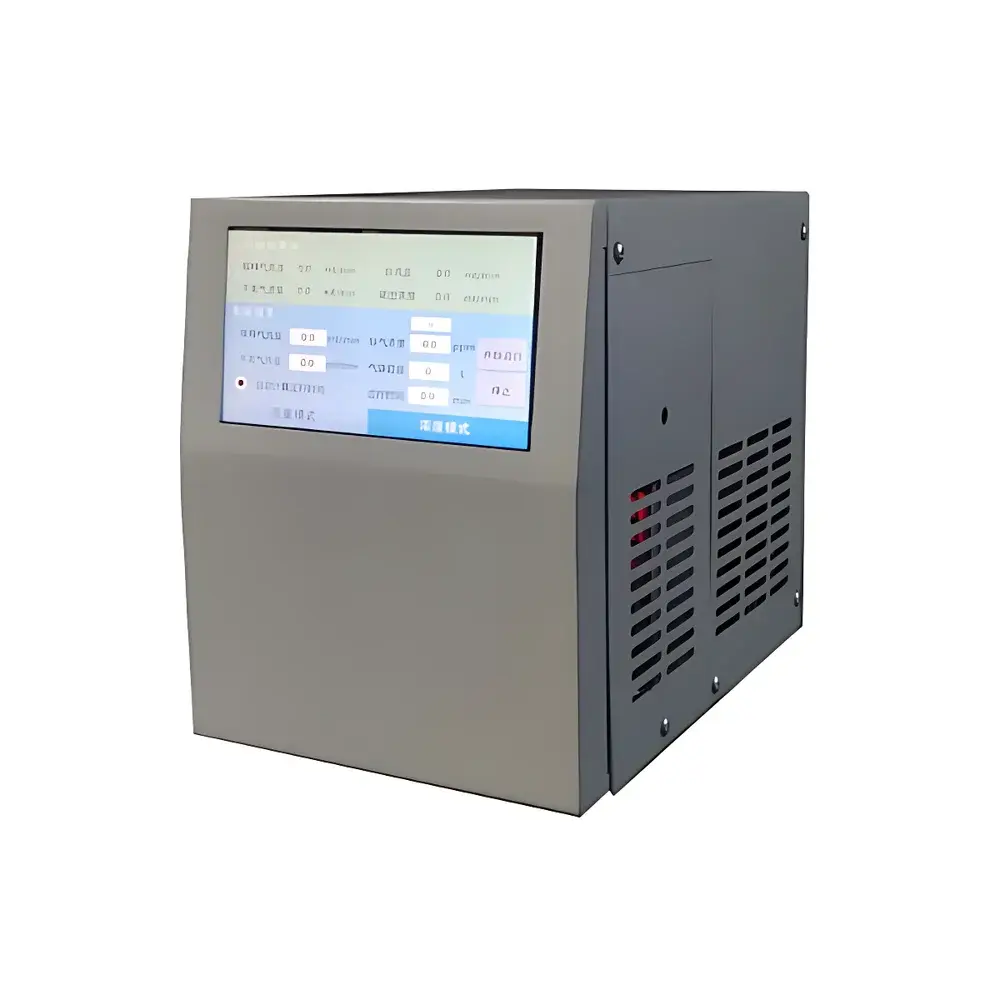
Zhonghuipu DAS-2 Dynamic Gas Dilution System
| Brand | Zhonghuipu |
|---|---|
| Origin | Beijing, China |
| Manufacturer Type | OEM Manufacturer |
| Product Origin | Domestic (China) |
| Model | DAS-2 |
| Pricing | Upon Request |
| Standard Gas Input Channels | 1–4 |
| Diluent Gas Flow Range | 0–5 L/min (customizable) |
| Standard Gas Flow Range | 0–100 mL/min (customizable) |
| Flow Measurement Accuracy | ±1% F.S. |
| Flow Control Repeatability | ±0.2% F.S. |
| Linearity Accuracy | ±0.5% F.S. |
| Operating Ambient Temperature | 5–50 °C |
| Dimensions (W×D×H) | 320×200×250 mm |
| Power Supply | 220 VAC, 50 Hz |
| Human-Machine Interface | Intelligent Touchscreen |
| Operating Pressure Range | 0.05–0.3 MPa |
| Tubing Material | PTFE |
| Fitting Type | M8×1 (customizable) |
Overview
The Zhonghuipu DAS-2 Dynamic Gas Dilution System is a precision-engineered instrument designed for the real-time generation of certified reference gas mixtures in laboratory and continuous emission monitoring environments. It operates on the principle of dynamic dilution—where high-concentration calibration gases are metered and mixed with purified diluent gas (e.g., zero air or nitrogen) under tightly regulated mass flow control. Unlike static blending methods, this system enables trace-level concentration generation (ppb to low ppm range) with high temporal resolution and minimal memory effect, making it suitable for calibrating gas analyzers used in ambient air quality monitoring, stack emission testing, and environmental chamber validation.
Key Features
- Modular multi-channel architecture supporting up to four independent standard gas inputs—enabling sequential or simultaneous dilution of multiple target compounds without cross-contamination.
- High-stability mass flow controllers (MFCs) with ±0.2% F.S. repeatability and ±1% F.S. absolute accuracy across full operating ranges (0–100 mL/min for standard gases; 0–5 L/min for diluent).
- Chemically inert PTFE gas pathways throughout the entire fluidic circuit—ensuring compatibility with acidic (e.g., SO₂, HCl), basic (e.g., NH₃), and reactive species (e.g., NOₓ, O₃) without adsorption or degradation.
- Integrated microcontroller-based control system with standardized digital I/O (RS-232/RS-485, optional Ethernet) for seamless integration into SCADA, PLC, or centralized QA/QC platforms.
- Compact desktop form factor (320 × 200 × 250 mm) with front-panel intelligent touchscreen interface—designed for benchtop deployment in ISO 17025-accredited laboratories or field-deployable mobile labs.
- Adjustable operating pressure window (0.05–0.3 MPa) accommodates both low-backpressure analyzers and pressurized sampling systems, with M8×1 fittings as standard (custom adapters available upon request).
Sample Compatibility & Compliance
The DAS-2 is validated for use with common calibration standards including hydrocarbons (CH₄, C₂H₆), greenhouse gases (CO₂, N₂O, CH₄), criteria pollutants (CO, NO, NO₂, SO₂, O₃), and volatile organic compounds (VOCs). Its PTFE-wetted components comply with ASTM D6196–22 (Standard Practice for Selecting Air Monitoring Methods for Hazardous Waste Sites) and EPA Method TO-15 requirements for inert surface materials. While not pre-certified to ISO 6145-7 (gas mixtures by dynamic volumetric mixing), the system’s documented flow performance metrics support user-generated uncertainty budgets aligned with ISO/IEC 17025:2017 Clause 7.6. The device meets electromagnetic compatibility (EMC) requirements per IEC 61326-1 and safety standards per IEC 61010-1 for laboratory electrical equipment.
Software & Data Management
The embedded firmware supports local configuration, real-time flow monitoring, and event logging via the touchscreen HMI. All operational parameters—including setpoints, actual flows, timestamps, and alarm states—are recorded internally with ≥30 days of buffer capacity. Optional PC-based software (Windows/Linux compatible) provides remote control, automated calibration sequence scripting, and CSV export for audit-ready traceability. Audit trail functionality satisfies GLP and GMP data integrity expectations, including user authentication, change history, and electronic signature support—fully compliant with FDA 21 CFR Part 11 when deployed with validated software modules.
Applications
- Primary and secondary calibration of continuous emission monitoring systems (CEMS) in thermal power plants, cement kilns, and waste incinerators.
- Generation of dynamic challenge gases for sensor response time and linearity testing (e.g., according to ISO 12039 or EN 15267).
- Reference gas supply for photometric ozone analyzers, chemiluminescent NOₓ detectors, and cavity ring-down spectrometers (CRDS).
- Method validation and inter-laboratory comparison studies requiring traceable, time-resolved gas standards.
- Environmental simulation chambers where programmable gas concentration ramps or step changes are required.
FAQ
Can the DAS-2 be integrated into an existing automated calibration system?
Yes—the unit features RS-232/RS-485 serial interfaces and Modbus RTU protocol support, enabling direct command-and-control from industrial PLCs or custom LabVIEW/Python-based orchestration platforms.
Is PTFE tubing sufficient for chlorine or hydrogen fluoride applications?
PTFE exhibits excellent resistance to Cl₂ and HF at ambient temperatures and typical operating pressures; however, extended exposure to anhydrous HF above 50 °C may require Hastelloy®-lined components—consult technical support for aggressive halogen chemistry applications.
What is the minimum detectable dilution ratio achievable with the DAS-2?
With standard 100 mL/min and 5 L/min flow channels, theoretical dilution ratios exceed 1:500; actual usable ratio depends on analyzer detection limit, background contamination, and flowmeter signal-to-noise characteristics—typically validated between 1:10 and 1:200 in routine operation.
Does the system include NIST-traceable flow calibration certificates?
Calibration certificates are provided upon request and traceable to national standards (e.g., CNAS-accredited labs in China); users may also perform in-house verification using primary standards per ISO 6145-3.
Can the DAS-2 operate unattended for extended periods?
Yes—its solid-state controller, thermal management design, and watchdog timer ensure stable 24/7 operation within specified ambient conditions (5–50 °C); recommended preventive maintenance interval is every 6 months or 2,000 operating hours.
Related Products







