
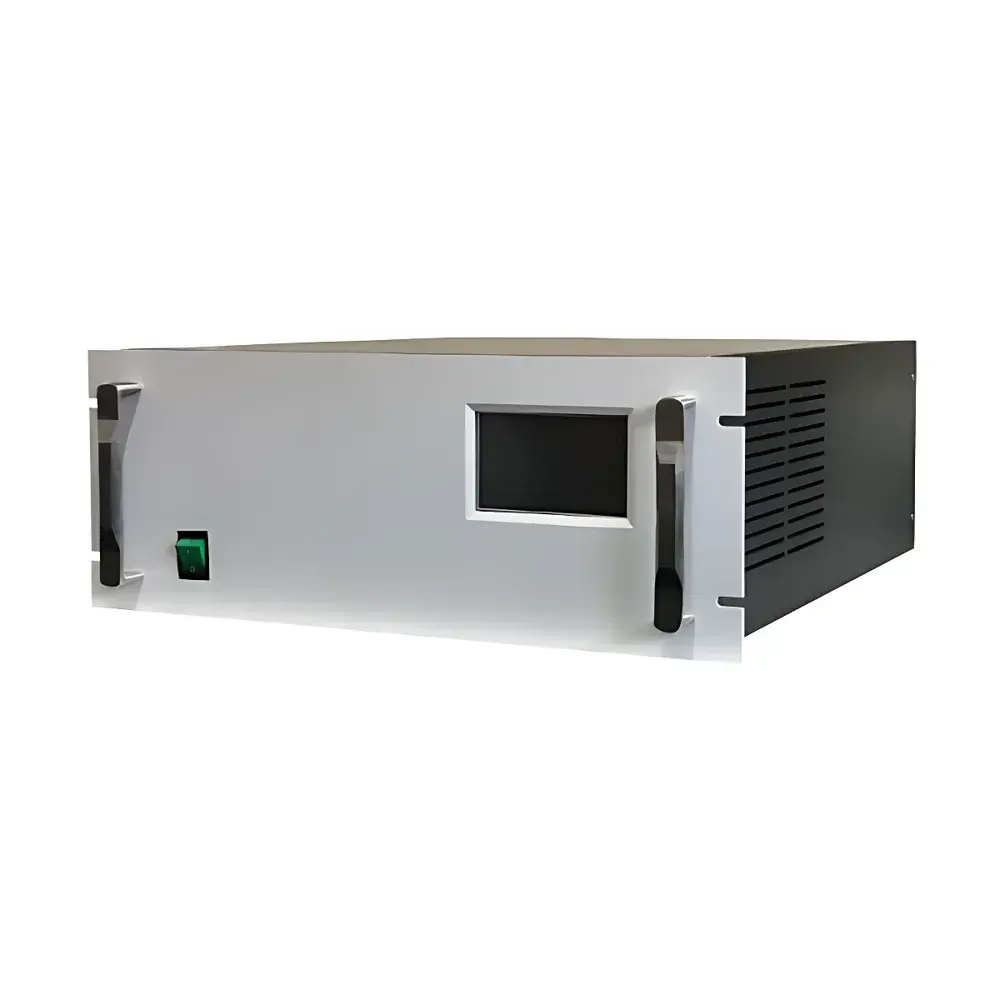
Zhonghuipu DS-2 Online Dynamic Gas Dilution System
| Brand | Zhonghuipu |
|---|---|
| Origin | Beijing, China |
| Manufacturer Type | Manufacturer |
| Country of Origin | China |
| Model | DS-2 |
| Pricing | Upon Request |
| Standard Gas Inlets | 1–4 channels |
| Diluent Flow Range | 0–5 L/min (customizable) |
| Standard Gas Flow Range | 0–100 mL/min (customizable) |
| Flow Measurement Accuracy | ±1% FS |
| Flow Control Repeatability | ±0.2% FS |
| Linearity Accuracy | ±0.5% FS |
| Operating Temperature | 5–50 °C |
| Dimensions | 480 × 450 × 177 mm (19″ 4U rack-mount chassis) |
| Power Supply | 220 VAC, 50 Hz |
| Human-Machine Interface | Integrated touchscreen HMI |
| Operating Pressure | 0.05–0.3 MPa |
| Tubing Material | PTFE |
| Fitting Size | 6 mm OD (customizable) |
Overview
The Zhonghuipu DS-2 Online Dynamic Gas Dilution System is an engineered solution for precise, real-time generation of certified reference gas mixtures in environmental monitoring, calibration laboratories, and industrial emission testing facilities. It operates on the principle of dynamic dilution—where high-concentration standard gases are continuously metered and mixed with a purified diluent gas stream (e.g., zero air or nitrogen) under tightly regulated mass flow control. Unlike static blending methods, this system delivers trace-level gas concentrations (ppb to ppm range) with high temporal stability and minimal memory effect, making it suitable for continuous calibration of gas analyzers such as FTIR, DOAS, GC-FID, and chemiluminescence NOx detectors. Its modular architecture supports both standalone operation and integration into automated emissions monitoring systems (CEMS), fulfilling core requirements for method validation under ISO 16140, EPA Method 205, and EN 14181.
Key Features
- Rack-mount 4U 19″ chassis design compliant with IEC 60297-3-100, enabling seamless integration into centralized laboratory or field-deployed control cabinets.
- Up to four independent standard gas inlets—each equipped with a calibrated thermal mass flow controller (MFC)—allow multi-component gas mixture preparation without manual reconfiguration.
- PTFE-lined gas pathways ensure chemical inertness against corrosive species including Cl2, SO2, HCl, NH3, and H2S, minimizing adsorption, carryover, and cross-contamination.
- Integrated touchscreen HMI provides intuitive navigation, real-time flow visualization, alarm logging, and password-protected parameter adjustment—designed for routine operator use without specialized training.
- Embedded microcontroller architecture supports RS-485 (Modbus RTU) and optional Ethernet/IP or Profibus DP interfaces for bidirectional communication with SCADA, PLC, or central data acquisition systems.
- Diluent and standard gas flow paths feature independent pressure regulation and temperature-compensated MFCs, maintaining ±0.2% FS repeatability across ambient conditions from 5–50 °C.
Sample Compatibility & Compliance
The DS-2 accommodates a wide range of calibration gases—including hydrocarbons (CH4, C2H6), acid gases (SO2, NO, NO2), greenhouse gases (CO2, N2O), and reactive species—provided they remain thermodynamically stable within the specified operating pressure (0.05–0.3 MPa) and temperature envelope. All wetted materials meet ASTM F2253-03 (PTFE purity standards) and comply with EU RoHS Directive 2011/65/EU. The system’s flow accuracy and linearity are traceable to national metrology institutes via factory calibration certificates (NIST-traceable where applicable). For regulated environments, audit trails, user access levels, and electronic signature support can be implemented via optional firmware upgrades aligned with FDA 21 CFR Part 11 and ISO/IEC 17025 documentation requirements.
Software & Data Management
The DS-2 includes embedded firmware with configurable data logging (up to 30 days at 1-second intervals), CSV export via USB port, and remote diagnostics via serial or Ethernet. Optional PC-based configuration software enables advanced scripting for time-segmented dilution profiles, scheduled concentration ramps, and automatic leak-check routines. All logged parameters—including individual MFC setpoints, actual flows, system pressure, ambient temperature, and error flags—are timestamped and stored with SHA-256 hash integrity verification. Data exports conform to ASTM D6348-19 Annex A1 format for direct ingestion into LIMS platforms. Firmware updates are delivered via signed binary packages to prevent unauthorized modification—supporting GxP-aligned change control procedures.
Applications
- Primary and secondary calibration of continuous emission monitoring systems (CEMS) in power plants, cement kilns, and waste incinerators.
- Dynamic generation of multi-gas test atmospheres for sensor response characterization and drift assessment per ISO 12099 and IEC 60079-29-1.
- In-situ verification of ambient air quality monitors (e.g., O3, CO, VOC analyzers) deployed in national reference networks (e.g., US EPA AirNow, EU Copernicus).
- Method development and validation for regulatory compliance testing under EN 15267, EPA Performance Specification 18 (PS-18), and China’s HJ 1019-2019.
- Research-grade gas standard delivery in atmospheric chemistry simulation chambers and catalytic reaction studies requiring sub-ppb precision and low dead volume.
FAQ
What is the minimum detectable concentration achievable with the DS-2?
The theoretical lower limit depends on the base standard gas concentration and dilution ratio; with a 100 ppm source and 1000:1 dilution, the system reliably delivers 100 ppb output. Actual achievable limits are governed by MFC resolution, background impurities in diluent gas, and analyzer detection capability.
Can the DS-2 be used with reactive or condensable gases?
Yes—provided the gas remains gaseous at operating temperature and pressure, and does not chemically degrade PTFE. For highly reactive species (e.g., ClF3, F2), consultation with Zhonghuipu engineering is required prior to deployment.
Is third-party calibration certification available?
Factory calibration reports are included. Accredited ISO/IEC 17025 calibration services (including uncertainty budgets) are available upon request through authorized metrology partners in APAC and EMEA regions.
Does the system support automated leak checking?
Yes—integrated pressure decay testing routines can be scheduled or triggered manually, with pass/fail thresholds configurable per gas path and logged with full event metadata.
How is firmware updated and validated?
Updates are delivered as digitally signed binaries. The bootloader verifies signature authenticity and performs CRC checks before installation, ensuring firmware integrity and preventing unauthorized modifications.







