
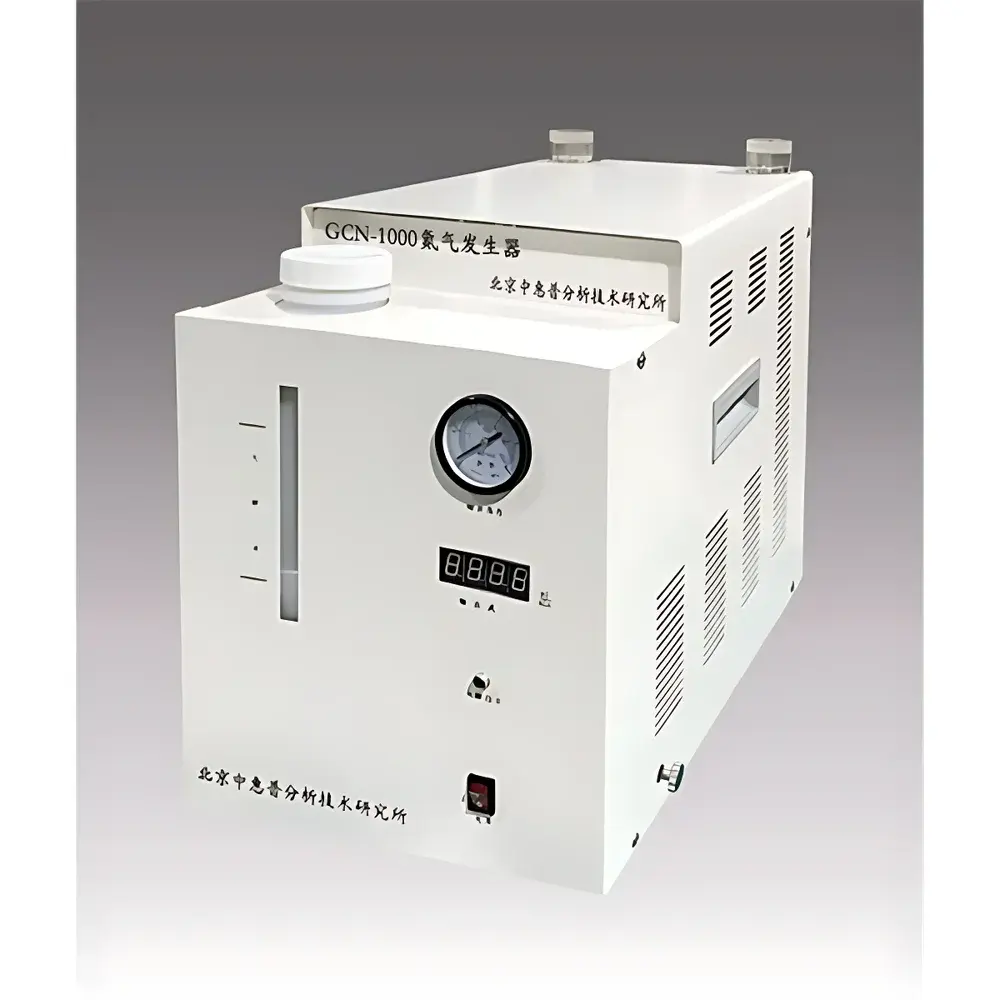
Zhonghuipu GCN-1000 Nitrogen Generator
| Brand | Zhonghuipu |
|---|---|
| Origin | Beijing, China |
| Manufacturer Type | Direct Manufacturer |
| Product Category | Domestic |
| Model | GCN-1000 |
| Instrument Type | Nitrogen Generator |
| Output Flow Rate | 0–1000 mL/min |
| Output Pressure | 0–0.4 MPa (air-source dependent) |
| Nitrogen Purity | <3 ppm O₂, dew point ≤ −56 °C |
| Nitrogen Dew Point | ≤ −56 °C |
| Pressure Stability | <0.003 MPa (subject to inlet air stability) |
| Power Supply | 220 V ±10%, 50 Hz |
| Power Consumption | 150 W |
| Operating Environment | 1–40 °C, RH <85% |
| Dimensions (W×D×H) | 460 × 360 × 350 mm |
| Net Weight | ~20 kg |
Overview
The Zhonghuipu GCN-1000 Nitrogen Generator is a compact, membrane-based nitrogen generation system engineered for continuous, on-demand supply of high-purity nitrogen gas in analytical laboratory environments. It employs a proprietary hollow-fiber membrane separation process to selectively permeate oxygen, water vapor, carbon dioxide, and other trace contaminants from compressed ambient air, delivering a stable stream of nitrogen with consistent purity and flow characteristics. Designed specifically for integration with gas chromatography (GC), liquid chromatography–mass spectrometry (LC-MS), electron microscopy (SEM/TEM), and inert atmosphere glove boxes, the GCN-1000 eliminates reliance on high-pressure nitrogen cylinders—reducing operational risk, logistical overhead, and long-term cost of ownership. Its robust architecture supports uninterrupted operation under standard laboratory conditions (1–40 °C, RH <85%), with built-in safeguards ensuring safe, hands-off performance over extended duty cycles.
Key Features
- Intelligent pressure and flow control: Real-time digital display of output pressure and nitrogen flow rate; fully automatic regulation maintains constant pressure and flow regardless of downstream demand fluctuations.
- Dual-stage filtration system: Two stainless-steel coalescing filters—each containing proprietary low-sulfur silicon rubber seals and integrated trace-oxygen scavenging media—ensure minimal sulfur contamination and sub-3 ppm O₂ residual levels without requiring periodic reactivation or regeneration.
- Enhanced gas quality assurance: Low-sulfur elastomeric sealing components prevent baseline drift in sensitive GC detectors (e.g., ECD, TCD); optimized internal gas path geometry minimizes dead volume and adsorption effects.
- Integrated safety architecture: Automatic anti-backflow protection prevents alkaline solution ingress (in compatible air compressor systems); overpressure relief valve and thermal cut-off provide redundant protection against abnormal operating conditions.
- Energy-efficient operation: Rated at only 150 W consumption; optimized membrane module design achieves >95% air utilization efficiency at rated flow, reducing heat load and acoustic emissions.
Sample Compatibility & Compliance
The GCN-1000 delivers nitrogen meeting ASTM D6866-22 specifications for instrumental analysis-grade carrier and purge gases. Its output (<3 ppm O₂, dew point ≤ −56 °C) satisfies ISO 8573-1:2010 Class 2.2.1 requirements for compressed gases used in analytical instrumentation. The system is compatible with all major GC manufacturers’ specifications for carrier gas (e.g., Agilent, Thermo Fisher, Shimadzu, PerkinElmer), including split/splitless injectors, FID, NPD, and ECD detectors. Internal wetted materials—including 316L stainless steel tubing, fluoropolymer-lined valves, and low-outgassing elastomers—are compliant with USP , FDA 21 CFR Part 11 data integrity prerequisites (when paired with validated software), and GLP/GMP audit-ready documentation protocols.
Software & Data Management
While the GCN-1000 operates as a standalone hardware unit with analog front-panel controls, it supports optional RS-232 or USB-to-serial interface modules for integration into centralized lab gas monitoring networks. When connected, real-time pressure, flow, and runtime hours can be logged via third-party SCADA or LIMS platforms. All operational parameters—including cumulative runtime, filter service intervals, and pressure deviation history—are stored in non-volatile memory for retrospective review during equipment qualification (IQ/OQ/PQ) and annual calibration audits. Audit trails comply with ALCOA+ principles when configured with timestamped, user-authorized access logs.
Applications
- Carrier gas supply for capillary and packed-column gas chromatography
- Purge gas for headspace samplers and thermal desorption units
- Collision/reaction gas in ICP-MS and triple-quadrupole MS systems
- Inert blanketing in sample preparation workstations and solvent evaporation systems
- Zero-air generation support (when coupled with catalytic oxidation modules)
- Standby nitrogen source for emergency purging in semiconductor metrology labs
FAQ
What is the minimum inlet air quality required for optimal GCN-1000 performance?
The generator requires clean, oil-free, dried compressed air meeting ISO 8573-1 Class 3.2.3 specifications (≤0.1 µm particulates, ≤1 mg/m³ oil aerosol, dew point ≤ −20 °C). A refrigerated dryer and coalescing filter upstream are strongly recommended.
Can the GCN-1000 be used with a built-in air compressor?
Yes—when paired with a certified oil-free scroll or diaphragm air compressor (≥1.2 m³/h @ 0.7 MPa), the system forms a complete “air-to-nitrogen” turnkey solution. Compressor compatibility must be verified per Zhonghuipu’s Air Source Integration Guide.
How often do the oxygen scavenger filters require replacement?
Under typical GC usage (8 h/day, 5 days/week), dual-stage filters maintain specification compliance for ≥18 months; replacement interval is tracked automatically via onboard runtime counter and signaled via front-panel LED alert.
Is the GCN-1000 suitable for use in regulated pharmaceutical QC labs?
Yes—when deployed with documented IQ/OQ protocols, calibrated flow/pressure transducers, and version-controlled firmware, it meets Annex 11 and USP requirements for ancillary analytical equipment qualification.
Does the unit support remote monitoring via Ethernet or Wi-Fi?
Not natively—but optional RS-485 or Modbus TCP gateway modules enable integration with building management systems (BMS) or lab-wide gas monitoring dashboards. Custom API development is available under NDA for enterprise deployments.



