
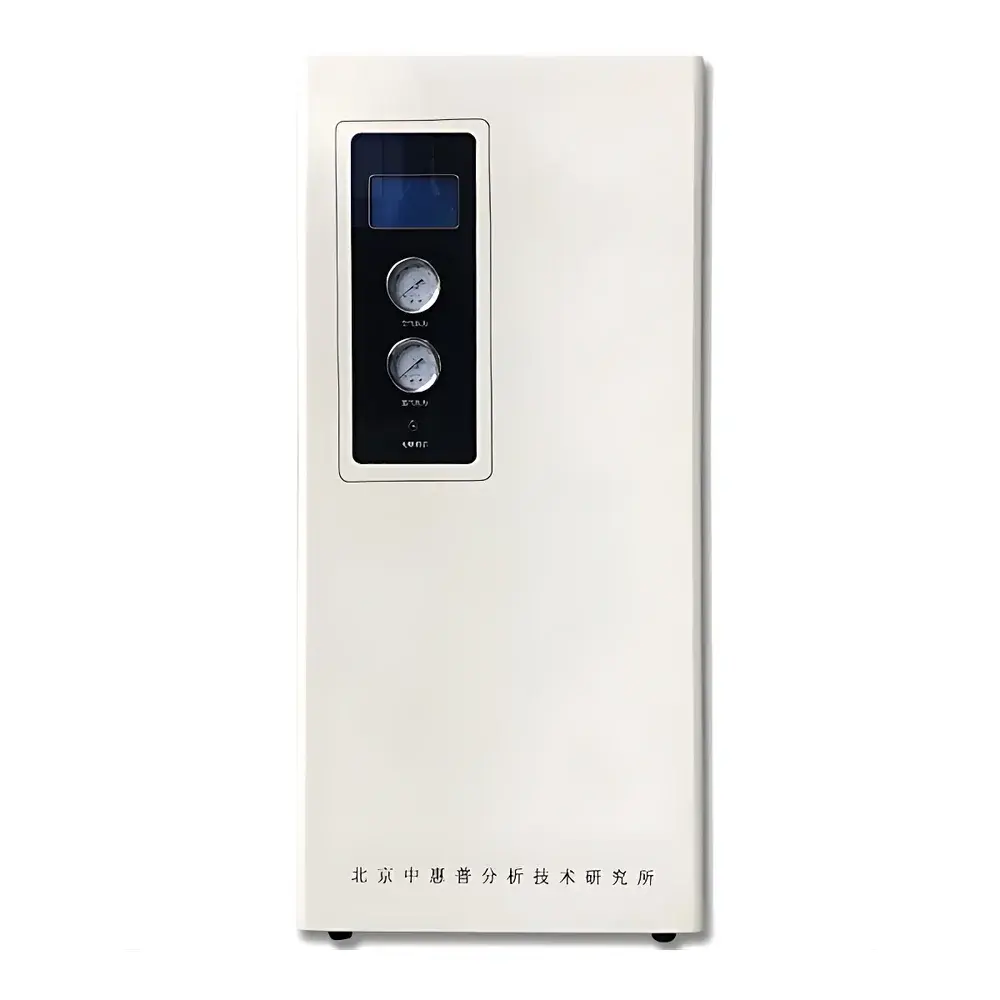
Zhonghuipu HA-3380 Hydrogen & Air Integrated Gas Generator
| Brand | Zhonghuipu |
|---|---|
| Origin | Beijing, China |
| Manufacturer Type | Direct Manufacturer |
| Country of Origin | China |
| Model | HA-3380 |
| Quotation | Available Upon Request |
| Hydrogen Flow Rate | 0–300 mL/min (optional 500 mL/min) |
| Hydrogen Purity | 99.999% |
| Hydrogen Output Pressure | 0.4 MPa (4 kgf/cm²) |
| Hydrogen Pressure Stability | < 0.001 MPa |
| Air Flow Rate | 0–2 L/min (optional 5 L/min) |
| Air Output Pressure | 0–0.4 MPa |
| Operating Environment | 5–40 °C, ≤85% RH |
| Max Power Consumption | 680 W (standard configuration) |
| Input Voltage | 220 V ±10% AC |
| Dimensions (L×W×H) | 350 × 400 × 730 mm |
| Net Weight | ~43 kg |
Overview
The Zhonghuipu HA-3380 Hydrogen & Air Integrated Gas Generator is an engineered solution for laboratories requiring continuous, on-demand supply of high-purity hydrogen and instrument-grade air—primarily for gas chromatography (GC), GC–MS, flame ionization detection (FID), thermal conductivity detection (TCD), and nitrogen–phosphorus detection (NPD). Unlike traditional cylinder-based gas delivery, the HA-3380 eliminates logistical constraints, safety hazards associated with high-pressure gas storage, and purity inconsistencies due to cylinder changeover. It employs two independent, parallel generation modules: a PEM-free alkaline electrolytic cell for hydrogen production and a Thomas-brand oil-free scroll compressor coupled with pressure swing adsorption (PSA) drying for air generation. The system operates on deionized or distilled water feedstock (no ultra-pure water requirement), enabling low-maintenance, long-interval operation—up to two months between refills when using the external 15 L reservoir.
Key Features
- Integrated dual-output architecture: Simultaneous, independently regulated hydrogen and air streams—each with dedicated flow control, pressure regulation, and real-time monitoring.
- High-purity hydrogen generation: 99.999% purity achieved via multi-stage purification (particulate filtration, catalytic recombination, and membrane separation), compliant with ASTM D4082 and ISO 8573-1 Class 1 requirements for trace hydrocarbon and moisture content.
- Durable construction: Critical wetted components—including electrolytic cell housing, gas storage buffer tanks, and internal piping—fabricated from ASTM A240 304 stainless steel to ensure corrosion resistance and long-term structural integrity under continuous operation.
- Intelligent microprocessor control: Full-system supervision via embedded single-chip controller with LCD interface; supports RS-232/RS-485 communication for integration into centralized lab management systems and remote status logging.
- Comprehensive safety architecture: Hydrogen leak detection with automatic shutoff, dry-run protection with level-sensing auto-refill, overpressure relief valves, and thermal cutout on both electrolyzer and compressor modules.
- Modular air subsystem: Standard Thomas oil-free compressor ensures zero hydrocarbon carryover; optional catalytic hydrocarbon scrubber upgrade enables zero-air compliance per ASTM D6215 and USP , suitable for sensitive electron capture detectors (ECD) and FTIR applications.
Sample Compatibility & Compliance
The HA-3380 is designed for compatibility with all major GC and detector platforms requiring hydrogen carrier or fuel gas and clean, dry air as oxidant or make-up gas. Its output specifications meet or exceed the operational thresholds defined in ICH Q5C, USP , and ISO/IEC 17025 for analytical instrument gas supply qualification. Hydrogen purity (≤0.1 ppm O₂, ≤0.1 ppm H₂O, ≤0.05 ppm total hydrocarbons) satisfies GLP/GMP method validation requirements for residual solvent analysis and impurity profiling. Air output meets ISO 8573-1:2010 Class 2:2:2 (solid particles ≤0.1 µm, dew point −40 °C, oil content <0.01 mg/m³), ensuring compatibility with FID baselines and extended column lifetime. All electrical components conform to IEC 61010-1 for laboratory equipment safety.
Software & Data Management
While the HA-3380 operates autonomously via front-panel controls, its serial interface enables bidirectional communication with laboratory information management systems (LIMS) or chromatography data systems (CDS). Logged parameters—including real-time flow rates, outlet pressures, temperature readings, electrolyte level status, and fault codes—are timestamped and exportable in CSV format. Audit trail functionality supports 21 CFR Part 11-compliant environments when deployed with validated third-party middleware. No proprietary software installation is required; standard terminal emulation (e.g., PuTTY) or custom Python/Node.js scripts can retrieve and archive operational history for preventive maintenance scheduling and regulatory review.
Applications
- Gas chromatography: Hydrogen as carrier gas (optimized for capillary columns at 30–50 cm/sec linear velocity) and fuel gas for FID/TCD/NPD.
- GC–MS: High-purity hydrogen for chemical ionization (CI) sources and collision gas in triple-quadrupole instruments.
- Trace gas analysis: Zero-air generation (with optional catalytic module) for ambient air monitoring, calibration gas dilution, and ozone generator feed.
- Hydrogenation research: On-demand hydrogen supply for small-scale catalytic reactors and electrochemical cells requiring precise stoichiometric control.
- Quality control labs: Stable, repeatable gas supply supporting ASTM D3606 (benzene in gasoline), EPA Method 8021B (halogenated hydrocarbons), and pharmacopeial assays requiring validated gas sourcing.
FAQ
What is the expected service life of the electrolytic cell under normal operating conditions?
With proper water quality (deionized or distilled, conductivity <5 µS/cm) and adherence to scheduled maintenance (electrolyte replacement every 12–18 months), the alkaline electrolyzer typically exceeds 15,000 hours of cumulative runtime.
Can the HA-3380 be integrated into a building-wide gas distribution network?
Yes—provided appropriate pressure-regulated manifolds, backflow prevention, and local shutoff valves are installed per ASME B31.9 and local fire code requirements; consult Zhonghuipu’s engineering support for piping schematics and flow-balancing guidance.
Is the air output compatible with mass spectrometry applications requiring zero-hydrocarbon air?
Standard configuration meets general-purpose air requirements; for zero-air compliance (≤0.005 ppm THC), the optional catalytic hydrocarbon removal module must be installed and validated per ASTM D6215.
Does the generator require periodic calibration?
No routine calibration is required; however, annual verification of flow sensors and pressure transducers against NIST-traceable standards is recommended for ISO/IEC 17025 accreditation.
What happens during a power interruption?
The unit performs a controlled shutdown: hydrogen generation ceases immediately, solenoid valves close, and stored gas in buffer tanks vents safely through calibrated bleed paths—no manual intervention required upon restoration.



