
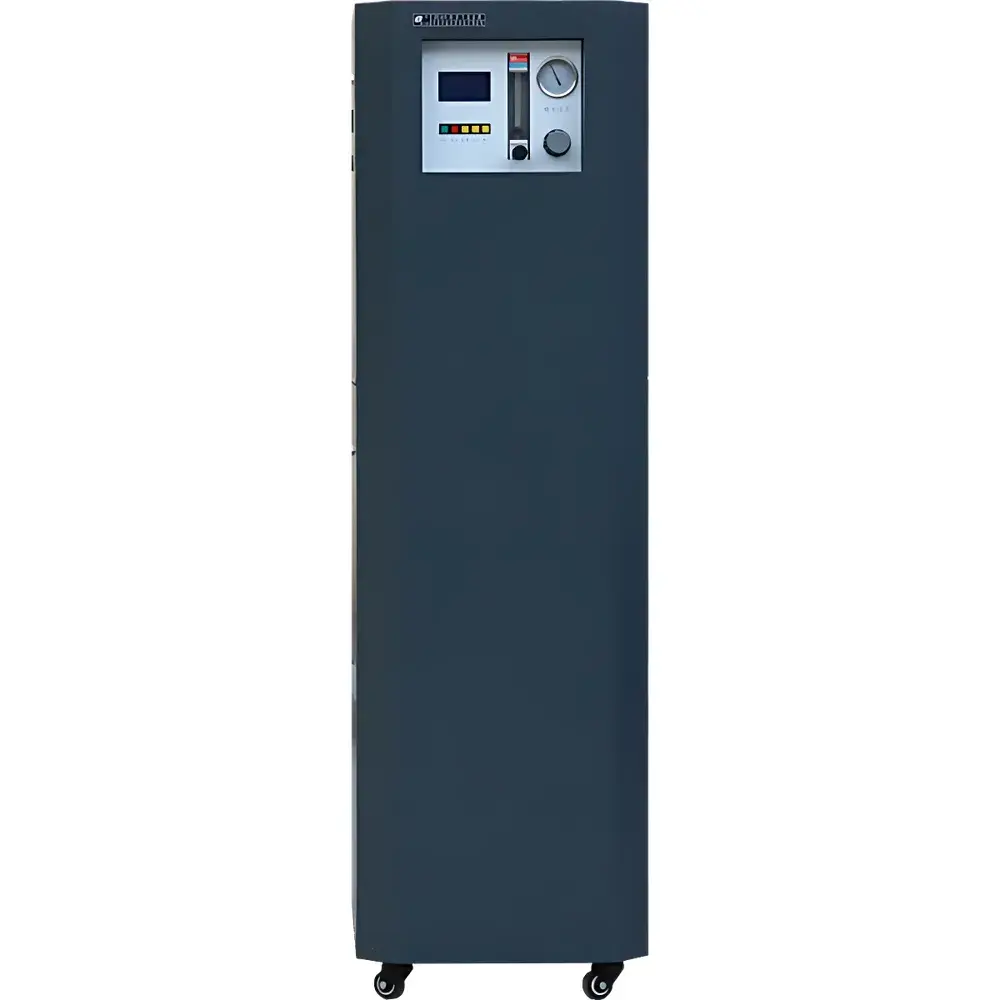
Zhonghuipu PSAN-30 PSA-Based Nitrogen Generator for LC/MS Applications
| Brand | Zhonghuipu |
|---|---|
| Origin | Beijing, China |
| Manufacturer Type | Direct Manufacturer |
| Instrument Type | Nitrogen Generator |
| Nitrogen Generation Principle | Pressure Swing Adsorption (PSA) |
| Output Flow Rate | 0–30 L/min |
| Output Pressure | 0–0.7 MPa (Factory Setpoint: 0.6 MPa) |
| Nitrogen Purity | 99.5%–99.9% |
| Dew Point | −40 °C |
| Input Air Pressure | 0.7–1.0 MPa |
| Input Air Flow | ≥120 L/min |
| Power Supply | 220 V ±10%, 50 Hz |
| Power Consumption | 100 W |
| Operating Temperature | 1–40 °C |
| Relative Humidity | <85% RH |
| Dimensions (W×D×H) | 400 × 400 × 1200 mm |
| Net Weight | ~50 kg |
Overview
The Zhonghuipu PSAN-30 is a dedicated, high-reliability nitrogen generator engineered specifically for liquid chromatography–mass spectrometry (LC/MS) systems requiring continuous, on-demand supply of high-purity nitrogen gas. It employs pressure swing adsorption (PSA) technology — a mature, robust, and widely validated gas separation method — to extract nitrogen from compressed ambient air. In PSA operation, compressed air passes through twin adsorption towers filled with nitrogen-selective carbon molecular sieve (CMS). Under elevated pressure, oxygen, moisture, CO₂, and trace hydrocarbons are preferentially adsorbed, while nitrogen passes through with minimal retention. The dual-tower architecture enables uninterrupted output: while one tower adsorbs impurities, the other undergoes rapid depressurization and purging to regenerate the CMS bed. This cyclic, fully automated process ensures stable delivery of nitrogen at 99.5–99.9% purity, with a certified dew point of −40 °C — meeting stringent requirements for LC/MS nebulizer, drying, and collision gas applications per ASTM D852 and ISO 8573-1 Class 2:2:2 specifications.
Key Features
- Intelligent microcontroller-based control system with intuitive Chinese-language HMI interface — supports real-time monitoring of flow rate, purity, system pressure, and operational status; user-configurable runtime scheduling and alarm thresholds.
- Dual-tower PSA design with optimized cycle timing and advanced regeneration algorithms, maximizing CMS utilization efficiency and minimizing nitrogen loss during transition phases.
- High-performance imported carbon molecular sieve with superior O₂ adsorption capacity, mechanical crush resistance, and long service life (>20,000 hours under recommended operating conditions).
- Proprietary CMS packing technique prevents bed channeling and powdering, ensuring consistent mass transfer performance and eliminating the need for frequent media replacement.
- Integrated dual-buffer tank system stabilizes outlet pressure fluctuations and delivers ≥99.5% purity nitrogen within 5 minutes of startup — critical for LC/MS instrument readiness and method reproducibility.
- All wetted components — including adsorption towers, buffer vessels, and gas manifolds — constructed from electropolished 316L stainless steel to prevent corrosion, leaching, or particulate generation.
- Multi-stage air pretreatment: integrated air-cooled refrigerated dryer followed by two-stage coalescing and adsorption-type water/oil separators, plus dual-stage precision pressure regulators for downstream stability.
- Comprehensive safety architecture: overpressure relief valves (set at 0.75 MPa), thermal overload protection, automatic shutdown on CMS saturation or sensor fault, and built-in diagnostic mode with error code logging for rapid troubleshooting.
Sample Compatibility & Compliance
The PSAN-30 is designed for integration into regulated analytical environments supporting GLP, GMP, and ISO/IEC 17025 workflows. Its consistent output meets the nitrogen quality specifications required by major LC/MS platform manufacturers (e.g., Waters, Thermo Fisher, Agilent, Shimadzu) for ESI and APCI source operation. The −40 °C dew point satisfies ISO 8573-1:2010 Class 2 for humidity control, while hydrocarbon and particulate levels remain below detection limits (<0.01 ppmv total HC, <0.1 µm particles). All electrical components comply with IEC 61000-6-3 (EMC) and IEC 61000-6-2 (immunity) standards. The unit is CE-marked and conforms to RoHS 2011/65/EU directives. For FDA-regulated laboratories, audit-ready operation logs and configurable event history support 21 CFR Part 11 compliance when paired with validated LIMS or instrument control software.
Software & Data Management
While the PSAN-30 operates as a standalone hardware device without proprietary cloud connectivity, its embedded controller provides RS-232 and optional RS-485 serial interfaces for integration into facility-wide monitoring systems. Real-time parameters — including flow (L/min), purity (%N₂), outlet pressure (MPa), CMS cycle phase, and fault codes — are accessible via ASCII protocol for SCADA, LabVIEW, or custom Python-based data acquisition scripts. Event logs store up to 1,000 entries with timestamps, enabling root-cause analysis during QA/QC investigations. Optional analog 4–20 mA outputs allow connection to building management systems (BMS) for centralized gas utility oversight. No firmware updates require external internet access; all configuration and diagnostics are performed locally via the front-panel interface.
Applications
- LC/MS mobile phase nebulization and desolvation gas supply in pharmaceutical QC, clinical toxicology, and environmental residue testing labs.
- Standby nitrogen purge for mass spectrometer vacuum systems during maintenance or overnight idle periods.
- Carrier and make-up gas for GC/MS systems where ultra-dry, oil-free nitrogen is required.
- Blanketing and inerting of solvent storage tanks, reagent dispensers, and sample preparation workstations.
- Supporting nitrogen-dependent detectors such as electron capture detectors (ECD) and nitrogen-phosphorus detectors (NPD) in legacy GC configurations.
- General laboratory use requiring continuous, low-cost, on-site nitrogen — replacing high-pressure cylinders and eliminating logistics, safety, and purity variability concerns.
FAQ
What is the expected service life of the carbon molecular sieve (CMS) under normal operating conditions?
With proper inlet air quality (ISO 8573-1 Class 2 or better) and adherence to maintenance intervals, the CMS typically maintains >95% of initial performance for 3–5 years or ≥20,000 operational hours.
Can the PSAN-30 be used with LC/MS systems requiring >99.9% nitrogen purity?
The standard PSAN-30 delivers 99.5–99.9% purity; for applications demanding >99.99% N₂ (e.g., certain HRAM instruments), integration with an optional external membrane or catalytic purifier module is recommended.
Is compressed air supply included with the generator?
No — a clean, oil-free, refrigerated compressed air source meeting the specified inlet pressure (0.7–1.0 MPa) and flow (≥120 L/min) must be provided separately.
Does the unit require routine consumable replacement beyond CMS?
Yes — coalescing filter elements should be replaced every 6 months or after 4,000 hours, and the final particulate filter annually; all are field-serviceable using standard 10-inch industrial cartridges.
How does the PSAN-30 handle power interruptions?
Upon power restoration, the system performs an automatic self-check, resets CMS cycle timing, and resumes operation without manual intervention — preserving system integrity and minimizing downtime.



