
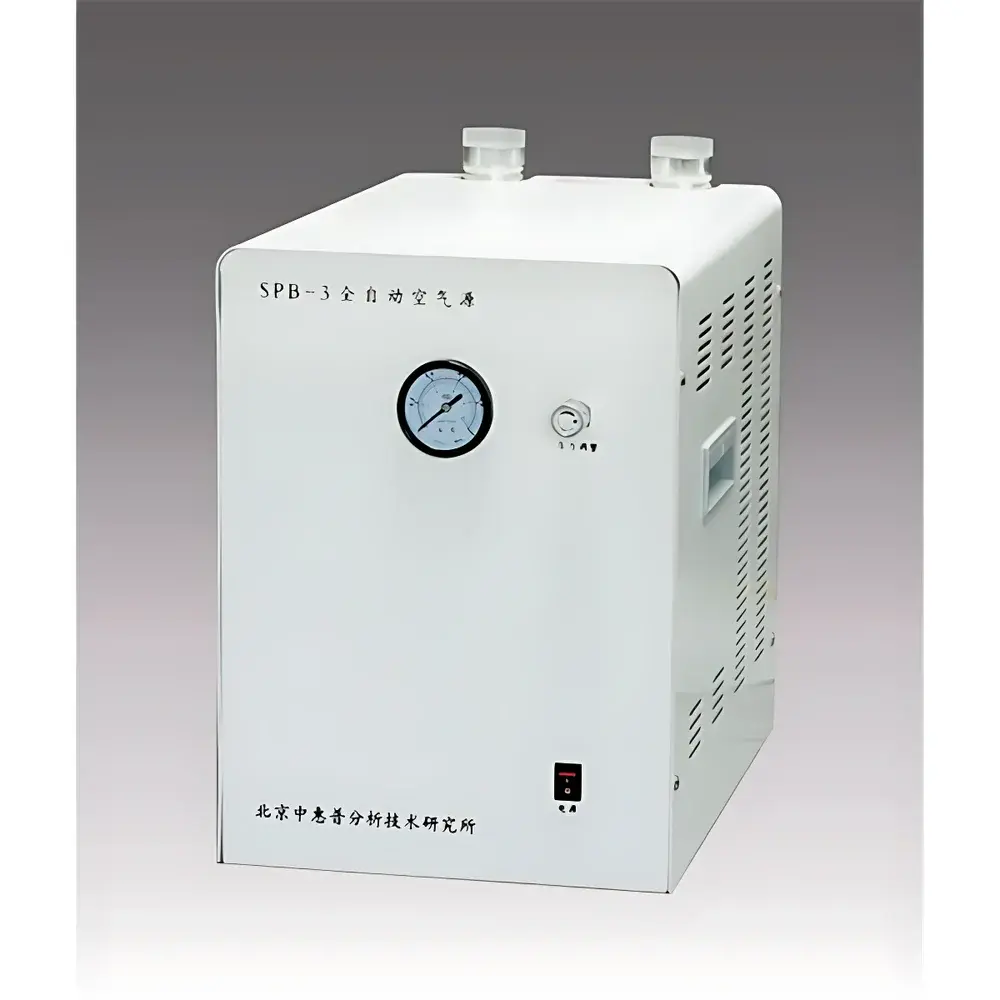
Zhonghuipu SPB-3 Fully Automatic Air Generator
| Brand | Zhonghuipu |
|---|---|
| Origin | Beijing, China |
| Manufacturer Type | Direct Manufacturer |
| Product Category | Domestic |
| Model | SPB-3 |
| Price | Upon Request |
| Output Flow Rate | 0–2000 mL/min at 0.4 MPa |
| Output Pressure | 0–0.4 MPa |
| Pressure Stability | < 0.003 MPa |
| Noise Level | < 35 dB(A) |
| Operating Environment | 0–45 °C, Relative Humidity ≤ 85% (non-dusty, non-corrosive atmosphere) |
| Power Consumption | 150 W |
| Input Voltage | 220 V ± 10% |
| Dimensions (W×D×H) | 420 × 260 × 350 mm |
| Net Weight | ~22 kg |
Overview
The Zhonghuipu SPB-3 Fully Automatic Air Generator is an engineered solution for laboratories requiring a continuous, stable, and ultra-clean source of compressed air—primarily as a carrier, detector, or combustion gas in analytical instrumentation including gas chromatographs (GC), GC-MS systems, nitrogen-phosphorus detectors (NPD), flame photometric detectors (FPD), and elemental analyzers. Unlike conventional oil-lubricated compressors or high-pressure cylinder banks, the SPB-3 employs a brushless rotary vane compressor coupled with integrated dual-stage pressure regulation, desiccant-based drying, and sulfur-free filtration to deliver instrument-grade air meeting ISO 8573-1 Class 2:2:2 (solid particles, water, oil) specifications. Its design eliminates reliance on external air sources, mitigates contamination risks from ambient particulates or volatile organics, and ensures long-term baseline stability—particularly critical for low-noise detection and trace-level quantification.
Key Features
- Dual-stage precision pressure regulation: Independent upstream and downstream regulators maintain output pressure stability within ±0.003 MPa under dynamic flow conditions—essential for consistent detector response and retention time reproducibility in GC applications.
- Intelligent automatic condensate drainage: A microcontroller-driven solenoid valve system performs timed, pulse-mode water ejection without continuous actuation—eliminating operational noise while preventing moisture accumulation in the stainless-steel storage tank and downstream filters.
- Sulfur-free internal sealing: All wetted seals utilize low-sulfur silicone elastomers compliant with ASTM D471, minimizing sulfur compound outgassing that could otherwise poison catalytic converters or interfere with sulfur-sensitive detectors (e.g., PFPD, SCD).
- Corrosion-resistant gas path: Dual 316L stainless-steel coalescing filters and a seamless welded 5 L pressure vessel withstand repeated cycling, elevated humidity, and incidental exposure to mildly corrosive vapors—ensuring structural integrity over >10,000 hours of operation.
- Low-noise thermal management: Optimized acoustic enclosure and vibration-dampened mounting reduce audible emissions to <35 dB(A) at 1 m—enabling installation in shared lab spaces without compromising acoustic comfort or regulatory compliance (ISO 11201).
Sample Compatibility & Compliance
The SPB-3 is compatible with all standard laboratory gas interfaces (¼″ NPT, CGA-590, or push-to-connect fittings via optional adapters) and supports continuous operation with GC ovens up to 450 °C, FID/FTD/NPD detectors, and air-driven autosamplers. It meets key international requirements for analytical gas supply: ISO 8573-1:2010 (compressed air purity), IEC 61000-6-3 (EMC emissions), and UL/CSA 61010-1 (electrical safety). While not certified to FDA 21 CFR Part 11, its programmable auto-drain cycle and pressure logging capability support GLP/GMP-aligned documentation when integrated into validated lab workflows.
Software & Data Management
The SPB-3 operates as a standalone unit with embedded firmware—no PC interface or proprietary software required. All operational parameters (pressure, flow status, drain cycle counter, fault codes) are displayed on a backlit LCD panel with real-time diagnostics. Optional RS-485 Modbus RTU output enables integration into centralized facility monitoring systems (e.g., LabVantage, DeltaV) for remote alarm notification and preventive maintenance scheduling. Audit trails for pressure excursions or unscheduled drain events can be extracted manually via serial log export for internal quality review.
Applications
- Carrier and make-up gas supply for capillary GC and GC-MS systems
- Combustion air for flame ionization (FID), flame thermionic (FTD), and nitrogen-phosphorus (NPD) detectors
- Actuation gas for pneumatic valves and automated sample introduction modules
- Air source for FTIR purge systems and environmental chamber conditioning
- Support gas for laser ablation ICP-MS auxiliary plasma stabilization
FAQ
What is the maximum continuous operating time between maintenance intervals?
With routine filter replacement every 6 months (or after 2,000 hours), the SPB-3 is rated for uninterrupted operation exceeding 5,000 hours under typical lab conditions (25 °C, 50% RH).
Can the SPB-3 be used with oxygen-sensitive detectors such as ECD?
No—the SPB-3 generates compressed ambient air (~21% O2) and is not suitable for electron capture detectors requiring ultra-low-oxygen (<1 ppm) or nitrogen-purged environments.
Is the output air suitable for LC-MS nebulizer gas?
Yes, provided the connected LC-MS system accepts dry, oil-free air at ≤0.4 MPa; however, verify compatibility with the instrument manufacturer’s gas specification sheet prior to integration.
Does the unit include a built-in particulate filter for ambient intake air?
Yes—a replaceable 5 µm pre-filter is installed at the air inlet to prevent dust ingress, extending service life of internal desiccant and coalescing elements.
How is calibration verified during routine QA checks?
Users may validate pressure stability using a NIST-traceable digital pressure gauge and flow accuracy with a calibrated thermal mass flowmeter (e.g., Brooks 5850E); no factory recalibration is required unless regulator drift exceeds ±0.003 MPa.



