
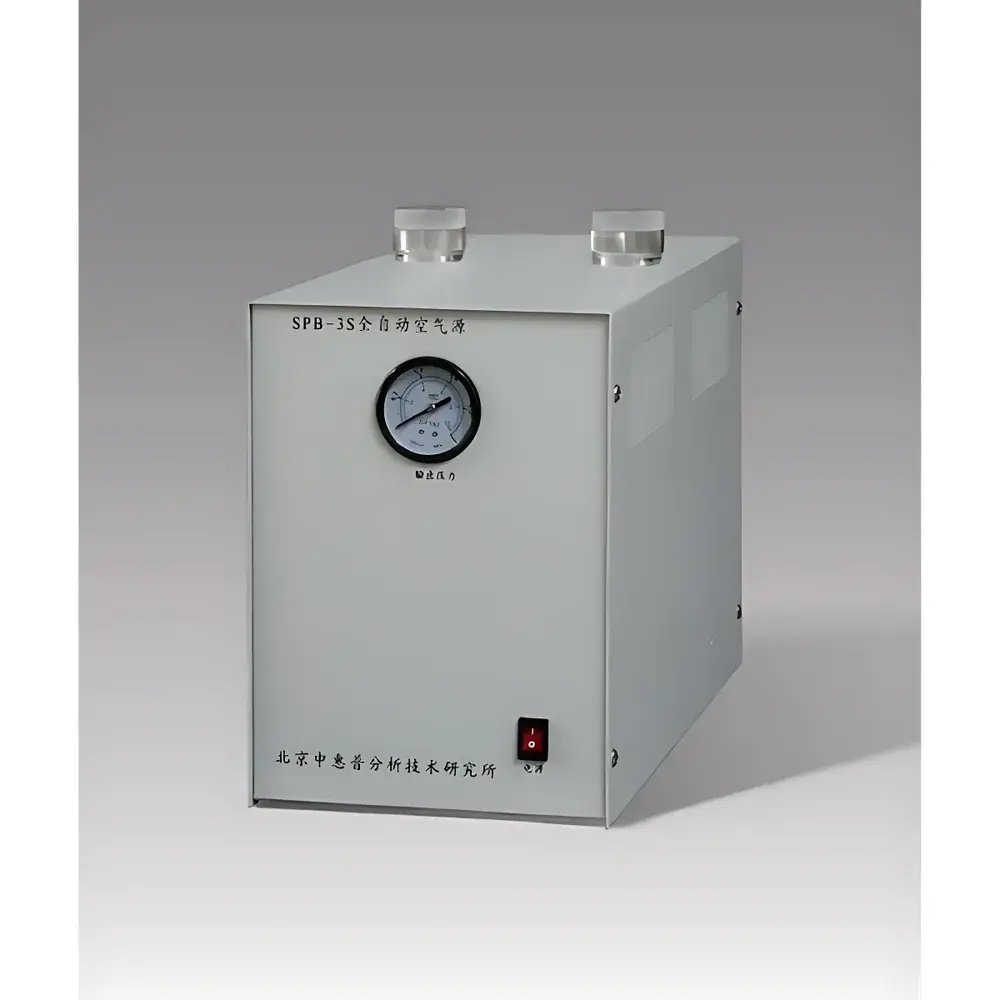
Zhonghuipu SPB-3S Fully Automatic Air Generator
| Brand | Zhonghuipu |
|---|---|
| Origin | Beijing, China |
| Manufacturer Type | Direct Manufacturer |
| Product Category | Domestic |
| Model | SPB-3S |
| Price | Upon Request |
| Output Flow Rate | 0–2000 mL/min at 0.4 MPa |
| Output Pressure | 0–0.4 MPa |
| Pressure Stability | < 0.003 MPa |
| Noise Level | < 35 dB(A) |
| Operating Environment | 0–45 °C, Relative Humidity ≤ 85% (non-dusty, non-corrosive atmosphere) |
| Power Consumption | 150 W |
| Input Voltage | 220 V ± 10% AC |
| Dimensions (W×D×H) | 400 × 180 × 250 mm |
| Net Weight | ~15 kg |
Overview
The Zhonghuipu SPB-3S Fully Automatic Air Generator is an engineered solution for laboratories requiring continuous, high-purity compressed air as a carrier, combustion, or auxiliary gas source—particularly in gas chromatography (GC), GC–MS, elemental analyzers, and other analytical instrumentation demanding stable, low-sulfur, oil-free air. Unlike conventional compressors or cylinder-based supply systems, the SPB-3S employs a dual-stage pressure regulation architecture combined with integrated desiccant and stainless-steel filtration to deliver clean, dry, and particle-free air on demand. Its core operation relies on a quiet, brushless rotary vane compressor coupled with automatic moisture removal via timed electromagnetic valve sequencing—eliminating manual drainage and ensuring uninterrupted operation over extended duty cycles. Designed for ambient laboratory environments (0–45 °C, ≤85% RH), it complies with general safety and electromagnetic compatibility (EMC) requirements per IEC 61326-1 for laboratory electrical equipment.
Key Features
- Dual independent pressure regulation system ensures exceptional output stability (< 0.003 MPa fluctuation), critical for retention time reproducibility in GC applications.
- Intelligent electromagnetic valve control enables fully automated condensate purging without audible cycling noise—noise level maintained below 35 dB(A) during full-load operation.
- Low-sulfur silicone O-rings and stainless-steel wetted components minimize sulfur compound outgassing, preventing baseline drift and column contamination in sulfur-sensitive analyses (e.g., ASTM D5292, USP <621>).
- Integrated dual stainless-steel filters (pre-filter + final particulate filter) and a high-pressure stainless steel storage tank (rated ≥0.6 MPa) provide mechanical robustness against corrosion, thermal expansion, and long-term exposure to trace ambient contaminants.
- Compact footprint (400 × 180 × 250 mm) and lightweight design (~15 kg) facilitate benchtop integration in space-constrained labs or mobile analytical setups.
- Energy-efficient operation at only 150 W nominal power draw supports sustainability goals without compromising flow delivery (0–2000 mL/min at 0.4 MPa).
Sample Compatibility & Compliance
The SPB-3S delivers instrument-grade air meeting ISO 8573-1:2010 Class 2:2:2 specifications for particulate, water, and oil content when operated within specified environmental limits and with scheduled filter maintenance. It is compatible with all major GC and detector platforms—including flame ionization (FID), nitrogen phosphorus (NPD), electron capture (ECD), and pulsed discharge helium ionization (PDHID) detectors—where air serves as fuel or make-up gas. The unit satisfies fundamental requirements of GLP and GMP-aligned workflows by supporting audit-ready operational consistency; while not inherently 21 CFR Part 11 compliant (as it lacks digital user authentication or electronic record functionality), its mechanical reliability and stable output contribute to data integrity in regulated environments when paired with validated instrument software.
Software & Data Management
The SPB-3S operates as a standalone hardware system with no embedded firmware, touchscreen interface, or network connectivity. All functions—including pressure regulation, auto-drain timing, and thermal protection—are managed via analog circuitry and electromechanical controls. This design prioritizes operational simplicity, long-term reliability, and immunity to software obsolescence or cybersecurity vulnerabilities. Maintenance logs, service intervals, and performance verification (e.g., flow/pressure calibration checks per ISO/IEC 17025 Clause 6.4) are documented manually or integrated into laboratory quality management systems (QMS) such as LabWare LIMS or Thermo Fisher SampleManager. Optional external pressure transducers or flow meters may be installed downstream for real-time monitoring and data logging via third-party DAQ hardware.
Applications
- Carrier and detector gas supply in capillary and packed-column gas chromatography.
- Fuel gas for FID and NPD detectors requiring consistent stoichiometric ratios.
- Make-up gas for ECD and mass spectrometric ion sources.
- Air supply for elemental analyzers (CHNS/O), FTIR purge systems, and pneumatic sample introduction modules.
- General-purpose clean air for lab instrumentation requiring low-particulate, low-humidity, sulfur-free gas—especially where cylinder logistics, rental fees, or safety concerns limit compressed gas cylinder usage.
FAQ
What is the maximum continuous operating time for the SPB-3S?
The unit is rated for indefinite continuous operation under specified ambient conditions (0–45 °C, ≤85% RH) and recommended maintenance intervals (filter replacement every 6–12 months depending on humidity exposure).
Does the SPB-3S require external cooling or ventilation?
No dedicated cooling is required; however, adequate ambient airflow around the rear and top vents is necessary to maintain internal temperature within safe operating limits.
Can the output pressure be adjusted externally?
Yes—output pressure is continuously adjustable from 0 to 0.4 MPa using the front-panel precision pressure regulator knob, with built-in gauges for real-time monitoring.
Is the SPB-3S suitable for use with sensitive GC–MS systems?
Yes—provided the dual stainless-steel filters are replaced per schedule and the unit is operated in low-dust environments, its low-sulfur construction and stable output meet typical GC–MS auxiliary air purity requirements.
What maintenance is required beyond filter replacement?
Routine visual inspection of O-rings, verification of drain cycle functionality, and periodic calibration of output pressure and flow (using NIST-traceable instruments) are recommended per ISO/IEC 17025 and internal SOPs.



