
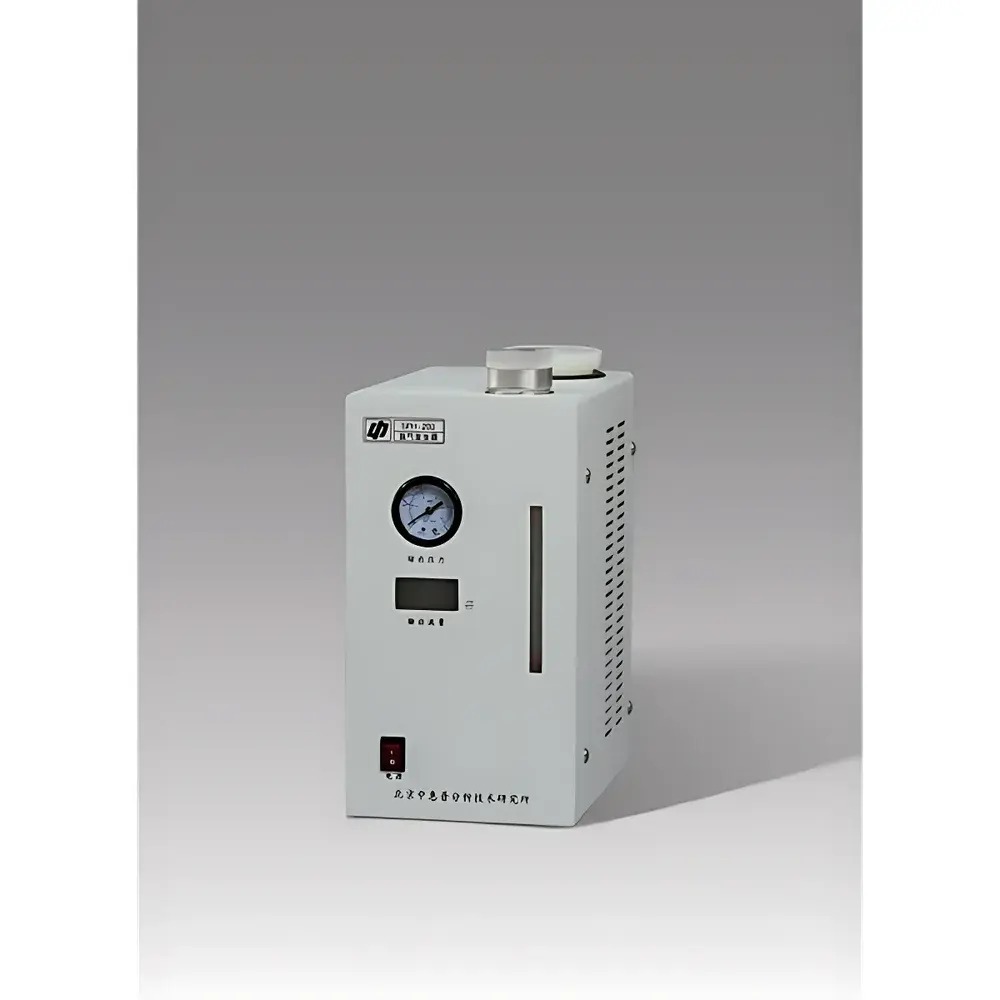
Zhonghuipu SPH-200 Alkaline Electrolysis Hydrogen Generator
| Brand | Zhonghuipu |
|---|---|
| Origin | Beijing, China |
| Manufacturer Type | Direct Manufacturer |
| Model | SPH-200 |
| Hydrogen Generation Principle | Aqueous Alkaline Electrolysis |
| Output Flow Rate | 0–200 mL/min |
| Output Pressure | 0–0.3 MPa |
| Hydrogen Purity | 99.999% |
| Power Consumption | 100 W |
| Pressure Stability | < 0.001 MPa |
| Input Power | 220 V ±10%, 50 Hz |
| Dimensions (W×D×H) | 200 × 140 × 290 mm |
| Net Weight | ~6 kg |
| Internal Sealing Material | Low-sulfur Silicone Rubber |
| Filtration | Stainless Steel Filter |
| Safety Features | Automatic Anti-Backflow Alkali Protection |
Overview
The Zhonghuipu SPH-200 is a compact, benchtop alkaline electrolysis hydrogen generator engineered for continuous, on-demand production of high-purity hydrogen gas in analytical laboratory environments. It operates on the principle of aqueous potassium hydroxide (KOH) electrolysis—where direct current decomposes deionized water into stoichiometric hydrogen and oxygen at nickel-plated stainless steel electrodes. Oxygen is safely vented, while hydrogen passes through multi-stage purification—including stainless steel particulate filtration and low-sulfur silicone elastomer seals—to achieve ≥99.999% purity (5.0 grade), with total hydrocarbon content <0.1 ppm and moisture <1 ppm (dew point ≤ –70 °C). Designed for integration with gas chromatography (GC), GC–MS, and other hydrogen-dependent instrumentation, the SPH-200 eliminates the logistical, safety, and regulatory burdens associated with high-pressure cylinder handling while delivering stable, traceable, and contamination-controlled gas supply.
Key Features
- Compact footprint (200 × 140 × 290 mm) and lightweight design (~6 kg) enable seamless placement on crowded GC benches or inside fume hoods.
- Digital pressure and flow monitoring with real-time LED display; closed-loop feedback control maintains setpoint stability within ±0.001 MPa and ±1 mL/min across the full 0–200 mL/min operating range.
- Automatic demand-based flow regulation: dynamically adjusts electrolysis current to match instrument consumption, minimizing energy waste and thermal drift.
- Electrochemical cell constructed from corrosion-resistant nickel-plated 316 stainless steel; integrated anti-backflow alkali protection prevents KOH solution migration into downstream lines—a critical safeguard for GC detectors and valves.
- Low-sulfur silicone rubber gaskets and seals eliminate sulfur-containing volatiles that could poison palladium-based catalysts or elevate baseline noise in sulfur-sensitive detection modes (e.g., pulsed flame photometric detection).
Sample Compatibility & Compliance
The SPH-200 delivers hydrogen suitable for all standard GC carrier gas applications—including split/splitless injection, headspace analysis, and thermal desorption—and meets the gas quality requirements specified in ASTM D7217 (Standard Practice for Gas Chromatography Carrier Gas Quality), ISO 8573-1 Class 1.2.1 (for particle, water, and oil content), and USP for residual solvent analysis. Its fully enclosed, leak-tested architecture complies with IEC 61010-1 for laboratory electrical equipment safety. No external cooling or drainage is required; operation is compatible with ambient lab conditions (10–35 °C, <80% RH non-condensing). The unit is CE-marked and manufactured under ISO 9001-certified quality management systems.
Software & Data Management
While the SPH-200 operates as a standalone analog-controlled generator without embedded firmware or network connectivity, its pressure and flow outputs are compatible with optional third-party analog-to-digital interfaces (0–5 V or 4–20 mA) for integration into centralized lab monitoring systems. All operational parameters—including runtime hours, cumulative gas output, and overpressure/overtemperature fault logs—are retained in non-volatile memory for GLP-compliant recordkeeping. Maintenance events (e.g., electrolyte top-up, filter replacement) can be timestamped manually and archived alongside instrument usage logs to support FDA 21 CFR Part 11 audit readiness when paired with validated electronic lab notebooks (ELNs).
Applications
- Carrier gas source for capillary GC and GC–MS systems requiring ultra-high-purity hydrogen.
- Fuel gas for flame ionization detectors (FID), nitrogen–phosphorus detectors (NPD), and helium ionization detectors (HID).
- Reduction atmosphere generation in thermal conductivity detectors (TCD) and catalytic microreactor studies.
- On-site hydrogen supply for portable hydrogen sensors, fuel cell test stations, and small-scale hydrotreatment screening.
- Replacement for compressed H₂ cylinders in regulated environments where storage permits, fire codes, or insurance policies restrict high-pressure gas inventory.
FAQ
What electrolyte is used, and how often does it require replenishment?
The SPH-200 uses a 25–30% aqueous potassium hydroxide (KOH) solution. Under typical GC usage (100–150 mL/min, 8 h/day), electrolyte top-up is required every 3–6 months. A transparent level indicator and fill port simplify maintenance.
Can the generator be operated unattended overnight?
Yes—the unit incorporates overtemperature cutoff, pressure relief valves, and automatic shutdown upon loss of coolant flow or power interruption. It is rated for continuous 24/7 operation per IEC 60068-2 environmental stress testing protocols.
Is the hydrogen output compatible with mass spectrometer ion sources?
Yes—provided the connected MS system accepts 99.999% H₂ with <0.1 ppm THC and dew point ≤ –70 °C, which the SPH-200 consistently delivers under stabilized conditions. Verify compatibility with your instrument manufacturer’s gas specification sheet.
Does the generator require external deionized water?
No—it includes an integrated 1.2 L reservoir filled with laboratory-grade deionized water (resistivity ≥18.2 MΩ·cm). Refill frequency depends on flow rate and daily usage duration.
How is calibration and performance verification performed?
Users perform periodic verification using certified gas analyzers (e.g., trace-level H₂O and O₂ sensors) or by comparing retention time stability and FID response factor consistency against reference standards—methods aligned with ISO/IEC 17025 method validation guidelines.
Related Products



